
Related videos:
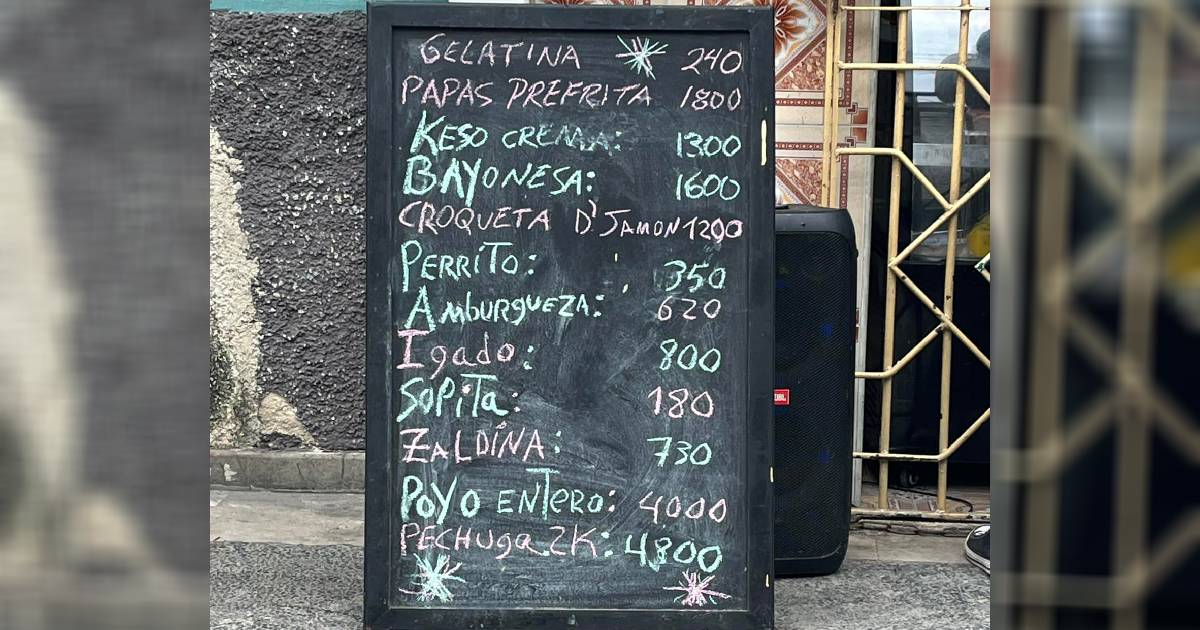
A menu board placed on the sidewalk of a food establishment in Cuba has gone viral on social media for two reasons: the exorbitant prices in Cuban pesos and a disastrous spelling that inadvertently reflects the reality of the country in 2026.
The image, posted by the Facebook page "EL CARTEL DEL MINUTO oficial", lists products written as they sound in Cuban colloquial speech: "AMBURGUEZA" (hamburger) for 620 pesos, "POYO ENTERO" (whole chicken) for 4,000 pesos, "PECHUGA 2K" for 4,800 pesos, "BAYONESA" (mayonnaise) for 1,600 pesos, "KESO CREMA" (cream cheese) for 1,300 pesos, and "ZALDINA" (sardine) for 730 pesos, among others.
Also available are "CROQUETA D' JAMON" for 1,200 pesos, "IGADO" (liver) for 800 pesos, "PAPAS PREFRITA" for 1,800 pesos, "SOPITA" for 180 pesos, "PERRITO" for 350 pesos, and "GELATINA" for 240 pesos.
Beyond the writing—full of spelling errors—the prices tell a much harsher story.
The official average salary in Cuba is around 6,930 pesos per month, according to data from the National Office of Statistics and Information for April 2026.
This means that a single chicken breast weighing two kilograms — priced at 4,800 pesos — consumes almost 70% of the entire monthly salary of a state worker.
The whole chicken at 4,000 pesos accounts for more than half of that salary.
The situation is even more serious considering that independent economists estimate that the minimum cost of living per person exceeds 50,000 pesos per month, a figure that is more than 15 times the average salary.
The official minimum wage, frozen at 2,100 pesos since January 2021, is not even enough to cover the price of a whole chicken displayed on that board.
The Cuban peso has also experienced a devaluation of nearly 48% in one year: it increased from 345 pesos per dollar in March 2025 to over 515 pesos in May 2026, further eroding the purchasing power of those who are paid in the national currency.
The prices on the sign are consistent with those recorded in Havana markets. In December 2025, chicken breast already cost between 4,500 and 5,100 pesos for a two-kilogram package, and prices have only continued to rise since then.
A Cuban woman reported spending 25,000 pesos on food weekly for her family, while eating at one of the most affordable restaurants in Havana costs 13,000 pesos for two people, which is equivalent to almost two average salaries.
La pizarra viral, con su mezcla de creatividad ortográfica y precios inalcanzables, se convierte así en un retrato involuntario pero elocuente de lo que significa sobrevivir en Cuba en 2026: donde escribir «poyo» en lugar de «pollo» puede arrancar una sonrisa, pero pagarlo se ha convertido en un privilegio fuera del alcance de la mayoría.
Filed under: