
Related videos:
A survey with over 42,000 responses reveals a staggering consensus regarding the current state of Cuba: both on the Island and in exile, there is a predominant rejection of the current political and economic system.
However, the study —carried out by an alliance of more than 20 independent digital media outlets, content creators, and actors from Cuban civil society, and blocked by the Cuban regime— also reveals differences between those who live under the daily conditions in the country and those who observe the crisis from abroad.
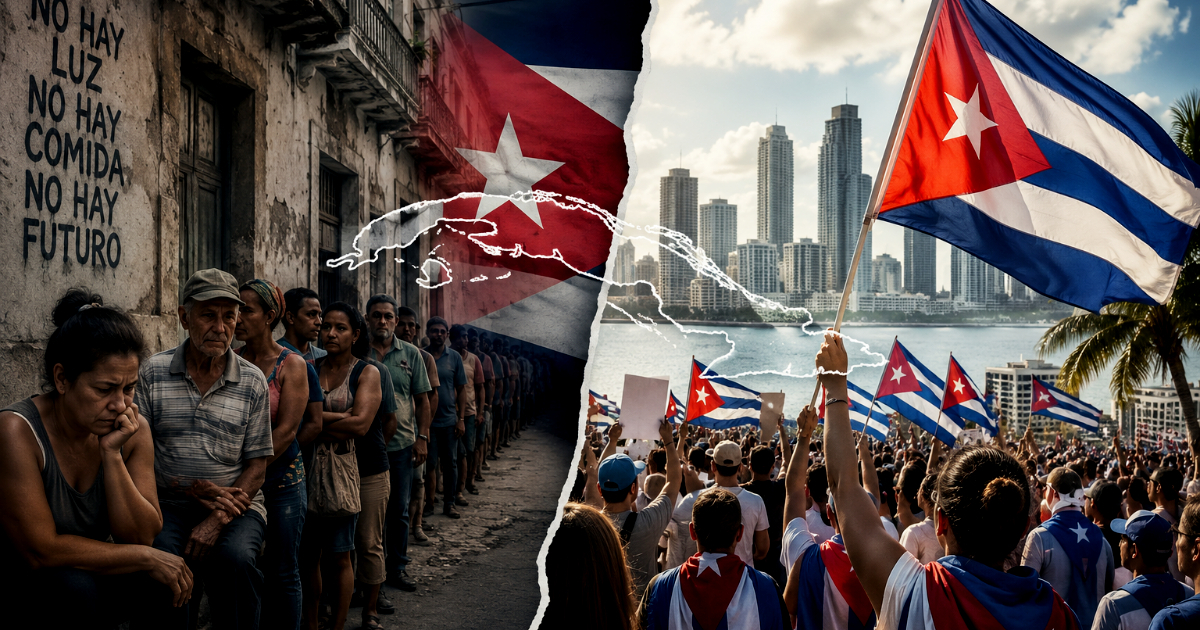
The data reflects a blend of hopelessness, fatigue, and desire for change, although with varying levels of radicalism depending on the location from which the participants responded.
The sample was divided between 24,503 responses from Cuba (58%) and 17,760 from exile (42%). In both groups, discontent reaches overwhelming levels. Over 92% of those living on the Island rated the national situation with the lowest possible score, while among the emigrants that percentage exceeds 96%.
The main consensus is clear: the majority consider the current model to be exhausted. More than 80% of respondents favor a liberal democracy and a market economy as alternatives for the country's future.
But as we delve deeper into the responses, political and emotional differences emerge that help us understand how the Cuban crisis is experienced and interpreted from very different perspectives.
Exile favors tougher stances
Among the Cuban emigrants, more radical responses against the regime predominate, along with much stronger support for international pressure measures.
In questions related to sanctions, diplomatic isolation, and confrontation policies, participants in exile showed significantly more support than those responding from Cuba. There was also a more frequent endorsement of positions calling for a complete break with the current political system.
The open responses reflect a tone marked by frustration and urgency. Many of the emigrated respondents speak directly about "regime change," "end of the dictatorship," or "immediate transition." Others consider the measures implemented so far by the international community to be insufficient.
In the most sensitive questions related to scenarios of political confrontation, the exile community also demonstrated a much more aggressive stance. Support for formulas such as “overthrowing the government by any means necessary” received greater backing outside of Cuba than within the Island.
The sympathy towards Republican figures from the United States also appears strongly in this segment. Marco Rubio received particularly high ratings among emigrants, while Donald Trump garnered relatively favorable support compared to other international leaders mentioned in the survey.
In many open responses, participants associate the pressure from Washington with a real possibility of weakening the Cuban regime. Some even called for harsher measures against the ruling elite and greater economic restrictions targeting companies linked to the military apparatus.
The overall tone of the exile is less cautious and more confrontational. There is a marked perception of a definitive break with the system and a lack of confidence in gradual reforms or partial negotiations.
Within Cuba, nuances and caution prevail
Although the rejection of the Government is also widespread within the Island, the responses show more caution and political nuances.
Many participants support profound changes, but a significant portion favors "mixed" models or gradual transformations over a sudden break. There are also opinions that combine economic openness with some form of state social protection.
In the more radical questions, a greater caution can be detected. While the exile openly expresses confrontational positions, within Cuba there are more ambiguous or less extreme responses.
That difference may be related to various factors: political fear, state surveillance, accumulated psychological weariness, or simply the everyday experience of living under a repressive system.
The open responses from the Isle mainly convey exhaustion. Rather than direct calls for confrontation, phrases related to fatigue and daily survival prevail.
Many participants describe a country “without a future,” “paralyzed,” “empty,” or “unsustainable”. Others speak of “surviving,” “solving,” or “enduring,” terms that are closely tied to everyday life in Cuba.
There are also signs of resignation. Some respondents claim they no longer believe in quick solutions or in political promises from any sector. Others express distrust towards both the Government and part of the opposition.
Nevertheless, the prevailing sentiment remains one of rejection of the current system. Even among those who hold more moderate positions, the general perception is that Cuba urgently needs structural changes.
Crisis of legitimacy
One of the most striking findings of the survey is the collapse of trust in official institutions. More than 96% of participants gave the lowest possible rating to the Cuban government.
The perception of a lack of representation is also nearly unanimous. Both inside and outside of Cuba, about 95% believe that citizens do not have a real voice in the country's decisions.
The survey also shows a strong support for the participation of the exiled community in a future political transition. More than 80% believe that emigrated Cubans should have an active role in the national reconstruction.
The results reflect a deeply fractured country, with a citizenry exhausted by the economic crisis and an increasing disconnection between the population and the political structure that has governed the Island for over six decades.
Although the differences between Cuba and the exile community are evident in tone and level of radicalism, the underlying message is similar: the majority of respondents believe that the current model no longer provides answers to the crisis facing the country.
Filed under: