
Related videos:
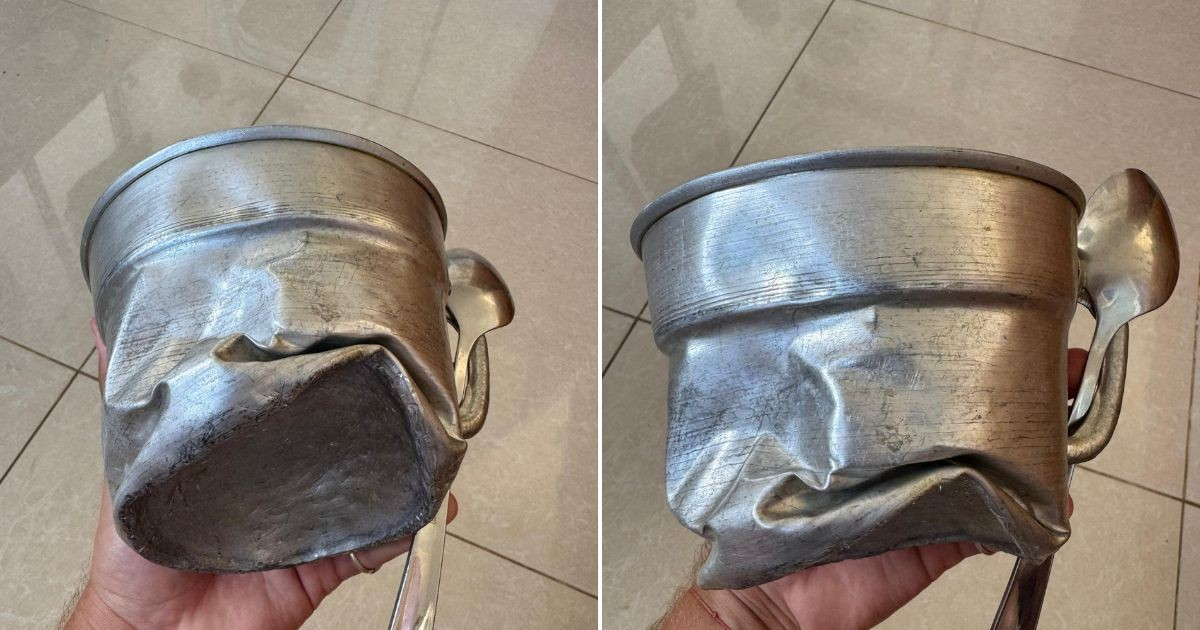
A Cuban sent journalist Magdiel Jorge Castro photographs of his completely dented and distorted aluminum pot after participating in the nighttime banging of pots and pans this Wednesday in Havana, as a testament to the intensive use of the utensil as a tool of protest.
The images show the container with a collapsed bottom, crumpled metal, and a handle bent outward, evidence of the sustained banging during the protests the night before.
The citizen also reported that the regime's police attempted to intimidate the neighborhood during the protests.
"He tells me that the regime's police tried to intimidate the neighborhood by revving their motorcycles at the base of the buildings," Castro wrote on his X account.
The tactic of acoustic intimidation using motorcycles did not achieve its goal: the protest continued that night, and according to Castro, it was expected to be repeated this Thursday.
The demonstrations on Wednesday spread simultaneously across at least ten municipalities in the capital, including Diez de Octubre, Marianao, San Miguel del Padrón, Nuevo Vedado, Guanabacoa, and Arroyo Naranjo.
In San Miguel del Padrón, neighbors gathered in front of the municipal government headquarters chanting "Current and food!", while in Reparto Bahía, the slogans included "Down with the dictatorship!".
In Marianao, residents lit bonfires during the early hours of the morning, and in Nuevo Vedado —just a few blocks from the Palace of the Revolution and the Central Committee of the Communist Party of Cuba— the locals protested after 24 consecutive hours without electricity.
Independent journalist José Raúl Gallego described the intensity of what occurred in Santos Suárez: "All of Santos Suárez is in the street. I have never seen anything like this since July 11."
The police repression was also evident in Playa municipality, where agents assaulted protesters, according to reports from the day.
This wave of protests began on March 6, 2026 in response to prolonged blackouts —which in some areas exceed 20 hours a day— and food shortages.
The Cuban Observatory of Conflicts recorded 1,245 protests in March and 1,133 in April of 2026, a figure that represents an increase of 29.5% compared to April of the previous year.
Since the beginning of the wave of protests, at least 14 people have been detained in Havana, while the regime has also responded with the militarization of areas and selective mobile data outages.
The dented pot circulating on social media thus becomes a symbol of a resistance that, night after night, spreads to more areas of the capital without police intimidation managing to extinguish it.
Filed under: