
Related videos:
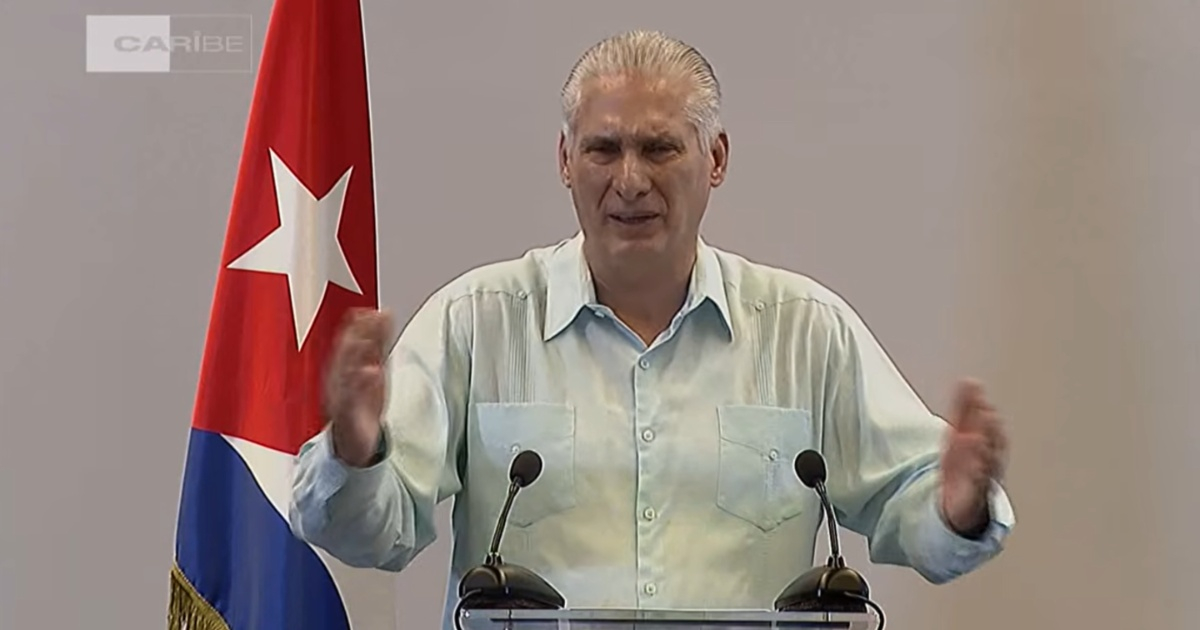
Miguel Díaz-Canel published a message on his X account this Thursday, defending the relationship between the Cuban regime and the Catholic Church, seemingly trying to position himself as a legitimate interlocutor in light of the offered 100 million dollars in humanitarian aid that Washington has announced for the Cuban people.
The background is crucial: the U.S. State Department has made it clear that this aid would be channeled through the Catholic Church and independent humanitarian organizations, expressly excluding the Cuban government from any mediation.
In his statement, Díaz-Canel asserted that "our country's experience in receiving international aid, including from the U.S., is extensive and constructive," and concluded with a phrase that encapsulates the political intent of the message: "Our experience working with the Catholic Church is rich and productive."
The leader also conditioned the acceptance of aid on adherence to "universally recognized practices for humanitarian assistance" and took the opportunity to reiterate the regime's position on the embargo: "The damage could be alleviated in a much easier and expedited manner with the lifting or easing of the blockade, as it is known that the humanitarian situation is coldly calculated and induced."
Díaz-Canel's message is part of a tactical shift by the regime in just 48 hours. Foreign Minister Bruno Rodríguez Parrilla described the offer as a "fable" and a "lie" last Tuesday, denying having received any formal proposal.
However, that same Thursday, it softened its stance and stated that Cuba "has no issues working with the Catholic Church" and is willing to "hear the details of the offer."
From Washington, Secretary of State Marco Rubio insisted this Thursday, in remarks from Air Force One en route to China, that "what is happening in Cuba is unacceptable" and that the regime is rejecting assistance.
The official statement from the State Department also revealed that Washington had made "numerous private offers" prior to Havana, including support for free satellite internet, all of which were rejected.
The reality on the ground contradicts the regime's narrative about its role in aid distribution. Caritas Cuba reported on May 8 that it had carried out 82% of a first donation of three million dollars, benefiting approximately 8,800 families in Santiago de Cuba, Holguín, Las Tunas, Bayamo, and Guantánamo, all through parish networks and volunteers, without government mediation.
This direct distribution was made possible thanks to the model that the U.S. imposed from the beginning: five containers of aid arrived in April at the port of Santiago with more than 1,300 food modules, 1,500 hygiene items, and 720 household goods, all managed entirely by Cáritas, prioritizing single mothers, the elderly, the sick, and people with disabilities.
Rubio announced the offer of 100 million on May 8, following a 45-minute private audience with Pope León XIV at the Vatican, where the topic of Cuba was central. The proposal states that the decision to accept or reject it "lies with the Cuban regime," according to the statement from the State Department.
Filed under: