
Related videos:
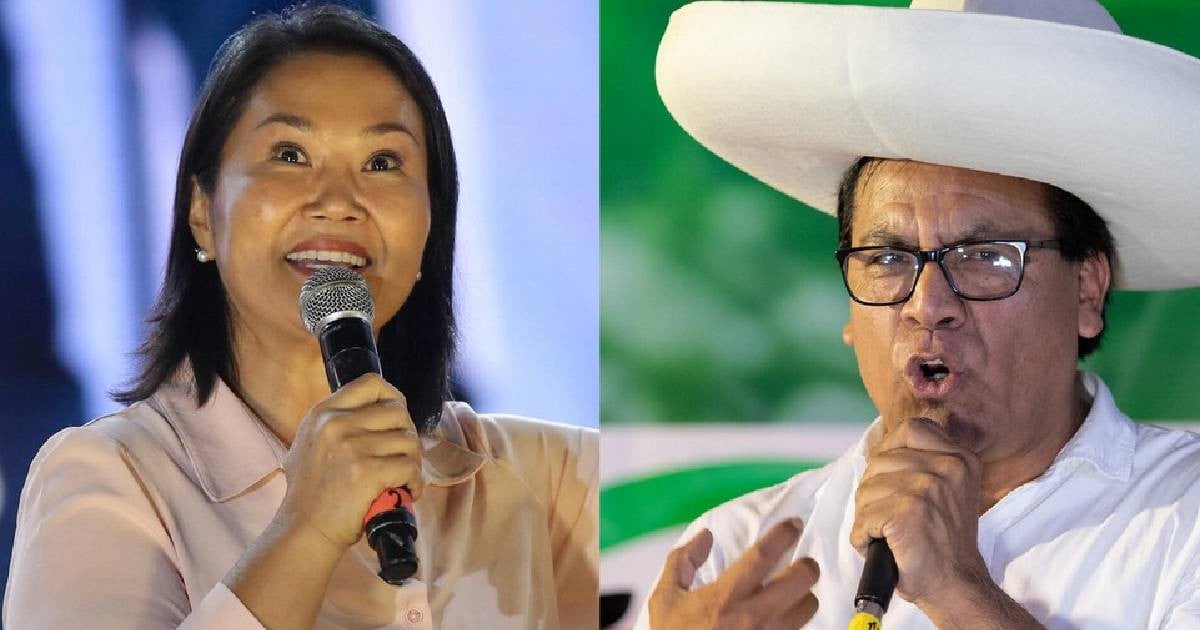
Peru confirmed this Friday that its presidential runoff on June 7 will pit the right-wing Keiko Fujimori from Fuerza Popular against the leftist Roberto Sánchez from Juntos por el Perú, following the nearly complete count of the first round held on April 13.
With 99.998% of the ballots counted by the National Office of Electoral Processes (ONPE), Fujimori received 17.18% of the valid votes (2,877,678 votes), while Sánchez reached 12.03% (2,015,114 votes), reported the news agency EFE.
The notable absence from the runoff is Rafael López Aliaga of Renovación Popular, who came in third with 11.914% (1,989,367 votes), separated from Sánchez by just about 14,000 votes in the final count.
The outcome represents a twist compared to the initial projections from April 13, when the partial count of 51.6% of ballots indicated a runoff between Fujimori and López Aliaga.
As the counting progressed, Sánchez moved up in the rankings, ultimately surpassing López Aliaga and establishing himself as the second most voted candidate.
The National Jury of Elections (JNE) announced that it will officially proclaim the results on Sunday, May 17, at noon.
For Fujimori, this will be her fourth consecutive presidential runoff, having lost to Ollanta Humala (2011), Pedro Pablo Kuczynski (2016), and Pedro Castillo (2021).
Daughter of former president Alberto Fujimori, who governed Peru from 1990 to 2000 and passed away in September 2024, the candidate arrives at the runoff election with legal issues that raise concerns among some voters.
Sánchez, a social psychologist and congressman for Juntos por el Perú, reached the runoff with leftist proposals focused on free public education, decentralization, and state reform, supported by figures such as Antauro Humala.
Her candidacy rose from 3.2% in March polls to a final 12%, marking one of the most striking comebacks of the campaign.
The ideological polarization is already defining the scenario for the runoff election; Sánchez challenged Fujimori to debate in Chota, and Fujimori replied by proposing Huaral as the venue.
López Aliaga's party, Renovación Popular, acknowledged the election results despite not making it to the second round.
Peru arrives at this runoff amid deep political instability. The country has had eight presidents in the last 10 years, and the first round on April 13 was marked by a logistical crisis in Lima that left 52,251 citizens unable to vote due to delays of up to five hours in the distribution of electoral materials.
Filed under: