
Related videos:
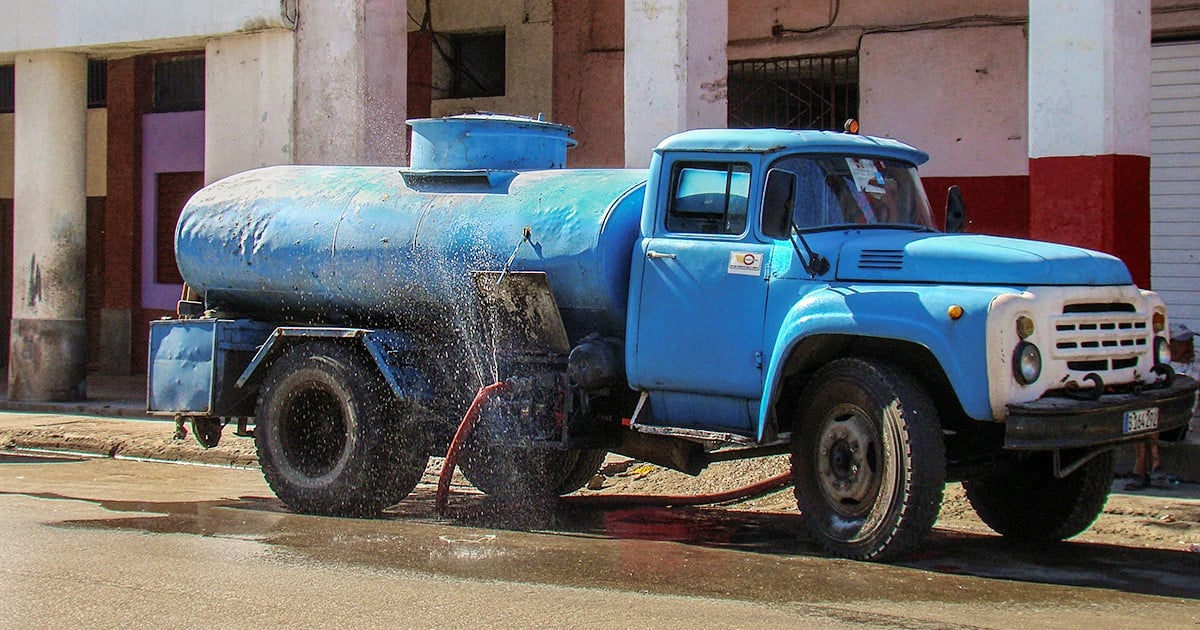
More than 376,000 residents of Havana have issues with access to drinking water, confirmed this Friday the president of the National Institute of Hydraulic Resources (INRH), Antonio Rodríguez Rodríguez, during a working session convened by Prime Minister Manuel Marrero Cruz to assess the multiple crises affecting the capital.
According to the head of the water organization, out of the 376,055 affected people, 66,961 were affected due to breaks in the network, while the remaining more than 309,000 were impacted by the lack of electricity that prevents the operation of water pumps, as reported by the Government of Havana on its Facebook profile.
The figure represents a dramatic worsening compared to April, when officials from Aguas de La Habana acknowledged impacts on 200,000 people, 11% of the capital's population, a statistic that already provoked public disbelief at that time.
The Minister of Energy and Mines, Vicente de la O Levy, attributed the deterioration of the service to the "combined effect of the lack of fuel and the unexpected failure of several generation units."
The minister himself acknowledged the magnitude of the collapse. "In Havana, power outages today exceed 20 to 22 hours. And when they do come, it's for two hours, an hour and a half, two hours, three hours in some circuits, four hours, and then we go back to 20, 22 hours. That's the situation in the capital," he noted.
The most recent trigger was the ninth breakdown of the Antonio Guiteras thermoelectric plant this year, which went offline on Thursday at 4:58 AM due to a leak in the boiler, causing a partial collapse of the National Electric System (SEN) from Ciego de Ávila to Guantánamo.
In response to the water crisis, the INRH announced priorities including the repair of pumping equipment, the elimination of large leaks in the Cuenca Sur pipeline, and the use of alternative water sources in communities.
The problem has structural roots. 87% of the water supply system relies on the electrical grid, and out of the 480 key pumping stations nationwide, only 135 are on protected circuits against outages.
The NGO Food Monitor Program reported in April on a black market for suction pumps sold for as much as 36,000 Cuban pesos, and private tanks between 18,000 and 26,000 pesos, while entire buildings could go 15 days without supply.
Roberto Morales Ojeda, Secretary of Organization of the Communist Party, stated in the session that "there are still reservations regarding organizational and subjective issues: in the electrical matter, water supply, food production, and information to the public."
The meeting took place amid mass protests in several neighborhoods of Havana, with barricades, bonfires, and noise from pots and pans in Guanabacoa, Marianao, Playa, San Miguel del Padrón, Luyanó, Santos Suárez, and East Havana, among others.
Marrero concluded the session with a call to work in neighborhoods and communities. "These are not times for the office, but for being out on the streets with the people, where the problems are, to find solutions together," he said.
Filed under: