
Related videos:
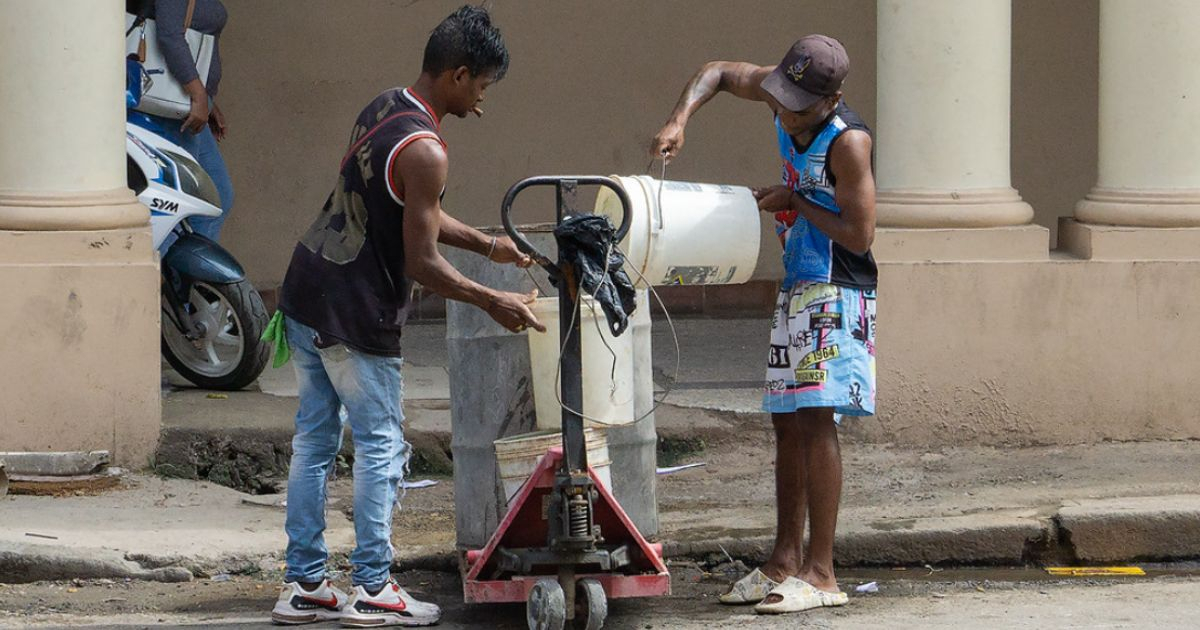
According to information provided this Wednesday by Abel Fernández Díaz, director of the Water Supply of Aguas de La Habana, more than 200,000 residents of Havana—approximately 11% of the capital's population—are without regular access to drinking water as a direct result of the blackouts affecting Cuba.
Fernández Díaz described the supply situation as "very complex" and pointed out that the Southern Basin, which supplies the municipalities of Diez de Octubre, Cerro, Plaza, Centro Habana, and Habana Vieja, is facing power outages lasting more than ten hours that are disrupting the pumping system.
According to a report from Canal Habana, this disruption is compounded by a break in the main pipeline of the Southern Basin, with repairs expected to be completed in the coming hours to initiate the restoration of service.
Another area severely affected is El Diezmero, which experienced a fire last week and began its recovery process this Wednesday.
The company executives warned that the prospects for improvement depend entirely on the performance of the electrical service: "the more the large equipment is halted, the more they suffer, as they are designed not to stop."
The electrical crisis is compounded by the effects of drought, which are already becoming visible in the Vento and Ariguanabo Canal, two key sources of the capital's supply, further complicating the recovery.
The alternative supply through tanker trucks is insufficient to meet the demand. Nationwide, around one million people rely on trucks to access water, a service limited by the shortage of diesel.
The 87% of the country's water supply system relies on the electrical grid for the operation of pumps, and out of the 480 essential pumping stations nationwide, only 135 are on protected circuits against power outages.
In April 2026, Cuba has recorded electrical generation deficits of up to 1,945 megawatts, with uninterrupted blackouts lasting 24 hours on several days. On April 12, the Electric Union projected a deficit of 1,630 megawatts that left 55% of the national territory without electricity simultaneously.
The Antonio Guiteras thermal power plant, one of the most important in the country, has suffered three breakdowns so far in 2026, while the supply of Venezuelan crude has been interrupted since December 2025, worsening the energy collapse.
In the same press conference, Lázaro Torres Laurenti, director of Mechanization at Aguas de La Habana, reported that the company is making progress in transitioning to electric vehicles, a process that began when "Aguas de La Habana started to feel the effects of the shortages of fossil fuels."
The current fleet includes an electric truck and a tank, with plans to install six charging stations at various locations in the capital, two of which will be solar fast chargers.
There are also plans to connect high-capacity solar networks to the large pumping stations, although that project "is still delayed due to its scale."
Filed under: