
Related videos:
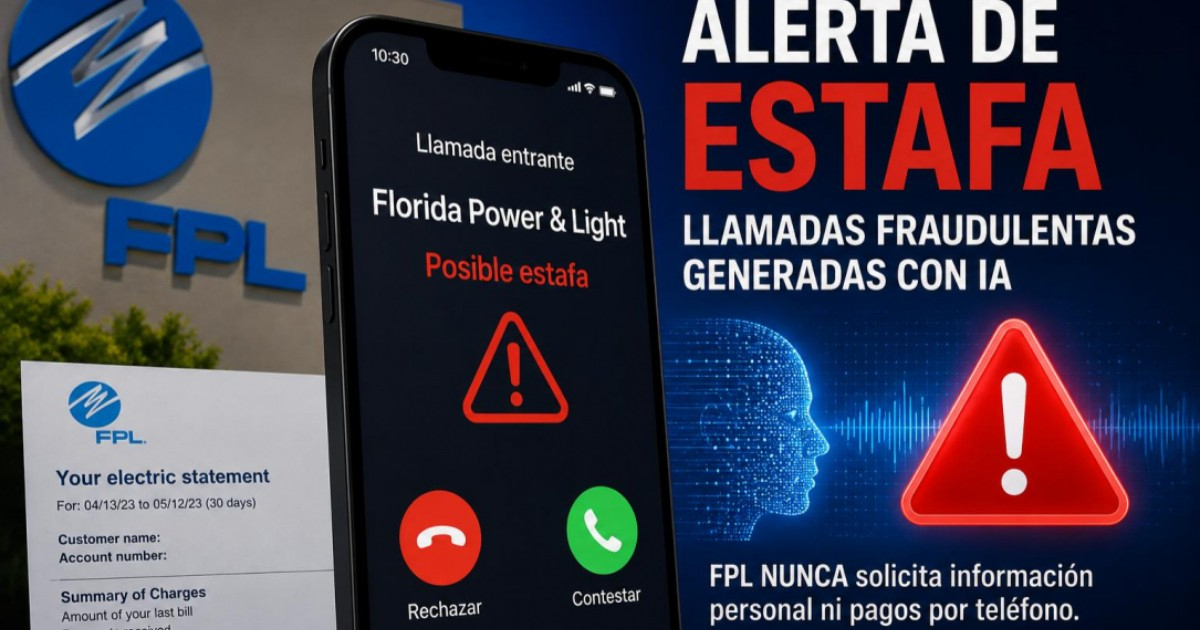
Florida Power & Light (FPL) issued a warning about a significant increase in fraudulent phone calls generated by artificial intelligence (AI) that impersonate representatives of the electric company to scam its customers in South Florida.
According to Local 10 News, the voicemail messages do not come from real people; instead, they are created with AI to sound convincing and exploit the habits of those who pay their electric bill automatically.
One of the fraudulent messages detected by FPL states: "The state of Florida recently changed its efficiency standards. Your home has been flagged for an energy compliance review."
Another message identifies itself with a false name: "Hello, I am Will from the compliance department of Florida Power and Light."
Scammers promise nonexistent benefits to attract victims: "You can get up to $3,000 in energy rebates and possibly a new air conditioner at no cost."
The real objective of the calls is to obtain personal information from customers and to demand fraudulent payments, as confirmed by the company itself.
This is not the first time FPL has issued a warning about this method.
On February 18, the company posted a warning on its Facebook account about scams related to fake air conditioning updates, where criminals pressured customers to upgrade their equipment immediately or face additional charges on their bills.
In that alert, FPL was categorical: "We never force our customers to upgrade their air conditioning to avoid additional charges." The company even published a screenshot of a fraudulent voicemail coming from a number in Boca Raton received on January 30, 2026.
FPL warns that it never requests payments through unauthorized methods such as prepaid cards, cryptocurrencies, bank transfers, Zelle, Cash App, or Venmo to avoid disconnection.
They also do not request home energy efficiency surveys over the phone; their technicians only visit the customer if the customer requests it and schedules an appointment in advance.
In the event of any suspicious call, FPL recommends hanging up immediately and contacting the company only through the number listed on the bill or by visiting FPL.com/Protect to learn how to protect yourself from scam attempts.
This phenomenon is part of an alarming trend: social media scams caused losses of $2.1 billion in the United States in 2025, eight times more than the $261 million recorded in 2020, according to the Federal Trade Commission (FTC).
Globally, scams involving artificial intelligence grew by 1,210% in 2025, with projected losses of up to $40 billion by 2027, according to data from Vectra AI.
In Florida, the FBI in Miami reported 1,579 cases of impersonation of federal agents, resulting in losses exceeding $12 million.
In April, the Social Security Administration warned about fraudulent emails that incorporate AI to make communications more convincing.
Filed under: