
Related videos:
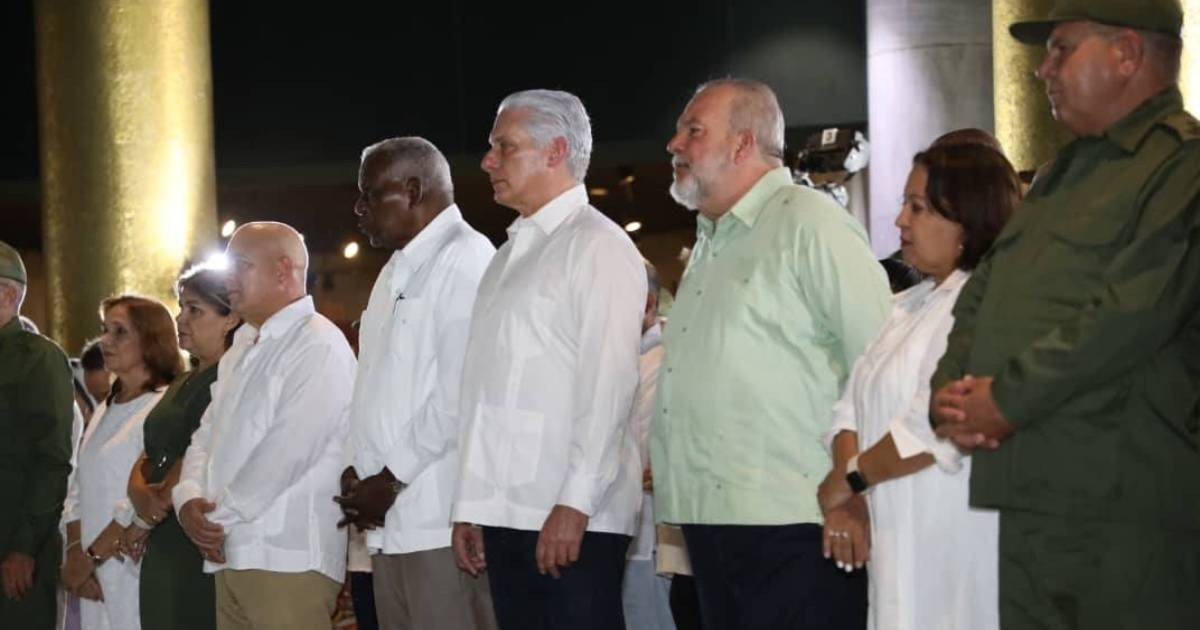
This Wednesday, Miguel Díaz-Canel received in a solemn ceremony a "documentary showcase" of the more than 6.2 million signatures collected in the campaign "My Signature for the Homeland", as reported by the Communist Party of Cuba on its social media, on a day that the regime deliberately chose to coincide with the anniversary of Cuba's formal independence in 1902.
The event was attended by the top officials of the State and the Party: Manuel Marrero Cruz, Prime Minister; Esteban Lazo Hernández, President of the National Assembly of People's Power and of the Council of State; and Roberto Morales Ojeda, Secretary of Organization of the Central Committee.
The official statement from the PCC describes those who submitted the signatures as "representatives of Cuban Society," a formulation that is striking in a country where no independent civil society is recognized.
All mass organizations—the Committees for the Defense of the Revolution, the Federation of Cuban Women, the Central Organization of Cuban Workers, the Union of Young Communists—are subordinate to the Communist Party and the State according to Article 7 of the 2019 Constitution.
The regime uses the language of "civil society" to give the appearance of spontaneity and pluralism to what is, in reality, a mobilization directed from the structures of the single-party system.
The campaign was launched on April 19 by the PCC, coinciding with the 65th anniversary of the Battle of Playa Girón, and Díaz-Canel was the first to sign the following day at the Ciénaga de Zapata Memorial Museum in Matanzas, where he declared that "the Cuban Revolution will never negotiate its principles."
On May 1, the government boasted of 6,230,973 signatures collected, a figure that Chancellor Bruno Rodríguez Parrilla presented as equivalent to 81% of Cubans over 16 years old.
However, with an estimated population of around 9.7 million inhabitants—and in sharp decline due to mass emigration since 2021—the numbers appear statistically implausible.
The campaign was widely criticized for its coercive nature from its early weeks.
Reports from Matanzas, Bayamo, Cárdenas, and Havana documented that executives of state-owned companies pressured workers to sign, with instructions to ensure at least 80% participation under the threat of dismissal.
A leaked audio revealed the performance on May 2, when a recording of an official from the Revolutionary Armed Forces was released, bluntly warning: "Those who do not agree with this should resign."
Analysts and opponents, including Manuel Cuesta Morúa, described the campaign as a "farce" and noted that it follows the same historical pattern of Castroism: in the face of external pressure — in this case, the intensification of the embargo by the Trump administration — the regime turns to mass mobilization as a tool for internal legitimacy and international projection.
The PCC concluded its publication with the assertion that the campaign "demonstrated the relevance of the Martiano and Fidelista ideology," once again appropriating the symbols of the nation to disguise what opponents and analysts describe as a staging of power and a facade lacking genuine citizen support.
Filed under: