
Related videos:
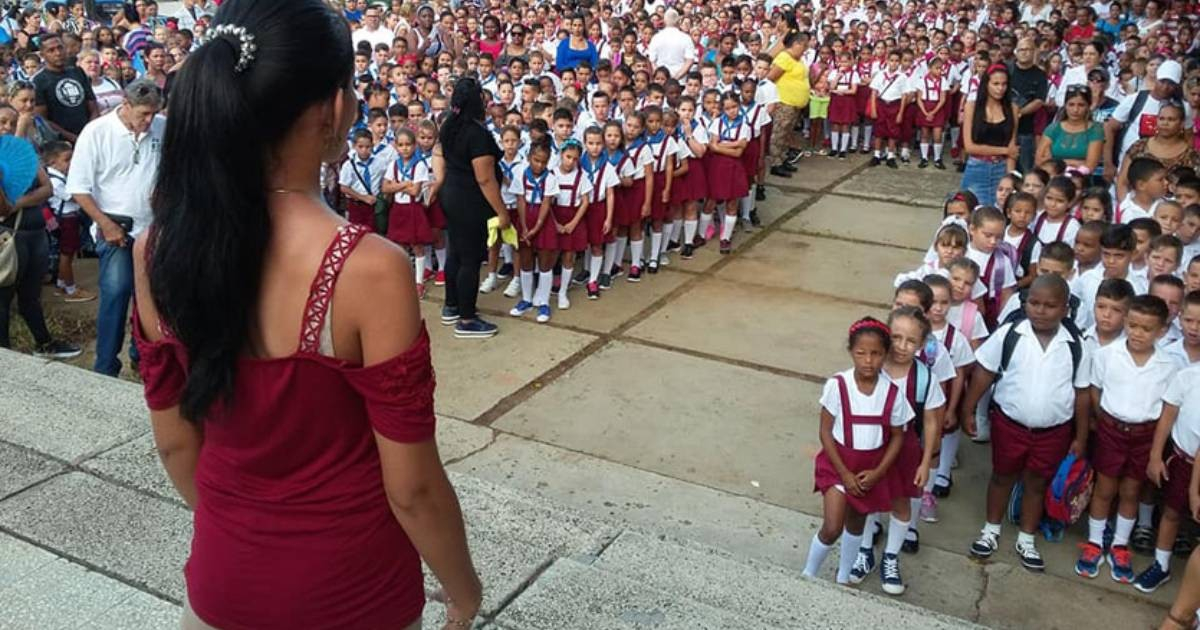
The Cuban regime announced the advancement of the school year 2025-2026 closure to the period between June 15 and June 30, which was originally scheduled for July, due to the severe logistical limitations the country is facing.
The decision was communicated this Tuesday by the Minister of Education, Naima Ariatne Trujillo Barreto, who appeared on the Mesa Redonda alongside the Minister of Higher Education, Walter Baluja García, to report on the adjustments planned for the final stage of the school year.
Trujillo Barreto justified the advancement with these words: "A level of limitations in logistical conditions and assurance make us consider it relevant to make the decision to move our course closure forward to a period from June 15 to June 30."
The minister acknowledged that the closure was published in the Official Gazette for the month of July, in accordance with Resolution 43/2025 of the Ministry of Education, but that the crisis necessitates moving it up.
Among the mentioned causes are the total lack of fuel, chronic blackouts, and transportation difficulties that affect both students and teachers.
"There has been a need to reduce, according to local particularities, the admissions, the semi-boarding service, and the number of in-person days in each territory. Long distances are traveled by both the children and their families as well as the teachers," the official detailed.
The minister clarified that the advance does not mean a complete closure of the institutions, which will remain open to support the most vulnerable children, and emphasized that this is not about bringing forward an exam schedule: "It is simply about starting a gradual closure."
At specific points during the course, between 10,000 and 22,000 students found themselves in exceptional circumstances due to being disconnected from their institutions or residing in remote areas.
Special education will close even earlier, in May, while graduations will be held in neighborhoods, schools, and municipalities, without large gatherings. "We need to hold the graduations. They will take place in the neighborhood, at the school, in the municipality. We cannot limit the opportunity for that tremendous event that entails achieving a degree," emphasized Trujillo Barreto.
At the university level, Baluja García reported that the university academic year will mostly conclude in the first half of July, although some practical activities, research projects, and thesis discussions may extend beyond that date.
In parallel, the regime announced the elimination of entrance exams for higher education for the 2026-2027 academic year, which will be replaced by the average or cumulative academic index from pre-university, ensuring a spot for all applicants.
This is the third time the government has made adjustments of this magnitude in a school year, as acknowledged by the minister herself, who described the process as "extraordinarily sensitive, sacrificial, and a tremendous commitment," which at times bordered on "everyday heroism."
The Cuban educational system is also facing a shortfall of approximately 24,000 teachers—one in every eight positions is unfilled—with provinces such as Matanzas, Camagüey, and Sancti Spíritus reporting individual deficits of over 2,000 teachers each.
Filed under: