
Related videos:
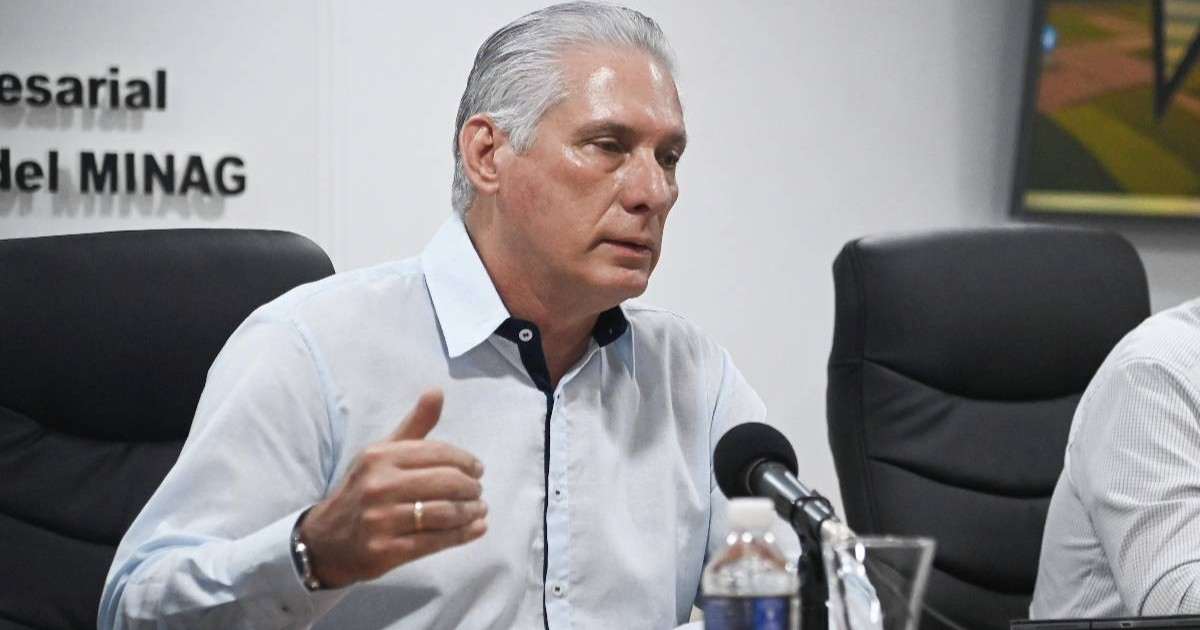
The Cuban leader Miguel Díaz-Canel promised again this Thursday that the priority is to ensure "there is food" and that the best indicator of progress will be "the reduction of prices," during the Technical Advisory Council meeting of the Ministry of Agriculture at the headquarters of the Business Group for Logistics (GELMA) in the Boyeros municipality of Havana.
The meeting, which included Vice Prime Minister Jorge Luis Tapia Fonseca and Agriculture Minister Ydael Pérez Brito, discussed the production of corn and soybeans for animal feed, agricultural extension services, and the analysis of the value chain for these crops.
Díaz-Canel acknowledged that "producing the food that the country needs remains a challenge on the path ahead" and warned that if the programs are not supported by a business plan, "everything will remain just a line of desire."
The leader also promised "access to knowledge" and "well-being," although he acknowledged that the plans have projections for the medium and long term.
The speech repeats almost word for word what Díaz-Canel has been promising for years without any concrete results.
In September 2025, during a visit to a farm in Alquízar, Artemisa, he stated that "if we have food available freely, prices will inevitably come down".
In May 2024, he urged Cubans to grow their own food and stated that "as we have more food, prices must come down."
In March 2024, he acknowledged that prices "will be high" due to structural issues, but he promised not to allow "abusive and speculative" pricing.
None of those interventions have reversed the trend.
The reality faced by Cubans stands in stark contrast to the official discourse.
According to the Food Monitor Program (FMP), as of May 17, 2026, 96.91% of the Cuban population does not have adequate access to food.
Five provinces—La Habana, Matanzas, Cienfuegos, Guantánamo, and Santiago de Cuba— are experiencing critical levels of food insecurity, according to the same organization.
The supply booklet is practically collapsed, failing to meet basic needs for rice, sugar, and peas.
The production of rice decreased by 81% and egg production by 61%, partly due to the diesel shortage that has paralyzed 96.4% of the more than 9,200 registered agricultural micro, small, and medium-sized enterprises.
A carton of eggs arrived at 3,800 Cuban pesos (CUP), and imported rice is sold between 690 and 840 CUP, while the average state salary is only 6,930 CUP per month, which is equivalent to about 13 dollars at the unofficial exchange rate.
The gap between rhetoric and reality was evident four days before the Technical Council: the Farmer's Day on May 17 was commemorated with empty agricultural markets or very limited offerings throughout the country.
Cuba annually imports about 800,000 tons of corn and 350,000 tons of soy for animal feed, a dependency that the programs announced by Díaz-Canel aim to reduce, although without clear timelines or funding.
"The best innovation we can achieve with all these programs is to have food," said the leader this Thursday, a statement that Cubans have heard too many times while the shelves remain empty.
Filed under: