
Related videos:
Amidst the worst economic crisis impacting the Cuban people in recent decades, the Cuban leader Miguel Díaz-Canel has once again resorted to simplism to tackle the inflation distressing the Cubans.
Far from offering real solutions, it insists on clichéd phrases that disregard the impact of its own policies on the current situation.
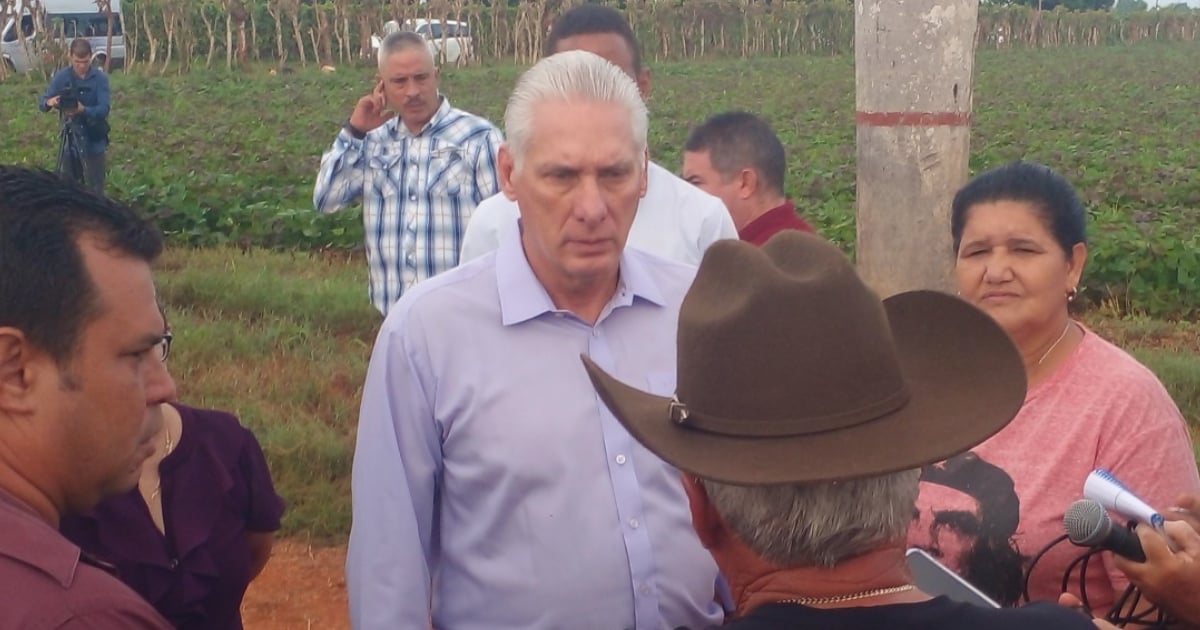
"If we have food available freely, prices will necessarily fall," he stated during a visit to the Consuelo farm in Alquízar, Artemisa, reducing the structural crisis of the economy to an almost simplistic formula, as if the shortages, lack of supplies, and state controls were not the responsibility of his government.
The president toured just 0.20 hectares of sweet potato and 0.60 hectares of banana cultivated by producer Wilfredo Vallés Rodríguez, showcased as a model to be replicated throughout the country.
He was accompanied by high-ranking officials from the PCC, in yet another of the usual staged events where the root of the problem is deliberately overlooked: the economic policies of the regime itself.
The ruler insisted that experiences like Vallés should be multiplied, as if a couple of plots could reverse the structural food shortages affecting the population.
Caps and fines instead of solutions
Díaz-Canel's statements came just one day after the Ministry of Finance and Prices announced on social media a "price control" in Alquízar, which concluded that the costs were in line with what was established, except for an outdated board.
The scene illustrates the government's obsession with pursuing vendors and imposing sanctions, while minimizing the supplies and resources allocated to the countryside.
That same municipality made headlines this week when a point of sale was fined 11,000 pesos after irregularities were detected in the price board and labor contracts.
Punishment does not solve the scarcity of products nor does it prevent salaries from losing value in the face of inflation that rises month after month.
Unfulfilled promises
Díaz-Canel's words contrast with his own recent admissions.
In last July, he acknowledged before Parliament that Cuba's revenues "do not even cover the cost of the most basic raw materials", and that economic management is limited to "redistributing scarcity."
He also acknowledged that the country lacks foreign currency to maintain a currency market and that the core of the crisis lies in the inability to generate wealth.
However, instead of proposing a change in the model or freeing the peasantry from state constraints, the leader insists on repeated speeches about "controlling prices" and "preventing abuses".
In March 2024, it had already been indicated that prices "will remain high" due to structural supply and demand issues, although there was a request to intensify inspections to curb speculation.
Reality in free fall
Far from their slogans, the daily life of Cubans is increasingly harsh: 70% of the family salary goes to food, markets are understocked, price caps discourage production, and farmers continue to receive fewer supplies and less freedom to trade.
The so-called "Tarea Ordenamiento," implemented since 2021, only accelerated the decline: devalued salaries, insufficient pensions, and out-of-control inflation.
Cuban agriculture is producing less and less, and the population is paying unaffordable prices.
While Díaz-Canel takes photos among sweet potato and banana fields, the country remains caught in a vicious cycle of shortages, controls, and sanctions that fail to curb rising prices or alleviate the distress of millions of families.
Frequently asked questions about the economic crisis in Cuba and Díaz-Canel's statements
What does Díaz-Canel propose to reduce prices in Cuba?
Díaz-Canel suggests that if food is available freely, prices will automatically drop. However, this idea overlooks the structural lack of food and the deeper economic problems in Cuba that impact supply and demand.
What are the criticisms of the Cuban government's economic management?
The Cuban government, under the leadership of Díaz-Canel, is criticized for not implementing necessary structural reforms and for focusing on price controls and sanctions instead of addressing the root causes of economic problems. Furthermore, the policies of redistributing scarcity and the lack of wealth generation have been pointed out as ineffective.
How does inflation affect the Cuban population?
Inflation is suffocating the Cuban population, with 70% of the family income allocated to purchasing food. The markets are undersupplied and prices continue to rise, while salaries are losing value constantly.
What economic measures has Díaz-Canel recently advocated?
Díaz-Canel has defended the partial dollarization of the economy as a necessary measure to obtain foreign currency. However, he has acknowledged that this increases social inequalities, benefiting those who have access to capital or remittances.
What impact does price control have on agricultural production in Cuba?
The price controls imposed by the Cuban government discourage agricultural production. Farmers receive fewer supplies and have less freedom to trade, which exacerbates food shortages and perpetuates the vicious cycle of scarcity and controls.
Filed under: