
Related videos:
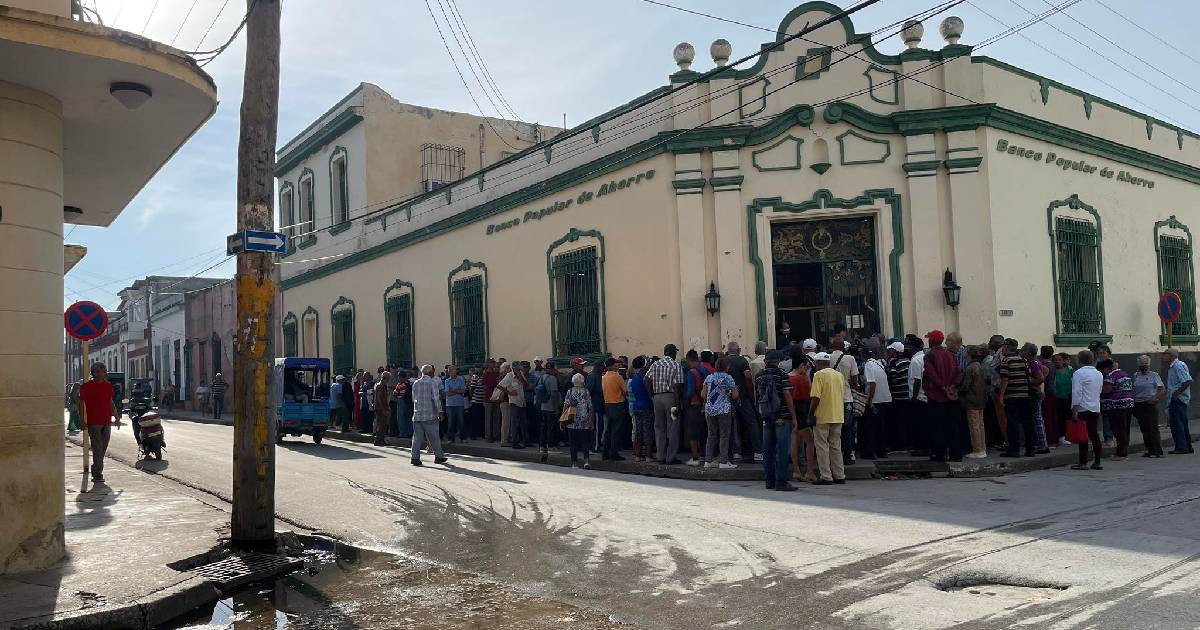
Dozens of retirees flocked to the bank branches in Holguín this month to try to collect their pensions, amidst complaints of long lines, disorganization, and a lack of real solutions for an aging and vulnerable population.
The complaint was posted this Friday on Facebook by the digital creator Pedro Lorenzo Hechavarría Pupo, who shared an image of a gathering of elderly adults around the Popular Savings Bank located at the intersection of Aguilera and Maceo streets, in the center of the Cuban City of Parks, accompanied by the message: “A new month... The same problem,” referring to the recurring chaos in collecting pension checks.
The reactions of other Cubans reflected the accumulated frustration over a situation that is recurring throughout the country. “All the banks are like this: filled with elderly people trying to cash their checks,” commented a user identified as Elizabeth Aguilera, who also questioned the failure of the supposed solutions implemented after the banking system was promoted by the regime.
Other testimonies described scenes of sick elderly people, individuals in wheelchairs, and retirees compelled to wake up at five in the morning to secure a spot at the bank branches.
Jorge Barciela recounted seeing a man with an amputation waiting in line to collect his pension, while he harshly criticized those who designed a banking system "without ever having seen a bank branch in the middle of summer or during a blackout."
The outrage was also characterized by references to the state’s abandonment of individuals who dedicated decades of work to the country. “Many sacrificed their lives for the Fatherland,” wrote Miriam Peña Hernández, who reported that numerous elderly people suffer from hunger, heat, and sleepless nights due to blackouts before having to face these long lines.
Although some users pointed out attempts at organization in certain branches, such as the prior collection of identity cards and tickets, most agreed that the issue remains without a structural solution. "That problem belongs to no one," summarized another commentator.
In the absence of real solutions, citizens are suggesting to reinstate home delivery services that mail carriers used to provide in the past, or to implement differentiated assistance for people with reduced mobility. User Rosa Luz summarized it bluntly: "Terrible, it’s like this all over the country, it's truly abusive."
Jose Luis Viñals concluded the debate with a phrase shared by many Cubans: "The good thing about this is that no one in power cares."
The scenes of retirees crowded in front of the banks contrast sharply with the official narrative about digitalization and financial efficiency promoted by the Cuban government.
In practice, a large portion of the elderly lack smartphones, stable internet access, or the knowledge to use banking apps, which means they continue to depend on cash and in-person transactions to collect pensions that barely suffice for survival.
Cuba has over 1.7 million retirees who rely on a collapsed banking system, with scarce ATMs, terminals rendered inoperative due to power outages, and branches operating on reduced hours.
The banking policy launched in August 2023 worsened the situation instead of resolving it. In Pinar del Río, only between 10% and 12% of monthly transactions are conducted through digital channels.
The very coordinator of the Provincial Government of that province, Calex Edilio González Chill, acknowledged that banking services "instead of making people's lives easier, have created another problem."
The official press acknowledged in April that "cash remains the undisputed king of the daily economy," with illegal surcharges of up to 20% for electronic payments standardized across much of the country.
In that same month, elderly people were sleeping in the doorway of the Charity Bank in Camagüey using sheets and cardboard to secure a spot for the next day. In January, Cienfuegos deployed police to organize the lines due to the collapse of banking services.
The maximum pension after the partial increase approved in 2025 is 4,000 Cuban pesos per month, equivalent to less than 10 dollars in the informal market.
The Family Care System, which could assist the most vulnerable, only covers 67,000 people out of more than 1.7 million retirees in the country.
Filed under: