
Related videos:
President Miguel Díaz-Canel posted a message on Facebook this Friday, stating that Cuba does not pose a threat to the United States and warned that the Cuban Armed Forces —“forged in the Sierra Maestra, Girón, and the internationalist missions in Africa”— will resist any aggression, in one of his “fired-up” responses to the escalation of tensions with Washington following the federal criminal charges against Raúl Castro.
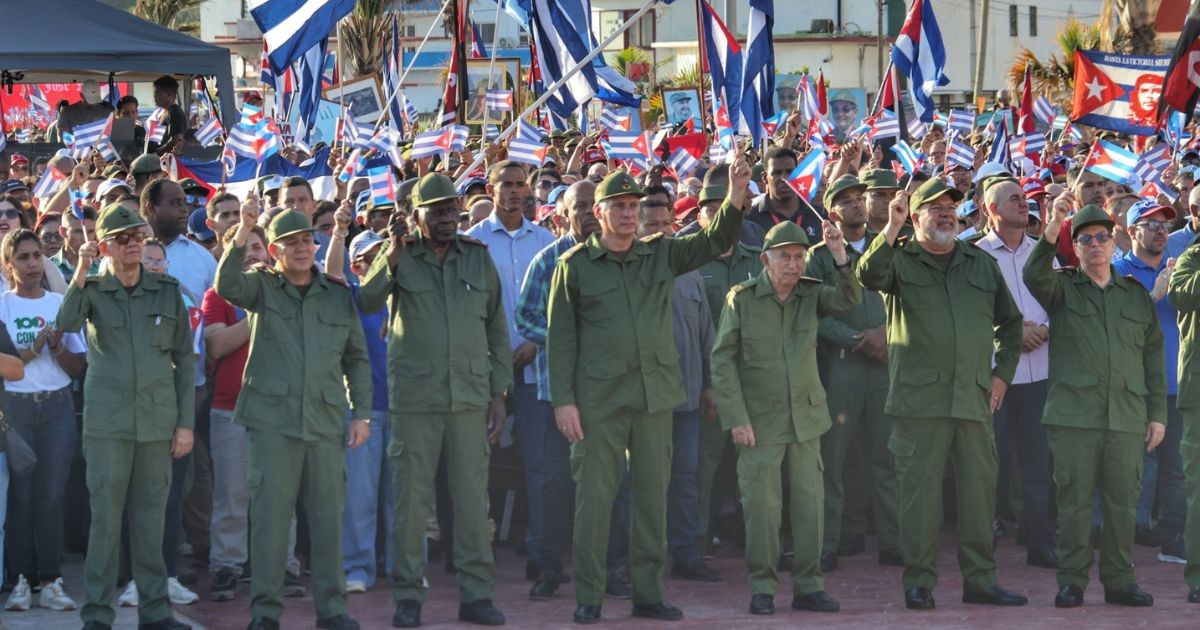
The post, tagged with #LaPatriaSeDefiende, was published shortly after an event organized by the regime in front of the U.S. Embassy in Havana, called in support of Castro after the U.S. Department of Justice filed federal charges against him this May 20 for the downing of the Brothers to the Rescue planes in 1996.
Díaz-Canel began his message with a statement that, coming from the leader of a country in collapse, is striking: "That Cuba represents a threat to the U.S. can only exist in the sick minds of some officials in the current U.S. administration who have hijacked the policy toward our island, who blatantly lie to the people of that nation and the world to justify a new irrational war."
The leader accused Washington of combining "absurd lies with military intimidation and depriving the Cuban people of the most basic resources and services necessary for their daily survival." The irony is hard to ignore: the very government that describes this deprivation as an external imposition is the same one that has been managing scarcity, power outages, and shortages experienced by millions of Cubans for 67 years.
Díaz-Canel additionally described the threat discourse from the U.S. as a "fevered dream of a stronghold of Cuban-origin mafiosos" and accused Washington of maintaining "its empty rhetoric in pointing us out as sponsors of terrorism, without presenting a single piece of evidence." He asserted that all of this is part of "a rapid media construction to justify a military aggression against Cuba."
The warlike rhetoric contrasts with the reality of the Armed Forces it invokes. The cited glories—the Sierra Maestra, the defeat of the Bay of Pigs invasion in 1961, and the missions in Angola—are decades old, while the island faces blackouts, critical shortages, and unprecedented mass emigration. Not to mention that the display of patriotic "bravado" is directed at the world's leading military power.
The charges against Raúl Castro include conspiracy to murder U.S. nationals and four counts of murder for the deaths of Carlos Costa, Armando Alejandre Jr., Mario de la Peña, and Pablo Morales. The proceedings are mainly symbolic in nature: the former leader is 94 years old, has never set foot on U.S. soil, and there is no extradition treaty in place. However, in the collective imagination, there lingers the possibility of a U.S. military operation that captured the dictator Nicolás Maduro in Venezuela on January 3 and brought him to justice in the United States.
The event in front of the embassy was organized with workers mobilized from workplaces; Raúl Castro himself was notably absent. In his place, his grandson Raúl Guillermo Rodríguez Castro, "El Cangrejo", the personal security chief of the nonagenarian general, appeared.
This rhetorical escalation is not new. Since May 1, when Trump threatened to send the USS Abraham Lincoln aircraft carrier "within 100 yards" of the Cuban coast and signed an executive order that expands sanctions in energy, defense, mining, and finance, Díaz-Canel has been responding with rhetoric of resistance.
The leader concluded his message with a phrase that seeks to balance bellicosity with a degree of moderation: "Even so, we continue to bet on the triumph of reason, dialogue, and peace." A call for reason that comes from the same government that for decades has imprisoned those who are calling for just that: dialogue and peace, but within Cuba.
Filed under: