
Related videos:
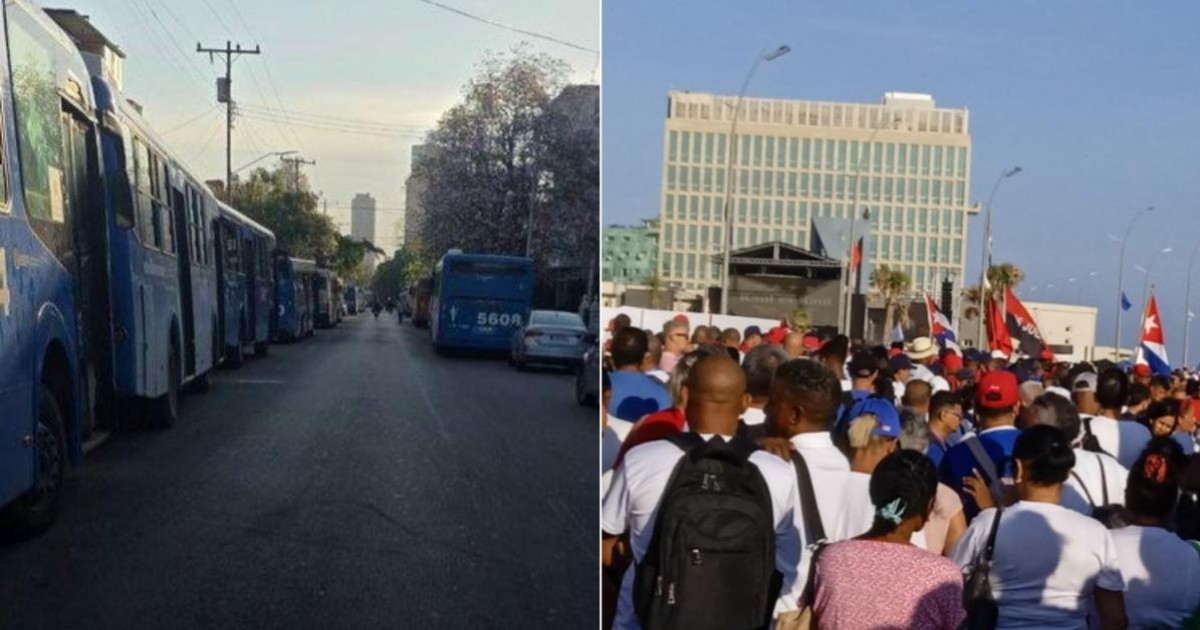
The Cuban regime mobilized dozens of public transport buses this Friday to transport attendees to the rally called at the José Martí Anti-Imperialist Tribune, in front of the U.S. Embassy in Havana, in support of Raúl Castro, indicted by the U.S. Department of Justice.
The complaint was published by journalist Mag Jorge Castro on X: "The regime is mobilizing public transportation for the official event called due to the indictment of Raúl Castro. Amid a fuel crisis, dozens of buses fill the streets around the U.S. Embassy."
The image accompanying the publication shows long lines of blue buses parked along the streets near the U.S. diplomatic headquarters, a scene that starkly contrasts with the paralysis experienced by public transport in Cuba on a daily basis.
The event was called for 7:30 am by the Union of Young Communists and led by Miguel Díaz-Canel, rather than by Raúl himself, as had been expected, an absence that did not go unnoticed.
The Communist Party of Cuba announced on X the official call, in which it described the indictment as "the despicable and infamous act of the Department of Justice against General of the Army Raúl Castro Ruz, leader of the Cuban Revolution."
The official slogan disseminated by Díaz-Canel the day before was: "The Army General is Cuba, and Cuba deserves respect."
The paradox is striking: the regime allocated transportation resources for a political event at a time when Cuba is experiencing one of its worst fuel crises, which has disrupted service across the country.
The government itself acknowledged in January that public transportation only met 42% of its planned targets.
In Havana, the official entity Transportación Habana TH reported in February that "there are no services on any of the available routes" due to a fuel shortage.
In Ciego de Ávila, out of 135 bus routes, only two were operational in March, while in Las Tunas, interprovincial departures were completely suspended since February 6.
On May 16, the Ministry of Transportation announced new cuts: starting June 18, departures between the capital and the provincial capitals will be reduced to three times a week, and routes like Manzanillo and Baracoa will be left with only one weekly departure.
The mobilization of buses for the political event fits into a documented pattern of forced convocations: since May 20, the regime has also turned state workplaces into venues for events supporting Raúl Castro, with workers summoned during working hours.
The charge that prompted this entire mobilization was presented on May 20 in Miami by acting Attorney General Todd Blanche, after being approved by a grand jury from the Southern District of Florida on April 23.
The charges point to Raúl Castro -who was then the minister of the Revolutionary Armed Forces as responsible for the downing of two civilian aircraft belonging to Brothers to the Rescue on February 24, 1996, resulting in the deaths of three Americans and one Cuban resident in the U.S.
Alongside Castro, five former Cuban military personnel were charged, and the allegations include conspiracy to assassinate U.S. citizens, four individual counts of homicide, and destruction of civilian aircraft.
If found guilty, Castro could face life imprisonment or the death penalty, although the proceedings primarily carry symbolic significance since Cuba would not extradite him.
Filed under: