
Related videos:
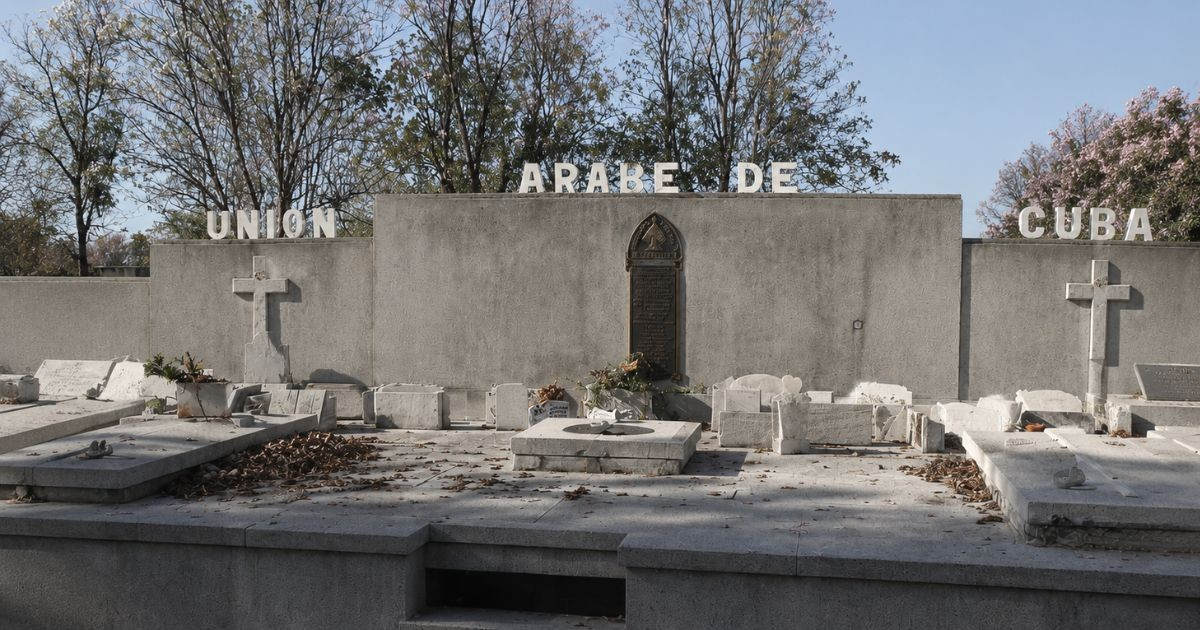
Yaumara Hernández Medina went to the Cementerio de Colón in Havana last Thursday to exhume the remains of her mother-in-law, who was buried in the tomb of the Unión Árabe de Cuba, and found herself in a situation that left her without answers: her relative's remains were nowhere to be found in the facility.
The woman, who posts on Facebook as YauMi Medina, had arrived at the cemetery since nine in the morning, an hour earlier than indicated.
The gravediggers opened all the graves in the cemetery, except for one that, as ordered, was sealed because it contained the remains of an ambassador. In none of the others did they find the deceased.
"When they were able to start the exhumation, it turns out that my mother-in-law is nowhere to be found in the cemetery," Yaumara wrote in her public complaint.
Yaumara's mother-in-law was of Arab descent and the sister of a former worker of the Arab Union of Cuba (UAC).
His burial in that cemetery was possible precisely because of that family connection, as he was initially informed that there was no available space.
In light of the disappearance of the remains, Yaumara contacted a person identified as Milagros, who had coordinated the date of the exhumation.
The response was that the responsibility lay with the cemetery, not with the association.
When Yaumara gave her a 24-hour deadline to provide an explanation, Milagros stopped answering calls and, when she finally responded in writing, asked her if she was being threatened.
Mrs. Lourdes, identified as the person in charge of the cemetery, confirmed that no grave is opened without explicit authorization from the Arab Association.
However, the president of the UAC, identified as Ayme, stated that no exhumation has taken place in that cemetery.
That contradiction is at the heart of Yaumara's complaint: "Where are my mother-in-law's remains if the president of the Arab Union of Cuba told me that no exhumations have been carried out? Because I saw several empty spaces."
The question carries legal weight. Article 233 of Law No. 151, the current Cuban Penal Code, classifies the exhumation or transfer of corpses or human remains without following legal formalities as a crime, punishable by imprisonment from six months to one year.
Yaumara explicitly mentioned it in her publication and was emphatic: "This crime cannot go unpunished. We demand an immediate response from those responsible."
The case adds to a pattern of documented irregularities at the Colón Cemetery.
In February 2024, the discovery of a trench with human bones exposed to the elements was reported in that same necropolis.
Similarly, in November of that year, images of destroyed graves and exposed remains circulated.
And just weeks before the case of Yaumara, in April 2026, the abandonment of human remains mixed with debris was reported again in the same location.
The deterioration of Cuban cemeteries is not a new phenomenon.
In December 2018, the Cuban Parliament itself admitted the critical situation of the country's necropolises, without this resulting in any visible improvements.
Filed under: