
Related videos:
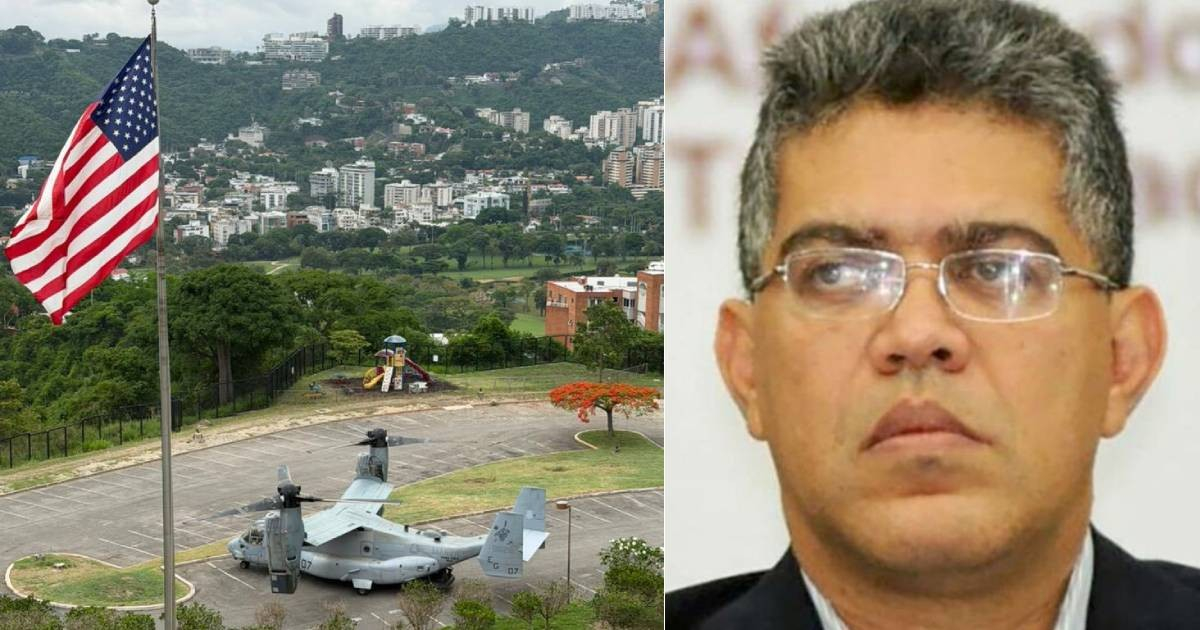
Elías Jaua Milano, former Vice President of Venezuela during Hugo Chávez's government, published an extensive message on Facebook on Saturday in which he described the United States as an "occupying power" and called for "civil resistance" in Venezuela, in direct response to the military evacuation drill conducted by the U.S. Embassy in Caracas.
The text, titled "The Silence Has Been Broken", was published hours after two MV-22 Osprey aircraft from the Marine Corps flew over the Venezuelan capital and landed at U.S. diplomatic facilities, while the USS Iwo Jima aircraft carrier and the USS Lake Erie guided missile cruiser positioned themselves less than six nautical miles off the Venezuelan coast.
The message is politically uncomfortable because it comes from a historical figure of chavismo who openly rejects the new relationship between Caracas and Washington, in contrast to the interim government of Delcy Rodríguez, which not only authorized the drill but has also actively promoted the bilateral normalization with the U.S.
Jaua thanked those who raised Venezuelan flags, painted graffiti, and protested in public squares, describing these actions as "small and beautiful forms of civic and popular resistance against a new violation of our sky by the occupying power."
The former vice president outlined three lessons that, in his view, emerged from the event: that important sectors of the population "are not willing to normalize the occupation or colonial administration," the ability for citizens to self-organize outside of traditional media, and the popular creativity "to make do without resources."
The exercise was formally authorized by the Venezuelan government and coordinated with the Venezuelan Red Cross and national aviation authorities. Foreign Minister Yván Gil announced the authorization on state television.
On the same day of the exercise, the head of U.S. Southern Command, General Francis L. Donovan, made his second official visit to Caracas to supervise and meet with high-ranking leaders of the interim government.
The simulation took place in a context of rapid bilateral normalization. The U.S. and Venezuela restored diplomatic relations on March 5, 2026, the U.S. embassy raised its flag in Caracas on March 14, and on April 30 American Airlines resumed direct flights from Miami to Caracas for the first time in seven years.
The rejection of the drill was not limited to Jaua. Marea Socialista called for a protest in Chacaíto under the slogan "Yankee go home!" and Aporrea published multiple citizen statements framing the exercise as a violation of Venezuelan sovereignty.
Jaua closed his message with a statement that points to the country’s political future: “Perhaps this May 23, 2026, will be remembered not as the day the foreign occupant dared to conduct military exercises on our homeland, but as the day the civic resistance began that will lead us to recover our national independence, which our ancestors earned with Bolívar at the forefront.”
Filed under: