
Related videos:
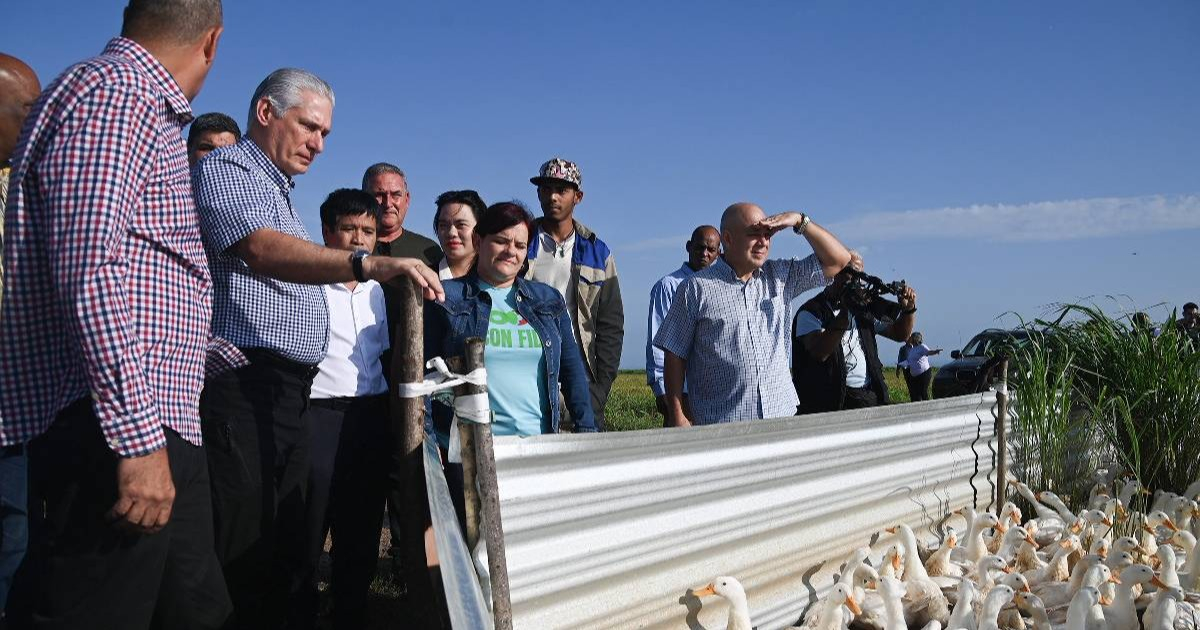
Miguel Díaz-Canel visited the Los Palacios Agroindustrial Grains Company in Pinar del Río this Thursday, where a joint project with the Vietnamese company Agri-VMA is underway, and reiterated his promise that Cuba will achieve self-sufficiency in rice "in a short time."
The phrase is not new. In March 2026, during a meeting in Havana with Nguyen Van Quang, president of Agri-VMA, Díaz-Canel had already stated that the Vietnamese support demonstrated "that in a short time Cuba would be able to achieve self-sufficiency in rice."
During the tour on Thursday, the leader described the experience as an example of "productive prosperity": "We replaced imports; we achieved productions that we were not having, created jobs, generated income for families, well-being... This is now associated with prosperity."
He was accompanied by Roberto Morales Ojeda, a member of the Political Bureau and Secretary of Organization of the Central Committee of the Communist Party, Minister of Agriculture Ydael Pérez Brito, and provincial authorities.
The general director of the Cuban company, Michel Ballate Camejo, explained that Agri-VMA operates with one thousand hectares of land under usufruct and has been working in the Pinar del Río territory for three harvests.
"Today we are harvesting rice at nine tons per hectare, a yield that we haven't seen in the country for many years," declared Ballate.
In total, the three campaigns of the project have produced 7,900 tons of rice with an average yield of 5.21 tons per hectare, according to data from the government itself.
The plan aims to plant 1,700 hectares and reach 14,000 tons in the company, with a medium-term goal of 4,000 hectares to ensure the basic food basket and generate surpluses for sale in foreign currency.
However, the industrial infrastructure does not support agricultural results. Ballate acknowledged that "rice is drying on roads, on runways; that is, in the sun," and that they are working on installing a biomass furnace that would save 2,050 liters of diesel daily in light of the energy crisis.
The actual figures for national production stand in stark contrast to official optimism. Between 2020 and 2024, rice production in Cuba fell by 62.3%, decreasing from 266,595 to 100,477 tons, while domestic demand is estimated at around 700,000 tons annually.
In 2023, Cuba imported 484,222 tons of rice and produced only 27,326 tons for consumption, covering 94% of what was available in the country with imports.
The economist Pedro Monreal estimated in February 2026 that to eliminate the need for imports in two to three years, Cuba would need to produce approximately 1.29 million tons of wet paddy rice, a goal he deemed "unlikely."
Meanwhile, rice reached a price of 340 pesos per pound in the informal market of Havana in May 2025, and deliveries of the regulated basic grocery basket faced months of delays in provinces such as Santiago de Cuba, Camagüey, and Las Tunas.
In November 2025, Vice President Salvador Valdés Mesa had assured that Pinar del Río would be capable of self-sustaining its rice supply in 2026 thanks to the project with Agri-VMA, a promise that has also not been fulfilled.
Díaz-Canel concluded his visit with a statement about bureaucratism, which he believes hinders production: "All obstacles must be removed."
Filed under: