
Related videos:
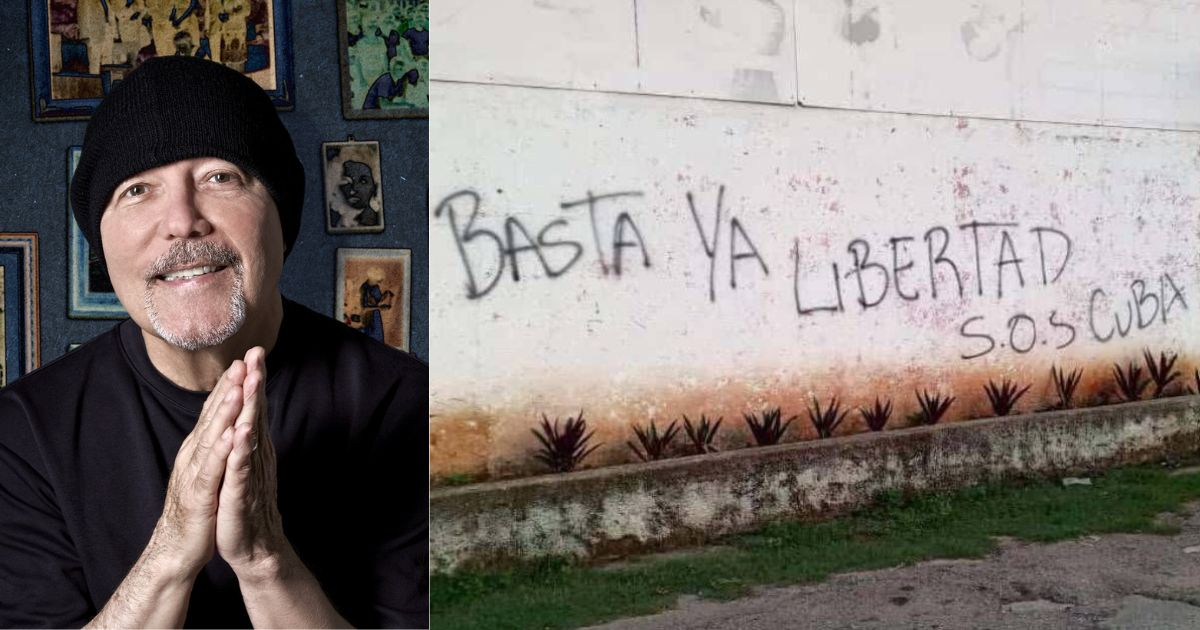
The iconic Panamanian singer-songwriter and political activist Rubén Blades published yesterday on his page "Notes from the Corner" a political analysis on Cuba in which he concludes that the dictatorship "seems finally compelled to confront its futility and relinquish the tight control and repression it has wielded over its rule for over half a century."
The trigger for reflection is the visit of the CIA director, John Ratcliffe, to Havana on May 14, an event that Blades describes as an "extraordinary political development."
Blades describes Ratcliffe's arrival as deliberately ostentatious: "He arrived on a huge airplane with the United States flag emblazoned on its fuselage, in what was obviously a premeditated display of publicity admitting and announcing a visit sanctioned by the dictatorship."
According to the artist, a Grammy award winner, the use of the CIA as a diplomatic channel follows a calculated logic: "to create pressure through intimidation, with the presence of someone who could execute an attack similar to or greater than the one carried out in Caracas," while simultaneously politically shielding Secretary of State Marco Rubio, who, had he negotiated directly, would have faced accusations of betrayal from the exile community in Florida.
Blades draws an explicit parallel with Venezuela, suggesting that Washington may have come to an agreement with Nicolás Maduro's circle—allowing him to remain in power in exchange for oil and minerals—and proposes that a similar arrangement could be sought in Cuba: "for the CIA, it would be easier to implement an arrangement that allows the Cuban government to stay in power in exchange for preventing a massive exodus to Florida."
In that scenario, the artist warns that the group GAESA, the military oligarchy that controls a substantial part of the Cuban economy, will not yield without resistance: "they will defend their wealth and future against the arrival of American investors," and adds that its members "will be willing to negotiate with those they have traditionally referred to as 'demons' in order to preserve their power and privileges."
Blades also offers his interpretation of the formal charges filed on May 20 by the U.S. Department of Justice against Raúl Castro and five Cuban officials for the shooting down of two planes from Brothers to the Rescue in 1996, which resulted in the deaths of four Cuban Americans.
For the composer, that accusation is not an act of justice in itself, but a political maneuver: "replacing Raúl and his allies in the negotiation about the future of Cuba is the only thing that explains charging a 94-year-old individual with offenses that are over three decades old and that I doubt can be proven in a court of law."
What is being sought, according to Blades, is "the replacement of one group, the 'historicals and hardliners' of Castro, with a more pragmatic one willing to come to an agreement with 'the empire'."
The analysis occurs in the context of a multidimensional crisis in Cuba: the economy fell by approximately 5% in 2025, blackouts have been chronic since mid-2024, more than one million Cubans have emigrated since 2021, and the population is already below 10 million, according to official data; although independent specialists place the figure at less than 9 million.
Blades, who has described the Cuban government as a dictatorship on multiple occasions —including after the protests of July 11, 2021— is categorical about the exhaustion of the model: "The existential difficulties that Cuba is experiencing cannot be resolved by appealing to its people with discredited barricade speeches or ideological proposals."
Although the artist himself acknowledges that his analysis is speculative, he concludes his text with a phrase that encapsulates his intuition about the historical moment the island is experiencing: "It is being felt that something is coming, any day now."
Filed under: