
Related videos:
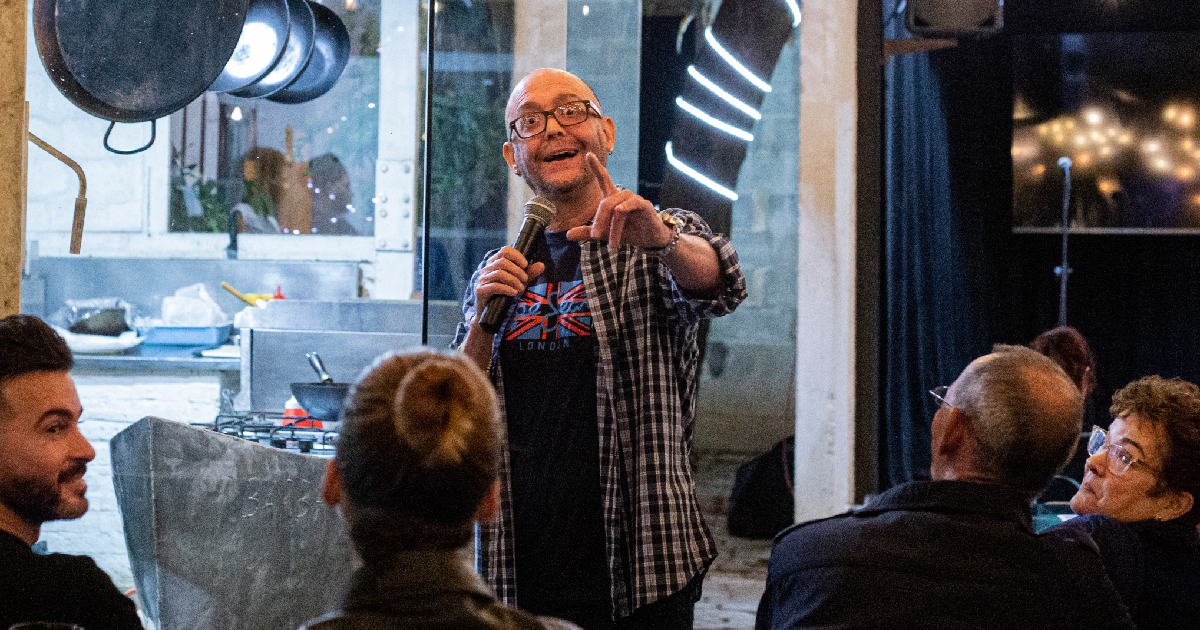
Amid laughter that stings more than it soothes, my interviewee has carved out a unique place in the Cuban scene: an actor, a comedian by profession, and a pianist by conviction, he transforms the ordinary into a spectacle and discomfort into laughter.
He calls himself "The Whip of Communals", a title that is not just a joke but a statement of principles. His humor points out, disturbs, and portrays the urban reality without embellishment, from the accumulated trash to the blackouts.
So, friends, here is my guest… ¡Rigoberto Ferrera!
It’s a great pleasure to talk with you, Rigo; it’s been a long time since we last did. Your humor blends satire and social reflection; how do you define the role of humor in times of crisis today?
Dear Julita, the pleasure is mine. I’m responding quickly. Humor in times of crisis serves as a pressure relief valve. For both the audience and the performer.
It's that moment… that moment on stage where one can make people laugh! It's that very moment when you are doing what you love and enjoy, which is entertaining and making people laugh. In that precise moment, the audience and the performer connect, and even the worst crises can be forgotten during an hour of show.
What are you doing today? Did you turn off the TV?
Indeed, at a certain point I decided not to do television anymore, but people recognize me on the street because of social media, not because of television, especially the new generations.
If I had to label what I'm doing right now, I think that since COVID, when many of us had to reinvent ourselves, I am engaging in my humor as a necessity to resist, but always employing beauty.
By the way, I want to share that for over five years now, I have graduated as my mother's caregiver (you know... pampers, bathing her, etc.). This may sound funny, but it's my reality.
Where do we draw the line between making people laugh and addressing uncomfortable realities?
Everything is reportable, everything that is done wrong, everything that affects a community must be reported. In my case, I believe I have always thought that all kinds of critical reports should be made with... they should be made with humor! It's the best way to reach the authorities, right? And it's the best way for that report to reach the community.
You call yourself "The Whip of the Communal," where does that name come from and what exactly did you want to convey when you started using it on social media?
"The whip of the community" was coined by Carlitos Gonzalvo, and it comes as a result of all the videos I started making to denounce the amount of trash that isn't picked up. It's a way to trademark a style, in a humorous manner, to get them to collect what needs to be collected.
You live with atopic dermatitis; how does this condition impact your life on stage? What goes through your mind when you perform knowing that you could end up hospitalized?
In the case of atopic dermatitis, a very complicated condition, it is inherited and must be addressed from multiple factors. There are few doctors here who fully understand this disease; in fact, I received very poor treatment since childhood. I was overwhelmed with corticosteroids and creams. Everyone had a different opinion: it should be treated by an allergist, a dermatologist, an immunologist, a psychologist...
So, on top of all this, add that Cuba is harmful to you; Cuba is harmful because there is an environmental crisis, there is a lot of dust, and a lot of dirt in the streets. The tropical climate, the humidity of the tropics, harms me; therefore, to achieve a balance with this illness, one should wear linen or cotton clothing and avoid sun exposure.
My parents knew very little about the illness at that time, and diet is very important. Here, following a diet is impossible, even though I was involved in an institute practicing a macrobiotic diet for a long time, and it didn't help me.
To improve, I would need a climate that is not humid, a proper diet, and continued care from specialists.
Let me explain that there was only one specialist who truly understood my illness; when I was 30, Dr. Leopoldina came into my life, and I continued my treatment with her until her passing three years ago. She designed a macrobiotic diet for me, and I underwent hyperbaric chamber sessions, among other treatments.
I imagine that this condition hasn’t been good for you with your sport, karate.
Not good. When I practiced karate and competed, it was very complicated because it caused a lot of itching in the early morning; changes in the weather make you itch a lot. You can't sleep well, and when you have to face a team match against people who weigh more than you and are much bigger, not having slept always takes its toll.
The incorrect diagnosis with corticosteroids also affected me because at times I had a slightly low competitive level, but suddenly, when I was taking prednisone and sleeping better, I felt much better in my skin, it gave me euphoria and made me feel more confident in competitions.
Later, when I started my acting career, it was intense! The heat, the theaters, the travel movements; all of that aggravates atopic dermatitis, which is a condition that doesn't kill but is very frustrating, and in my case, I've been hospitalized about three or four times. That's why I try to stay as calm as possible here at home.
Returning to sports: by the age of 16, I was already a black belt and then I trained in kickboxing with Master Mandy Quintana.
Indeed, they are teachers you never forget, both in sports and in humor and music...
First, in karate, I have been fortunate to have great teachers since I started practicing the sport at the age of 11: Jorge Manuel Querol Catalá, Roberto Vargas Lee, Master Raúl Rizo, Nubia Obregado, Isabel Rodríguez, the master's daughter, and thanks to them, I was able to position myself within the karate do community in Cuba and be part of the youth team of the ESPA directed by Nubia Obregado.
Later on, I left sports and enrolled in the Higher Institute of Art, ISA, where I received many influences: my brother Jorge Ferrera, Chaplin, Buster Keaton; Martes y Trece, the duo Faemino y Cansado (the latter two are Spanish comedians); Tricicle, Les Luthiers, and others thereafter.
And well, Cuban comedians, of course: La Seña del Humor from Matanzas, the Salamanca group, the Nos y Otros group, La Leña del Humor from Santa Clara...
In relation to music, I have also had great teachers and people who have influenced me, such as Bobby Carcassés, Robertico Carcassés from the group Interactivo, and my piano teacher, María Matilde Alea, who gave me my first lessons in 1997.
I picked up the piano again in 2012 when I began studying piano and music theory with my music theory teacher, Olga Oria, the mother of Pedrito Fajardo, the violinist from Los Van Van.
I want to tell you, Julita, that for me music holds a paramount place, a central place in my life, even above humor, becoming a daily motivation that accompanies me during long hours of work.
I would like the audience to appreciate Cuban music in all its dimensions, even though it is a challenging goal. That's why I try to bring it closer from the stage, incorporating it into my humorous performances. For decades, I have been singing live and using the piano as an expressive resource.
How do you build your character on stage?
The part of real characters that I bring to life comes more from observation and exaggeration of the everyday. It's been a while since I stopped interpreting characters and now I interpret myself. And all, almost all, arise from, well, observation—the exaggeration of everyday life, which is a constant for a character to be humorous, one of the many tips for making characters funny, right? And characters also emerge from fantasy. But reality is the foundation, the observation of reality.
As a person from Havana who lives what they share, have you ever had to laugh at something that actually hurt you deeply?
As a person from Havana, I find myself constantly laughing in the face of a reality that hurts. If I don't approach it this way, I might as well perish, and one of the realities that pains me the most is the trash everywhere. I laugh about it, and at the same time, I denounce it.
What’s interesting about this is that many people tell me, "Hey, but you get paid for that, you earn from likes," and you know what? That’s the most hurtful thing anyone has said to me. "You’re just in it for the likes, or the empire is paying you," I’ve even been told that, and I don’t earn a single cent from my social media. They are designed to promote what I do, but I don’t charge a dime for anything.
To what extent should an artist take a public stance on social and political issues?
An artist, well, the term artist is very broad; there are people who consider themselves artists who are not, and there are others who are artists but do not see themselves that way. I believe that one, as a human being, must define themselves. Everyone working in culture knows what is just and what is unjust, and they have the ability to choose.
I have always chosen to stand by those who suffer the most, which is the people. And I owe my loyalty to them. All those who follow me on social media, which is almost everyone outside of Cuba, do so because I believe I have maintained a consistent stance regarding what is happening and have tried by all means to take action.
Doing is the best way to express oneself, and one cannot float through life like a cork, hiding behind a cultural entity to define or have the power to shape someone’s future. And I will continue… I will keep going until the seawall dries up!
What changes in your mood when you move from the physical stage to the digital stage of social media? Do you feel that you are more direct or more free on social media than on stage?
On social media, I feel completely free. I have faced significant clashes across the country regarding censorship; major confrontations. I have always tried to be consistent with what I do; on social media, of course, the message reaches more directly, and I have the opportunity to experiment with microphones, camera angles, or in the streets. In the streets, you have to react to everything. It’s similar to performing a solo show.
What has been the most unexpected reaction you've received on social media for your critical content?
I have been fortunate on social media to have few critics, and I delete any comments that show disrespect and block the person who made them. Anyone who makes a disrespectful comment and doesn’t even have a photo on their profile, or claims to have a restricted profile, is almost always a troll.
In my social media, I try to maintain a respectful and responsible approach; not for any gossip, but rather to promote what I do.
Do you think that humor remains a space of freedom, or is it constrained by fear?
Humor is a space of freedom like jazz and cannot be constrained by fear, although sometimes circumstances dictate otherwise. To live happily is to live without fear; that is not a phrase of mine, but I share it, and woe to anyone who makes humor while being conditioned by fear!
Amidst all the daily hardships, what continues to seem beautiful or worthy of being saved in Cuban daily life?
Amidst so much daily hardship, I believe the memory should be preserved; especially cultural memory, which has been fading for many years, has been mistreated, and a country without culture reflects what it ultimately becomes.
Great figures of Cuban humor, such as Consuelito Vidal, used humor as a form of criticism. Do you think that humor continues to be an effective way to question?
Humor is certainly an effective way to question reality. Just consider how it is an effective way to question and exorcise ills that, even if they are not your own, hurt you because it is the place, the country where one lives.
Great humorists like Consuelito, Enrique Arredondo, and many others criticized the government of Fulgencio Batista, as there have always been prominent artists in this country who have coherently and beautifully critiqued reality.
But, in terms of television comedy, many years ago, since I started doing comedy on television, it was almost impossible to do, and it continues to be impossible to do at this moment. There isn't a single humor show on television and comedians have had to turn to social media.
How can we sustain artistic creation if art is silenced?
Artistic creation, amid scarcity and difficulties in Cuba, can only be sustained by maintaining passion, because one must first have guaranteed bread, and only then can art come.
So that is what keeps me going, passion and hope, and always being grateful that I am not missing an arm or a leg, because when I look at the Paralympians and see all those athletes who have had to overcome obstacles; that’s when my spirit truly lifts and I forget my complaints. You really stop complaining when you look at the Paralympians.
And so, amid blackouts, rubble turned into jokes, and truths spoken with a smile, we bid farewell to Rigoberto Ferrera, a man who has made humor a form of resistance and also of hope. Because, as he states: "Doing is the best way to say," and perhaps that's why his stories resonate so deeply: because they come from the street, from the neighborhood, from the reality that many live every day.
So as he himself tells us: "Until next time, friends."
Filed under: