
Related videos:
The Food Monitor Program (FMP), an independent organization monitoring food safety in Cuba, recently published a column documenting how state inspectors and police agents have turned access to food into a tool of social control, pressure, and personal gain on the island.
The report, titled "The Flip Side of the Law: Injustices in Times of Hunger,"指出 the issue lies not only in systemic scarcity but also in the way certain officials intervene discretionarily in the circuits of food access and distribution.
"In a country where de facto practices carry more weight than formal laws, control over food — already limited by the crisis itself — becomes an instrument of pressure and, in some cases, personal gain," the organization warns.
The scope of the operations is revealing: according to official figures presented by the National Assembly in July 2025, there had been 1,066,435 inspections for price control, with 675,783 violations detected, 661,653 fines issued, over 2.177 billion pesos collected, 8,430 closures of establishments, and 2,432 confiscations.
However, the FMP emphasizes that these figures do not reflect an equal application of the law: "If these penalties were equal and based on a consensual legal framework, then it would be fine, but that is not the case."
A report from the Cuban Institute for Freedom of Expression and the Press (ICLEP) during the same period documented that workers and merchants reported being forced to pay money or hand over products to avoid fines ranging from 1,500 to 15,000 pesos.
The same report mentioned a "conspiracy" between state inspectors and merchants from small and medium enterprises as well as agricultural points to evade fines, license suspensions, closures, and asset confiscations.
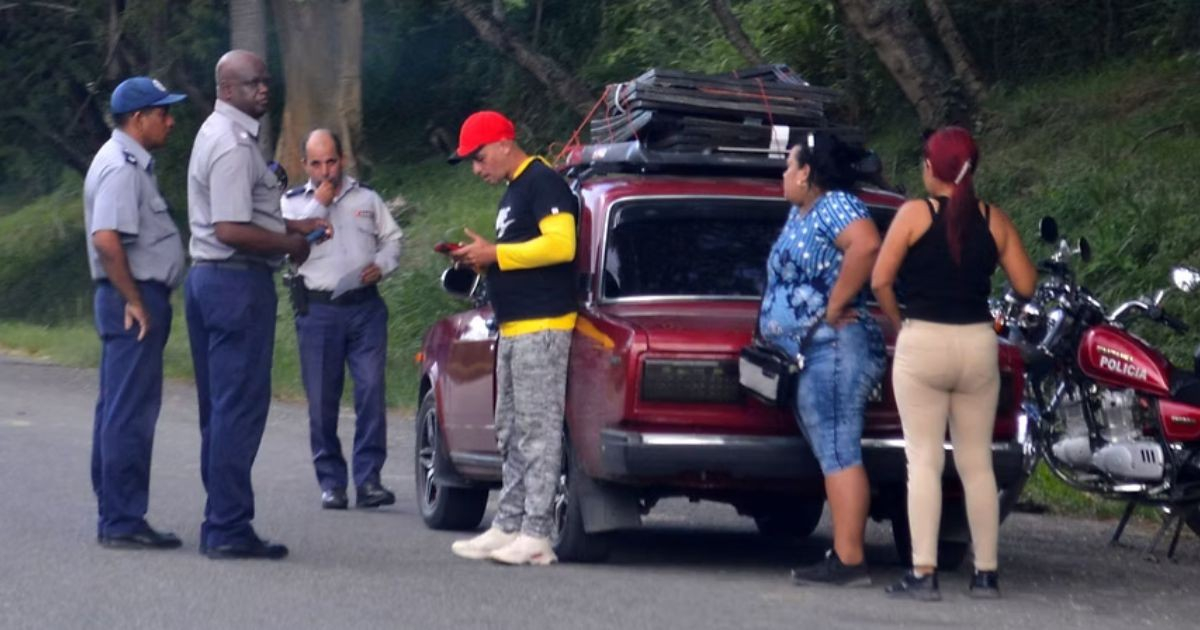
Among the most frequently documented practices by the FMP is the systematic inspection of vehicles across municipalities, where agents immediately confiscate essential products such as rice, beans, meat, milk, or domestic fuel, even in minimal quantities, without clear criteria for proportionality or mechanisms for appeal.
The operations have left concrete traces in several provinces: in Granma, inspectors issued fines ranging from 16,000 to 72,000 pesos for selling chicken or operating without a license; in Santiago de Cuba, fines, confiscations, and license suspensions were reported due to irregularities involving oil, chicken, powdered milk, and spaghetti; and in Villa Clara, the police seized 25 gas cylinders from a residence during a national exercise against "illegalities."
The report also notes that patrols monitor the areas around stores that operate in foreign currency to prevent the informal acquisition of foreign exchange, further restricting access to food available only in those circuits.
Many of those affected are, according to the FMP, small traders operating under subsistence conditions: "These complementary activities —reselling bread, flour, sweets, or home food production— do not follow a logic of accumulation, but rather of survival and precariousness."
The organization concludes that these practices create "a scenario where food, far from being guaranteed as a basic right, is subject to dynamics of control, arbitrariness, and informal negotiation," and characterizes the situation as "a chronic institutional deficit" that demands urgent mechanisms for supervision and accountability.
The deterioration of access to food in Cuba is ongoing: the 2025 National Food Security Survey by FMP found that 33.9% of households had at least one member who went to bed hungry in the last 30 days, compared to the 24.6% recorded in 2024.
Filed under: