
Related videos:
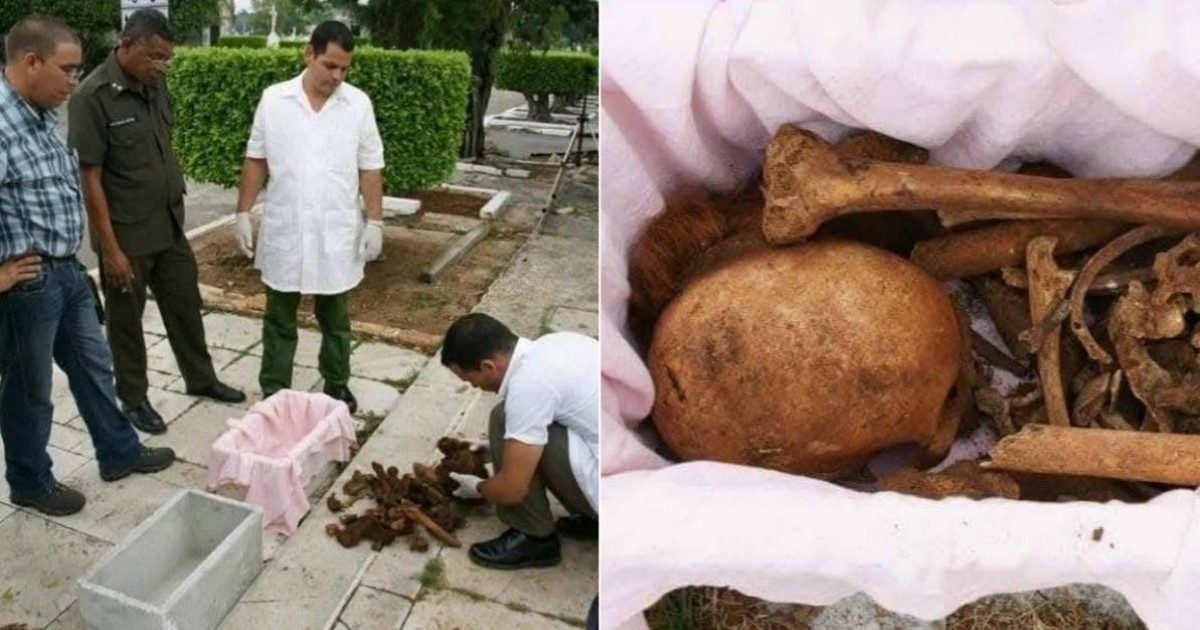
The publication of photographs showing the skeletal remains of José Francisco Martí Zayas Bazán (El Ismaelillo), son of the national hero José Martí, laid to rest in the ground of Colón Cemetery has sparked a wave of outrage on social media.
The images correspond to a forensic exhumation carried out in the Bances Martí family mausoleum, where the remains of the son of the Apostle are laid to rest.
According to a revelation by user Juan Antonio Balboa on Facebook, the goal was to determine the origin of a lock of hair preserved in a reliquary at the Museum of Goldsmithing in Havana, to clarify whether it belonged to José Martí or his son.
The team, consisting of a forensic anthropologist from the Provincial Legal Medicine Service of Matanzas, two dentists, five physicians, and a criminal expert, determined that the remains belonged to a man between 1.66 and 1.68 meters tall and approximately 66 years old, data that matched the historical records of El Ismaelillo.
Through the technique of cranio-photographic superposition and genetic analysis of hair, bones, and teeth, it was confirmed that the lock of hair in the locket belonged to the son and not the father.
However, the way the procedure was carried out generated widespread rejection.
The dissident Cuban writer Ángel Santiesteban-Prats was one of the first to raise his voice, publicly questioning the treatment of the remains: “How is it possible that in the published photos the remains of the child of the most important person ever born in the Cuban archipelago are found lying on a sidewalk in the public thoroughfare within the cemetery? Was there no appropriate place, a table where his remains could be laid to rest, without having to expose them to such a humiliating situation?”
Santiesteban-Prats recalled that El Ismaelillo fought in the War of Independence under the command of General Calixto García, earned the rank of captain through his own merit, rose to the position of colonel and chief of staff of the Army in the Republic, and received the Grand Cross of Naval Merit with a white insignia in 1921.
The comments from internet users on Santiesteban-Prats' post reflected an indignation that went beyond the name of the deceased. "Respect for everything has been lost, including something as sacred as the remains of a human being, especially those of Ismaelillo," wrote one user.
Another questioned the very logic of the procedure: "I cannot understand what urgent need there is to carry out this exhumation to explain the historical significance of Ismaelillo, when his real name isn't even taught in schools. I find the treatment very undignified, completely lacking in ethics and respect. That is not science."
Several also pointed out the scientific dimension of the problem. "Any scientific act of this nature is conducted under appropriate conditions, regardless of whether someone has spat there, a dog has passed by, or simply the feet of those who come to the cemetery," noted another internet user.
A user summarized the feelings of many: "If there is no respect for the living in Cuba, what can we expect for those who no longer walk among us?" Another was more direct: "On the ground, like those of a dog."
A third party described the procedure as desecration, stating that "Fidel and his Revolution cared little about El Ismaelillo, and now they come with the story of scientific investigation."
"If they do that to him... what is left for the others?" concluded another internet user, summarizing the distrust of many Cubans towards the institutions that organized the procedure.
The Colón Cemetery has been the site of numerous complaints: in February 2024, workers were reported handling skeletal remains without gloves, and that same month, a trench filled with human bones was discovered exposed.
In May of this year, a family reported the disappearance of remains in a mausoleum in the same cemetery.
Filed under: