
Related videos:
The National Revolutionary Police (PNR) arrested a man in Santiago de Cuba accused of offering cash in exchange for bank transfers with a 20% interest in his favor, according to the official profile Héroes del Moncada on Facebook, linked to the Ministry of the Interior (MININT) in that province.
The arrest took place near the ATM located at Avenida Garzón and Calle 3 de Santa Bárbara, and was witnessed by several people passing through the area.
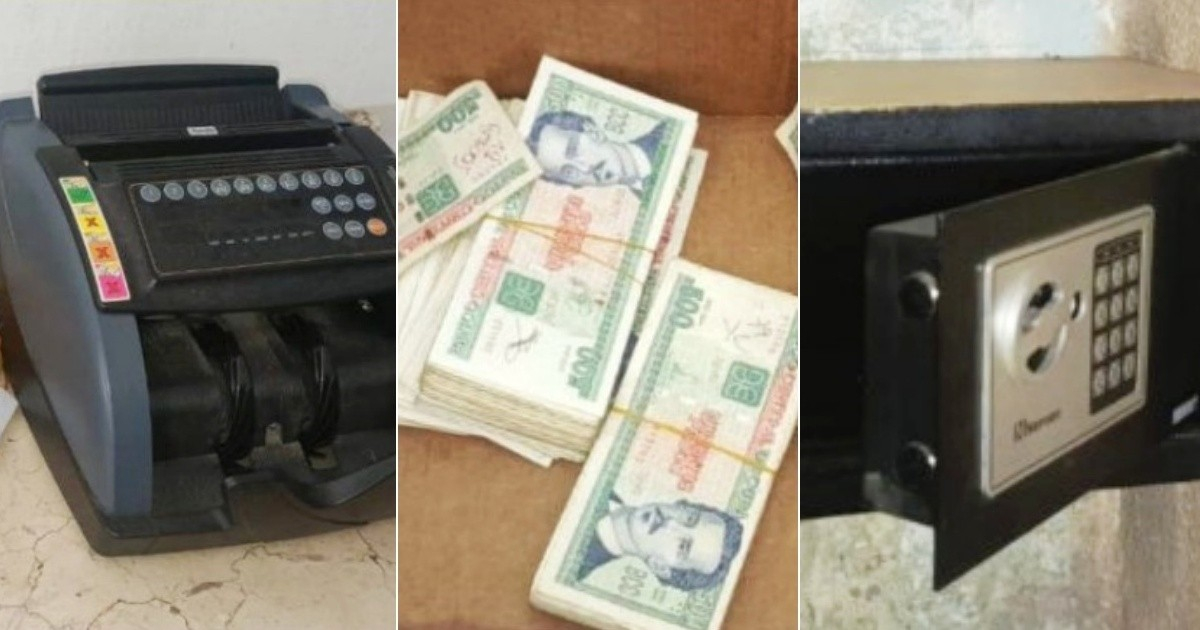
After a house search, the agents seized approximately 380,000 Cuban pesos (CUP) and items that were used to carry out the activity.
The MININT publication in Santiago de Cuba frames the arrest as a successful operation against "criminal" activities.
However, the public's reaction in the comments on the official publication dismantled that narrative with force.
Most commentators do not see the detainee as a criminal, but rather as someone who meets a need that the State is unable to fulfill.
What Cubans say: the real culprit is the system
The most notable comments point directly to the structural crisis of the Cuban financial system as the real cause of the phenomenon.
"They took the instrument; the big fish is inside the bank," wrote a user, in what became one of the most repeated phrases.
"The question is: where was he getting the cash from if there is no money in the banks?" another commentator raised, pointing out the central contradiction of the case.
"They caught the one who was solving a problem that the bank is unable to resolve," summarized a third party.
Several users pointed directly to the complicity of bank employees: "What they should investigate is the bank workers who facilitate the cash" and "The real business is within the banks; everyone knows where the money comes from."
Others warned that the arrest will change nothing: "Now they've caught the one from the 20%, but on the street, they're already charging between 30% and 50%" and "The measure doesn't solve the problem; it just removes one person and another will take their place."
The most direct criticism of the regime was expressed in this comment: "The government creates the conditions for these businesses to arise and then punishes those who take advantage of them."
The cash crisis that explains everything
The case cannot be understood without the context of the forced banking imposed by the Central Bank of Cuba through Resolution 111 in August 2023, which restricted the use of cash for businesses and pushed transactions towards digital platforms such as Transfermóvil and Enzona.
The outcome was the opposite of what was promised: empty ATMs, long lines starting at dawn, and withdrawals limited to minimum amounts that are insufficient for basic expenses. The government itself admitted that the ATM network could not meet the demand due to a lack of parts and replacements.
In June 2024, Díaz-Canel blamed the private sector for the cash shortage, attributing it to a supposed "extraction effect" from the banks.
In November 2025, Granma acknowledged that MININT had over a hundred ongoing investigations into the retention, accumulation, and illegal resale of cash, with cases involving hundreds of millions of pesos.
In Santiago de Cuba, the Provincial People’s Tribunal sentenced three individuals for embezzling state funds and forging banking documents in April 2026, with sentences of up to 15 years, confirming that corruption within the state financial system is not just a public perception.
A detention that resolves nothing
Many businesses in Cuba still do not accept transfers, forcing retirees, workers, and families to seek cash in the informal market at any price.
"Retirees and workers are the most affected because they receive payment on a card and then cannot access their money," noted a commentator.
The conclusion that is commonly echoed among Cubans is as simple as it is striking: "The activity exists because there is a real need; if the system worked, no one would pay a percentage for their money."
Filed under: