
Related videos:
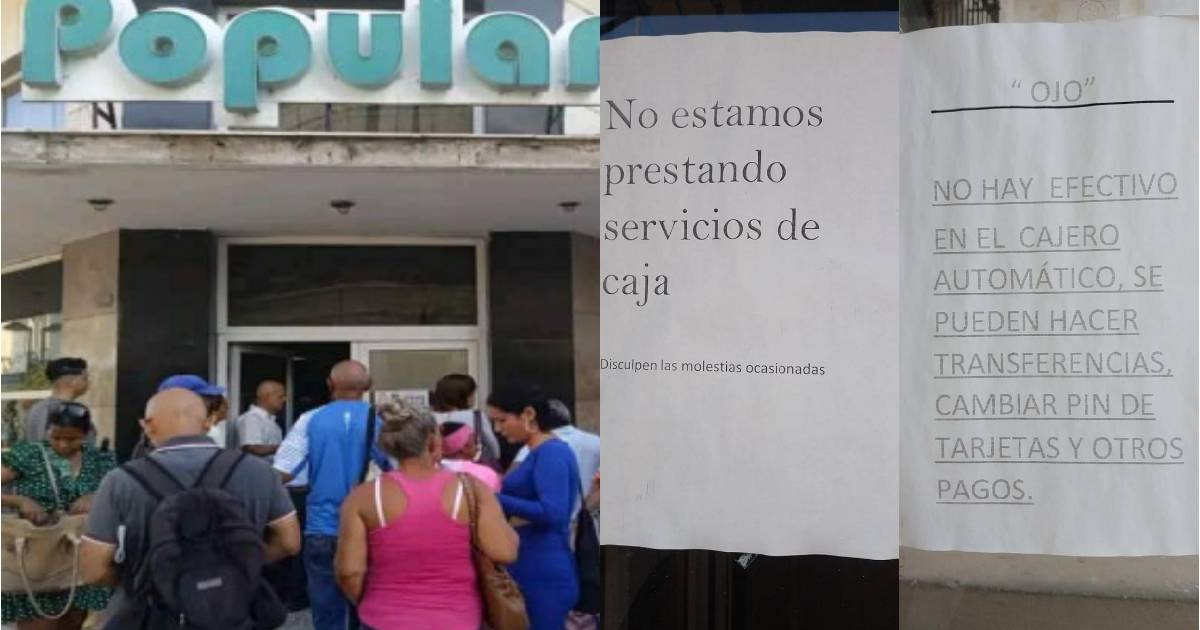
Citizens and self-employed workers in Cienfuegos reported a series of issues with the banking process on Friday, including a shortage of cash, nonexistent mobile coverage, and a structural trap that drives small businesses to bankruptcy if they operate solely through digital means.
The complaints arose during the fourth broadcast of 2026 of the program Aquí el pueblo, from the station Radio Ciudad del Mar, dedicated entirely to the banking process in the province, reported the provincial newspaper 5 de Septiembre.
The meeting was moderated by Armando Carranza Valladares, first secretary of the Communist Party in Cienfuegos, and the governor Yolexis Rodríguez Armada, with participation from officials of the Popular Savings Bank and the Credit and Commerce Bank (Bandec).
Anay Terry Tejeda, institutional communicator for Bandec in Cienfuegos, acknowledged that the funds allocated to branches are "limited at the provincial level," a situation exacerbated by the failure of state enterprises and self-employed workers to make the mandatory deposits required by Law 111 of 2003.
The so-called "extra box," a mechanism set up to withdraw cash at retail locations, received harsh criticism due to the almost nonexistent amount of cash available at the designated points.
A listener who identified herself as the owner of a small business highlighted the central contradiction of the system. "It's not that we don't want to accept transfers or tax payments, but when it comes time to buy those products from the small and medium-sized enterprises, they don't accept transfers of any kind, not even five thousand pesos, as stated in Resolution 93. When you conduct all your sales through that channel, the numbers just don't add up and you end up going bankrupt," she argued.
The same citizen pointed out that large private companies "can afford to purchase large quantities at Mariel," while local businesses are caught between the obligation to charge digitally and the inability to buy their supplies through that same means.
The cash shortage is compounded by a connectivity crisis that paralyzes banking operations in the municipalities of the interior of the province.
Miguel A. Granados Rodríguez, head of the Operations Department of the Territorial Division of the state-owned and sole Telecommunications Company of Cuba S.A. (Etecsa) in Cienfuegos, admitted that many municipal radio bases were left without fuel backup.
"Many times, the population does not have coverage or connectivity even when there is electrical power, because there are points that depend on others to function," he explained.
As a temporary measure, Etecsa installed photovoltaic systems at nine locations in the province—eight donated systems with 7 kilowatts of battery capacity, and one with 3.6 kilowatts in the Nuclear City—however, the official himself acknowledged that these systems do not have the capacity needed to support the full operation of the radio bases.
Landline telephone service is, in practice, the only means of connectivity that keeps banks operational in the province.
Listeners also reported noncompliance with the established banking hours, from 8:30 a.m. to 3:00 p.m., even in branches that are already equipped with solar panels.
The chaos in Cienfuegos is not an isolated incident. In January, the province deployed police to organize queues at the banks due to the collapse of services for retirees.
Days ago, it was reported that there were pushing incidents at a branch in Havana del Este during a queue to withdraw cash, while elderly people were sleeping at the entrance of a bank in Camagüey waiting to collect their pensions.
Cuba has more than 1.7 million retirees who depend on a collapsed banking system, and the official press acknowledged this month that "cash remains the undisputed king of daily economics," with illegal surcharges of up to 20% for electronic payments that have become normalized in much of the country.
Filed under: