
Related videos:
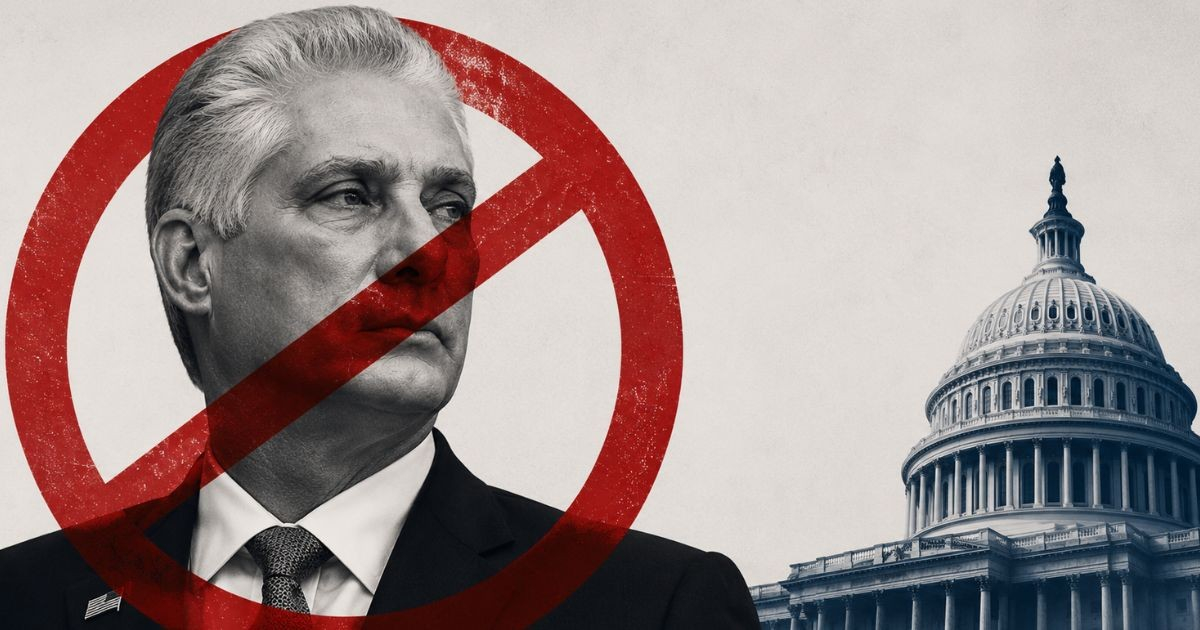
Miguel Díaz-Canel Bermúdez was finally included this Thursday in the Specially Designated Nationals list (SDN) of the U.S. Department of the Treasury, becoming the first sitting Cuban leader directly sanctioned by Washington since he came to power in 2018.
The measure, implemented by the Office of Foreign Assets Control (OFAC) under Executive Order 14404, freezes all assets of Díaz-Canel under U.S. jurisdiction and prohibits U.S. citizens, banks, and companies from conducting any transactions with him.
Inclusion on the SDN list also implies a strong international financial isolation, as numerous banking entities and companies from other countries typically avoid transactions with individuals sanctioned by OFAC to prevent exposure to secondary sanctions or restrictions within the U.S. financial system.
For many Cubans, the sanction also carries significant symbolic weight as it targets the highest political authority in the country amidst a deep economic and social crisis characterized by blackouts, shortages of food and medicine, inflation, and a decline in basic services.
The measure also reinforces the complaints about the privileges of the ruling elite in contrast to the daily struggles of the population. While millions of Cubans face shortages and a constant loss of purchasing power, Díaz-Canel and his inner circle have been criticized for maintaining a lifestyle associated with comforts, access to exclusive resources, and frequent travels, in stark contrast to the conditions experienced by most citizens.
Alongside the leader, four individuals from his closest circle were appointed: his wife, Lis Cuesta Peraza (born in Holguín on March 28, 1971); his stepson, Manuel Anido Cuesta (living in Madrid), who has acted as an informal representative for Díaz-Canel on international trips; Alejandro Castro Espín, known as "El Tuerto," son of Raúl Castro; and the son of the latter, Raúl Alejandro Castro Calis.
The inclusion of Alejandro Castro Espín carries particular political weight: he was the main Cuban negotiator in the secret talks with the Obama administration that led to the diplomatic thaw of 2015. His sanction indicates that Washington has chosen a different interlocutor for any contact with Havana.
In addition to individuals, OFAC designated five entities: the Ministry of Revolutionary Armed Forces (MINFAR), the Committees for the Defense of the Revolution (CDR), the Cuban Institute of Friendship with the Peoples (ICAP), the travel agency Amistur Cuba S.A. — linked to ICAP — and the mining company Minera La Victoria S.A., based in the Miramar Business Center in Havana.
The CDR and ICAP, two historical organizations of the regime, were founded in 1960. The former as a neighborhood watch and social control network; the latter as a platform for external influence linked to Cuban intelligence.
This is the third wave of sanctions under EO14404 in less than a month. The first, on May 7, targeted the military conglomerate GAESA and its CEO. The second, on May 18, sanctioned nine high-ranking officials as well as the Intelligence Directorate, MININT, and the National Revolutionary Police.
The Secretary of State Marco Rubio harshly justified the measures: "These sanctions target the vast and violent network of radical action of the Cuban regime and the actors who implement and finance it."
Rubio also accused Havana of serving as a "base of operations for the global irregular war against U.S. interests, recruiting, training, and equipping violent leftist militants in our region."
The day before, before Congress, the Secretary of State left the door open for a negotiated solution, although with skepticism: "There are clearly individuals within the power structure in that country who understand that what they have now is unsustainable and needs to be fixed. But do they have power? They do not."
Since January 2026, Washington's maximum pressure campaign has accumulated over 240 new sanctions against Cuba, marking the most intense offensive against the regime in decades. The designations announced this Thursday come just one day before the deadline for foreign companies to cease operations with GAESA, set for June 5.
Filed under: