
Related videos:
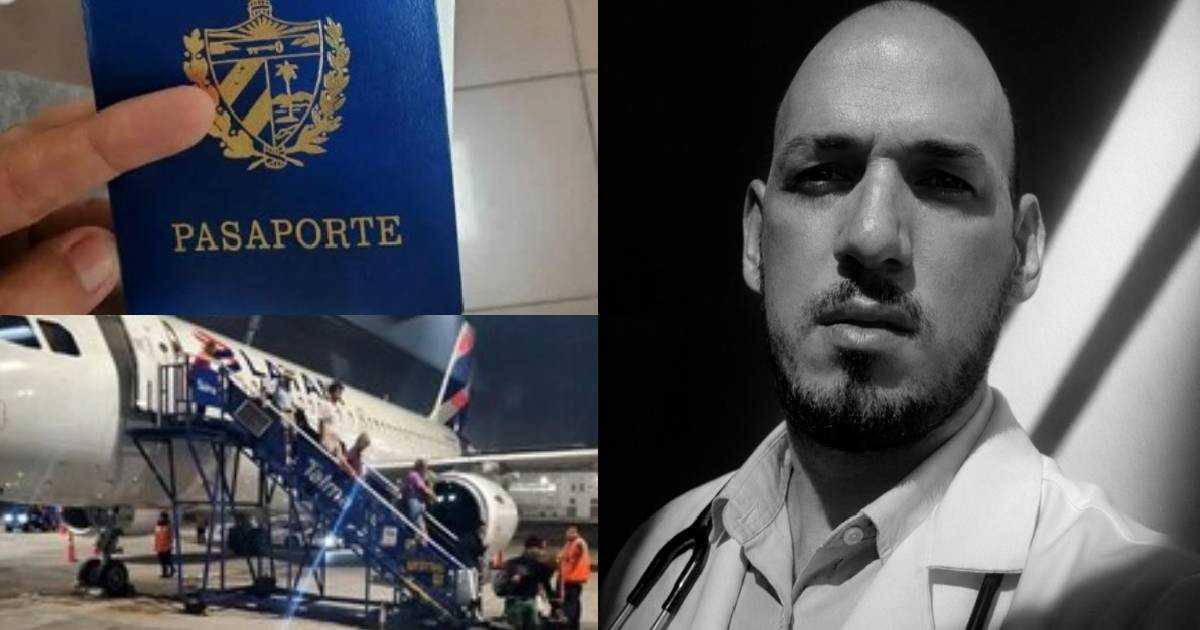
A Cuban doctor identified as Yuniel Bravo García shared this Saturday a testimony about his emigration, which took place seven months ago, in which he vividly describes the reasons that led him to leave Cuba and his family.
"I left because I felt that staying meant giving up my future," posted Yuniel on his Facebook profile, while accompanying his story with a photo collage that shows his Cuban passport and the boarding pass for the flight he took from the island to Peru.
The doctor insists that his decision was not driven by ambition or a desire for adventure. "I did not cross borders in search of wealth. I did not leave my family for the thrill of it. I did not abandon my parents, my friends, and my homeland because I wanted to," he stated.
In his post, Yuniel describes what he witnessed during years of professional practice in Cuba. "I saw hospitals lacking essential medications. I saw entire families relying on remittances sent from abroad to be able to eat. I saw highly trained professionals surviving on salaries that were insufficient to cover basic needs," he expressed.
Regarding the causes of the crisis, the doctor leaves no room for ambiguity, emphasizing that it is "a failed socialist system, that is the cause," and added that economic centralization, lack of productivity, and planning mistakes have limited the country's development for decades.
Yuniel's testimony reflects a documented reality. Between 2021 and 2024, more than 30,000 doctors emigrated from the Cuban national healthcare system, and between 2023 and 2024 alone, 5,399 professionals were lost.
In July 2025, the Minister of Public Health himself, José Ángel Portal Miranda, acknowledged before the Cuban Parliament an "unprecedented structural crisis."
The shortage of medications exacerbates the situation, as of the 395 drugs that the state-owned BioCubaFarma was supposed to supply to the system, 255 were unavailable in January 2025, resulting in a deficit of 64.56%. The availability in pharmacies barely reached 32%.
The doctor also describes the impact of blackouts, which in some provinces have exceeded 20 hours a day. "Opening the refrigerator and finding spoiled food because the electricity was gone for hours. Seeing an elderly person suffering in the heat without a fan. Watching a mother cook with charcoal. Seeing a child study by candlelight. That’s not a political theory. That is the everyday life of millions of people," he expressed.
Yuniel concluded his story with a reflection that encapsulates the struggle of a generation. "Emigrating is not about winning. Emigrating is about surviving. It's about missing birthdays, hugs, Christmases, funerals, and irreplaceable moments with the people you love. No one leaves the land where they were born without a reason," he said.
"Nations are not destroyed overnight... They deteriorate gradually, when promises replace results, when ideology becomes more important than reality, and when those who warn of the problems are ignored," the doctor concluded.
The doctor Yoelvis Estanquero Oliva, from Güines, with only three years since graduation, announced in November 2024 that he was leaving the practice of medicine due to the "degrading situation" of the healthcare system.
Today, more than 300 Cuban doctors are living in a migration limbo in the United States, and over 40 have decided to stay in Jamaica following the termination of the healthcare cooperation agreement with Havana.
Filed under: