
Related videos:
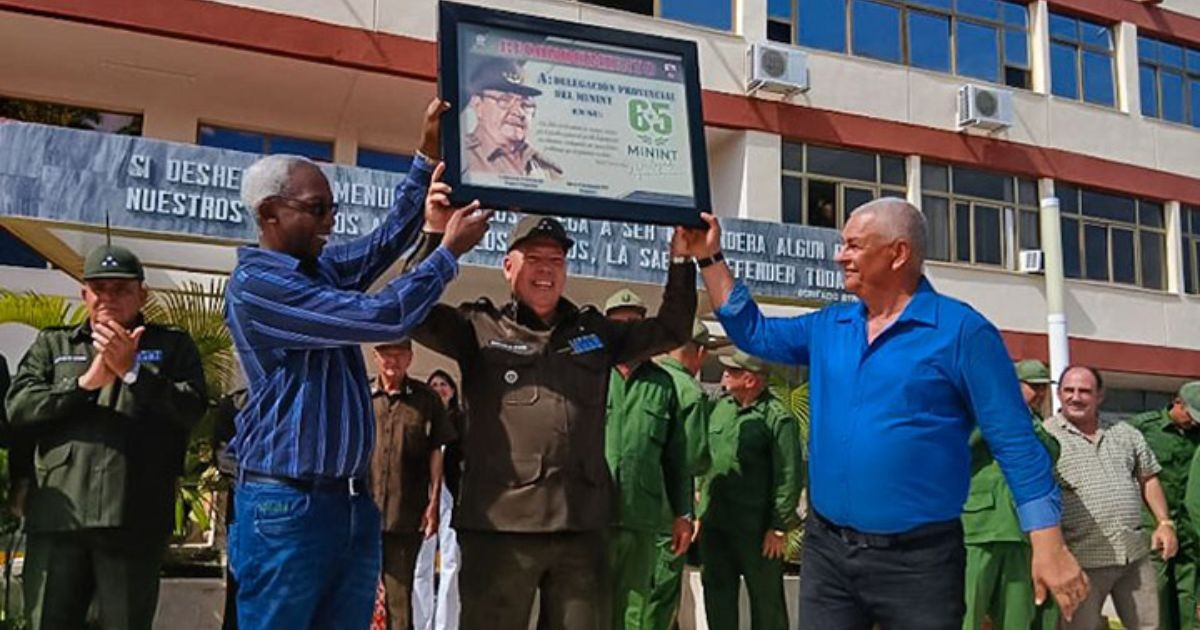
The Cuban regime celebrated this Friday the 65th anniversary of the Ministry of the Interior (MININT) with a political-cultural gala in Holguín, where it acknowledged the "distinguished service" of its officers and awarded promotions and decorations to those who, according to the official narrative, have ensured "internal order and state security."
During the event, the "65th Anniversary" recognition was awarded to agencies and specialties of the MININT in the province, along with the "Praise for Virtue" distinction to a group of members of the organization, for their achievements "in fulfilling their duty in the interest of preserving internal order and state security," as reported by the Cuban News Agency.
Several officials were promoted and awarded distinctions for Distinguished Service from MININT, as well as for 10, 15, and 20 years of dedication and loyalty, in what official propaganda described as commitment "amid adverse circumstances."
The colonel Yosbel Marañón, head of the MININT in Holguín, received tributes from the Central Workers' Union of Cuba, the Association of Revolution Combatants, the Eastern Army, the provincial government and party, as well as from other companies, for "more than six decades of uninterrupted activity for the well-being of the people." That is to say, for the violent protection of the interests of the ruling caste on the Island.
The event was attended by Major General Eugenio Armando Rabilero, head of the Eastern Army; Joel Queipo Ruíz, member of the Central Committee of the Communist Party of Cuba and first secretary in the province; and Governor Manuel Francisco Hernández Aguilera, along with other governmental, political, and military authorities from the region.
The celebrations in Holguín occurred simultaneously with a larger event in Havana, where the regime gathered the senior leaders of the MININT at the Karl Marx Theater in Miramar. CNN correspondent Patrick Oppmann documented the gathering of uniformed personnel and noted encountering "a large concentration of military officers on my morning stroll, apparently to commemorate the anniversary of the Ministry of the Interior of Cuba."
A local resident reported the waste of public resources intended to beautify the area around the theater: "The area of the theater and its surroundings is filled with trucks, cranes, and small excavators, all full of soldiers, a complete revolution," he said, adding that in the days leading up to this effort, curbs were painted, streetlights that had not worked for years were replaced, flower beds were repaired, accumulated garbage from months was collected, and palm trees were planted in front of the Central House of MININT, all in stark contrast to the widespread deterioration experienced by the Cuban population.
Roberto Morales Ojeda, a member of the Political Bureau of the Communist Party of Cuba, described the MININT as the "faithful guardian of the Revolution," with a legacy "forged in the example of Fidel and Raúl Castro." The institution was founded on June 6, 1961, by Fidel Castro with the stated goal of preserving state security, although in practice it has functioned for 65 years as the primary instrument of political repression of the dictatorship.
The celebrations take place just one day after the United States tightened its grip on the economic and military elite of the regime: on June 4, the Office of Foreign Assets Control (OFAC) formally blocked MININT under Executive Order 14404, completing the encirclement of the three pillars of the regime's power: GAESA, MININT, and the Ministry of Revolutionary Armed Forces (MINFAR). The OFAC warned that any transactions with entities in which MININT has a 50% or greater interest expose non-U.S. companies to secondary sanctions.
While the regime rewards its officials, the reality that these "guardians" oversee is devastating for the Cuban people. According to the report by Prisoners Defenders from May 2026, Cuba ended April with 1,260 political prisoners, an all-time high, of which 785 were in prison and 475 were under house arrest or other restrictions, with reports of harassment, torture, sexual assaults, and death threats within the prison system, at the hands of members of the very armed force that is celebrating its newly appointed 65 years, and to whose celebration General Raul Castro attended, making a notable public appearance after several weeks of being absent from public view.
Since May 20, the nonagenarian former dictator has been legally charged in the United States for the downing in 1996 of two civilian planes from Brothers to the Rescue, resulting in the loss of four lives.
The reality of the Cuban people —primarily the responsibility of the Castro regime and the country’s ruling elite— is one of widespread decline, marked by resource scarcity, prolonged blackouts, and crumbling infrastructure. The ostentation of resources for these celebrations stands in stark contrast to the daily hardships faced by the population.
Filed under: