
Related videos:
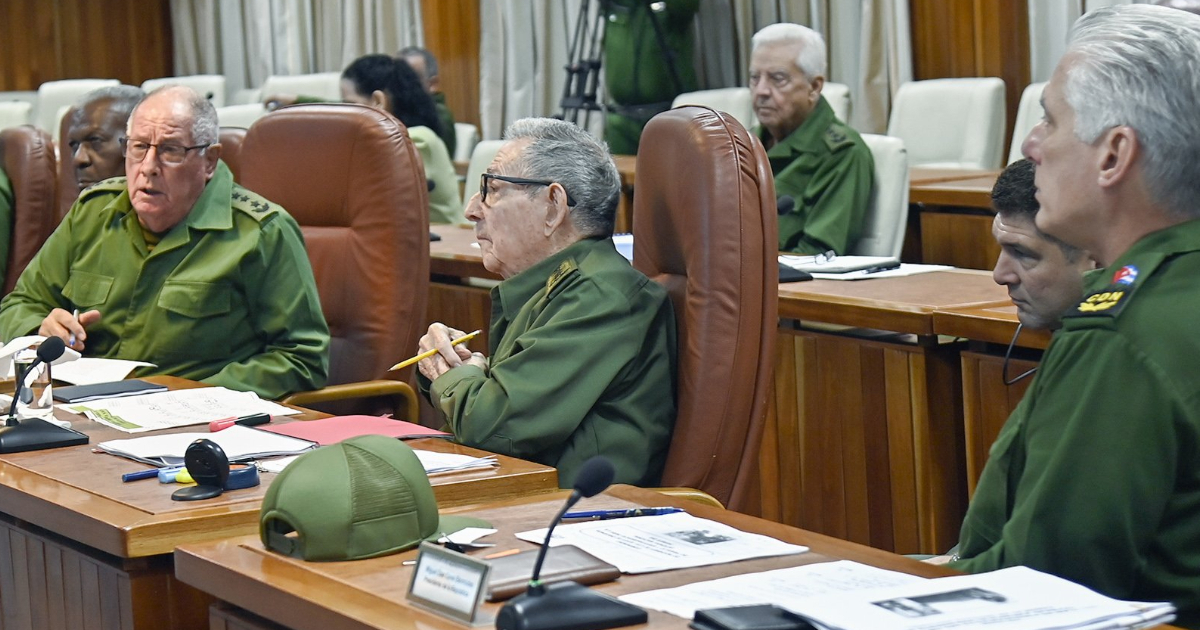
The Office of Foreign Assets Control (OFAC) expanded its sanctions against Cuba this Thursday by formally blocking the Ministry of Revolutionary Armed Forces (MINFAR) as an institution, thus completing the tightening of the noose around the three pillars of the economic and security power of the regime: GAESA, MININT, and MINFAR.
In the third wave of measures under Executive Order 14404, the OFAC added this sanction to those from the Department of the Treasury, which included president Miguel Díaz-Canel Bermúdez, several members of the regime's leadership, and key entities of the military, security, and economic apparatus of the island to the List of Specially Designated Nationals and Blocked Persons (SDN).
Alongside Díaz-Canel, his wife Lis Cuesta Peraza (born in Holguín in 1971) and her son, Manuel Anido Cuesta (born in 1994), who currently resides in Madrid, Spain, were appointed.
Also blocked were Alejandro Castro Espín, known as "El Tuerto," son of Raúl Castro and an influential figure in the Cuban intelligence apparatus, and his son Raúl Alejandro Castro Calis (born in 1995).
The inclusion of Díaz-Canel's stepson, who resides in Spain, and Castro Espín's son suggests an effort to dismantle the family network that could be used to evade sanctions from abroad.
Among the blocked entities are the Committees for the Defense of the Revolution (CDR), the Cuban Institute of Friendship with the Peoples (ICAP), the travel agency AMISTUR Cuba SA —connected to ICAP— and the mining company Minera La Victoria SA, based in the Miramar Business Center in Havana.
Meanwhile, the OFAC published the Frequently Asked Question 1258, aimed at non-U.S. persons and entities, with a global warning: "As of June 4, 2026, GAESA, MININT, and MINFAR are all blocked under Executive Order 14404."
The document specifies that the risk of secondary sanctions "extends to transactions with any entity in which GAESA, MININT, or MINFAR holds, directly or indirectly, a 50% or greater interest."
Given that GAESA controls more than 70% of Cuba's dollarized economy, including hotels, foreign currency shops, and imports, the practical impact of this measure is extraordinarily vast.
The OFAC also warns that "any non-blocked entity on the Restricted List of Cuba may become subject to future sanctions actions," which means that "individuals who engage in transactions with any entity on that list run the risk of being sanctioned by the U.S. government."
This action is part of a gradual escalation that began on May 7, when the State Department designated GAESA, and continued on May 18 with sanctions against the Cuban Intelligence Directorate.
The deadline granted to foreign companies to close operations with GAESA expired precisely this Thursday, just one day after this new round, in what seems to be a deliberate coordination to maximize the impact.
Several major international shipping companies had already halted their operations with Cuba before that deadline, anticipating the tightening of the financial blockade against the regime.
Filed under: