
Related videos:
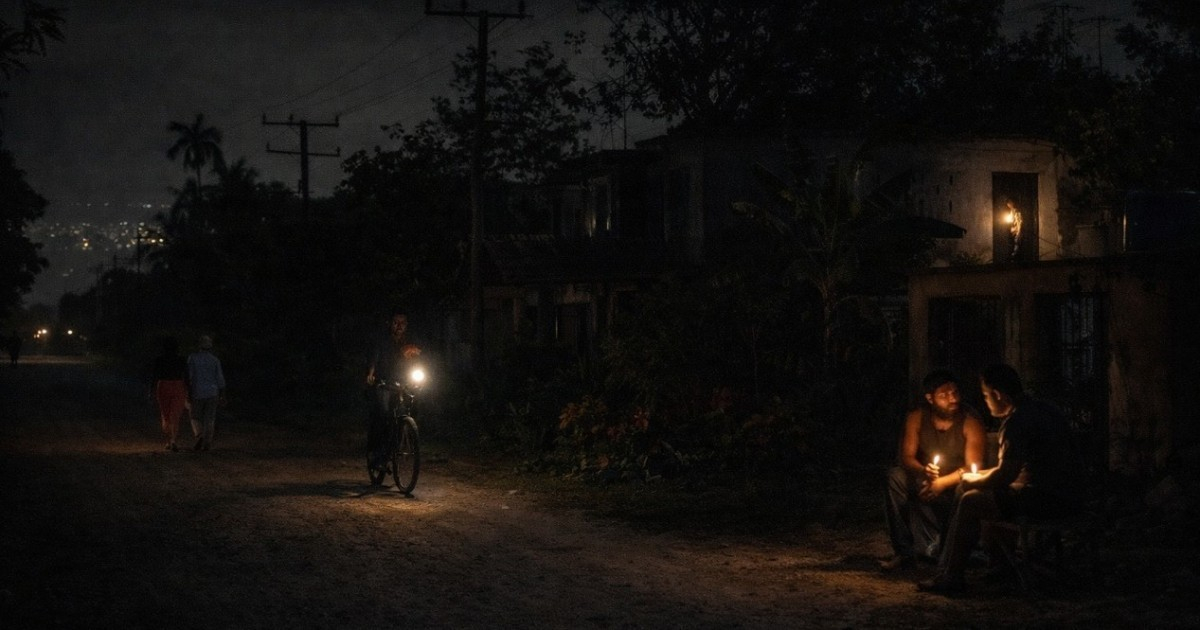
Cuba is facing a day of devastating blackouts this Saturday: the Electric Union (UNE) reported that at 6:00 am the availability of the National Electric System (SEN) was only 1,090 MW compared to a demand of 2,557 MW, leaving 1,510 MW without coverage since early morning.
The situation is worsening as the day progresses, and by midday, a reduction of 1,650 MW is anticipated.
During peak night hours, the deficit will reach 1,960 MW against a maximum demand of 3,050 MW, with an estimated impact of 1,990 MW, nearly double what the system can generate (only 1,090 MW).
Friday was equally disastrous. According to UNE itself, "the service was disrupted due to a capacity deficit throughout the 24 hours, and the disruption continued during the entire early morning hours," with a peak impact of 1,878 MW at 9:40 PM.
The causes of the collapse are multiple and structural.
Among the main incidents reported this Saturday are malfunctions at the thermoelectric plants Guiteras, Máximo Gómez, Ernesto Guevara, and Lidio Ramón Pérez, in addition to three units under maintenance at the plants in Mariel, Renté, and Nuevitas.
The most revealing data points directly to the regime's management: 106 distributed generation plants are idle due to a lack of fuel, representing 890 MW, and the total unavailable megawatts due to fuel shortages amounts to 1,203. The Patana de Regla, the Patana de Melones, the Central Fuel in Mariel, and the Central Fuel in Moa are also out of service.
The 54 photovoltaic solar parks generated 3,310 MWh on Friday, with a maximum output of 455 MW during the daytime, but their contribution is insufficient to compensate for the nighttime deficit.
In Havana, the situation is equally grave.
The Electric Company of the capital announced that service was interrupted for 24 hours. "The maximum impact was 341 MW at 9:40 PM," which required emergency circuits of 90 MW to be turned off, and it was not possible to restore the service.
At the end of the note, the six blocks and emergency circuits (277 MW) remained affected.
Citizen desperation is manifested in protests.
On Friday, residents of Regla closed Maceo Street demanding water and electricity, and the authorities responded by sending a water truck.
A few days earlier, on June 3 and 4, banging of pots and pans and demonstrations were reported in El Vedado, Centro Habana, Playa, Habana Vieja, Cayo Hueso, and San Miguel del Padrón, accompanied by police deployments in response from the regime.
In Bayamo, instead of providing solutions, the government mobilized the Association of Combatants of the Cuban Revolution to "explain" to the population the reasons for the blackouts as part of the "Neighborhood for the Homeland" movement.
The crisis this Saturday is part of a sustained decline that has set records in 2026.
On May 14, the worst deficit of the year was recorded: 2,174 MW, with only 976 MW available. The system has experienced seven total collapses in 18 months, including a nationwide blackout on March 16 that lasted 29 hours and 29 minutes.
Díaz-Canel himself admitted on May 2 that "the oil donated by Russia is running out these days," while the Minister of Energy, Vicente de la O Levy, acknowledged that Cuba operated without any fuel reserves between December 2025 and May 2026, and warned that "2026 will be a difficult year."
Filed under: