
Related videos:
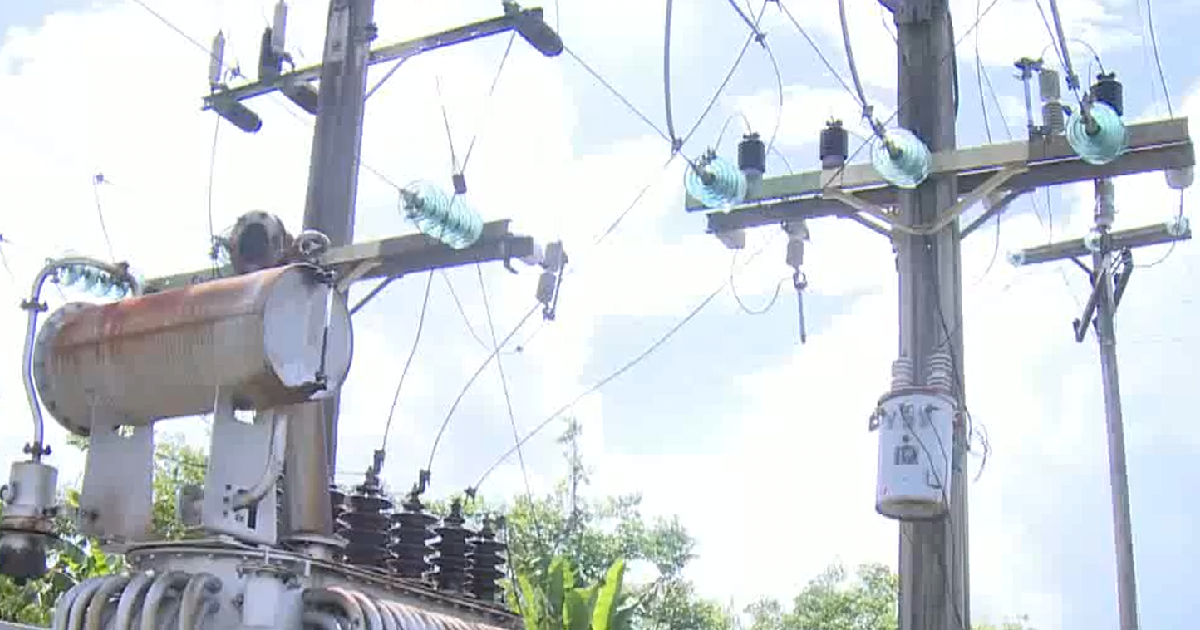
The Cuban Electric Union (UNE) acknowledged this Sunday that eight transformers are damaged in the province of Guantánamo and that there is no physical availability of equipment to repair them, which exacerbates an electrical crisis that already leaves several municipalities without electricity for up to 20 continuous hours.
The official report from the UNE for this Sunday details that the thermal unit GER experienced an unexpected shutdown at 5:47 p.m. due to a problem with the automatic pump, and it was not restored until 10:30 p.m., which exacerbated the blackouts in a province that was already facing serious difficulties.
The most affected municipalities are Imías, San Antonio del Sur, Jamal, and Maisí, all experiencing up to 20 continuous hours without electricity and at risk of reaching 30 hours of disruption.
Maisí is facing a particularly critical situation: in addition to the general generation deficit, it is experiencing a breakdown in the 33 kV line that supplies it from Baracoa.
"Technicians are investigating the failure. The official report warns that the impact could last up to 30 hours."
The distribution of the eight damaged transformers in the province is as follows: three in Baracoa, two in Maisí, two in El Salvador, and one in Manuel Tames.
The most revealing part of the statement is the one that acknowledges the impossibility of an immediate solution: "There are no physical transformers available at this time, but efforts are being made to resolve the issue as soon as possible."
This recognition is not new. Since May 30, Guantánamo has been facing the lack of a transformer bank necessary to repair the Yumurí pumping station in Baracoa, a component that was also nonexistent in the country and had to be arranged through the only transformer factory in Havana.
The shortage of transformers is a problem that extends beyond Guantánamo.
In Mayarí, Holguín, more than 400 customers were without power for almost 29 days following the theft of dielectric oil at a substation, and the solution was to transport a transformer from Havana due to a lack of equipment in the province. In Matanzas, in February, nearly 100 damaged transformers were reported.
The collapse in Guantánamo is part of a national crisis of historical proportions.
This Sunday, the Felton thermoelectric plant was taken out of the National Electric System, joining the already non-operational Antonio Guiteras plant, while 106 distributed generation plants remained out of service due to a lack of fuel.
The UNE projected a supply of only 1,060 MW for the peak demand this Sunday, against a demand of 3,050 MW, resulting in a deficit of 1,990 MW and an estimated impact of 2,020 MW.
The consequences in Guantánamo go beyond the lack of electricity. On April 9, local residents protested against power outages that left some areas with electricity for only 45 minutes to an hour a day, and the water pumping stations have been inactive for weeks, forcing authorities to plan water distribution using animal traction as a contingency measure.
The municipalities of Maisí and Baracoa have accumulated 144 and 62 reports of blackouts respectively, with an average duration of 24 hours each, according to the blackout tracking in Cuba that reflects the true extent of the crisis in the eastern part of the island.
Filed under: