
Related videos:
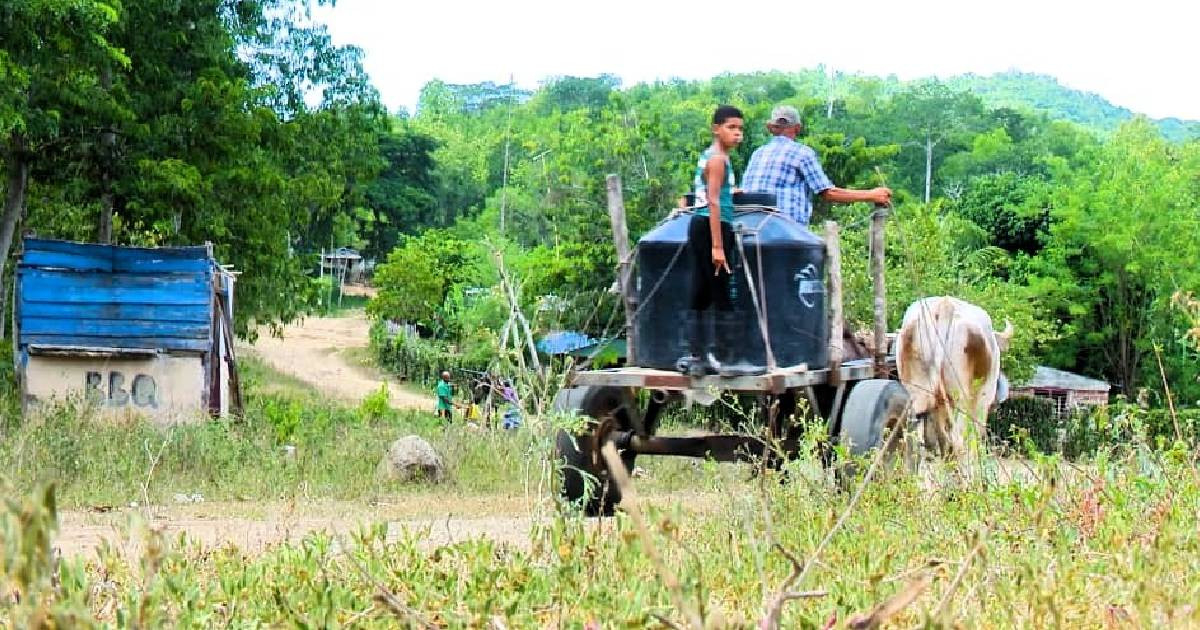
The Guantánamo Hydraulic Resources delegation is preparing the use of animal traction—horse-drawn carts—to distribute water to the population if fuel runs out completely, confirmed its provincial delegate in an interview with Radio Guantánamo published this Saturday.
Edilson Delgado Guzmán, delegate of Hydraulic Resources in the territory, explained that the province is facing a combination of fuel shortages, prolonged blackouts, and breakdowns of pumping equipment that is affecting several municipalities.
"We are experiencing technological disruptions in the municipalities of Baracoa, Imías, and Manuel Tames, which are the areas most affected," he stated.
In Baracoa, the pumping stations of Jamal, Caguina, Yumurí, and Mango Carrizal are out of operation, with the latter having two malfunctioning units.
The Yumurí station is facing a difficult problem. "It's an issue due to the 19,000 transformer bank, which the country currently does not have. Work is underway at the transformer factory in Havana to secure that transformer," the official specified.
In the municipality of Manuel Tames, Boquerón de Tames, Ciro Frías, and Héctor Infante are affected by the canal. All damaged equipment is currently in national workshops awaiting repair and transfer to the province, the source specified.
As long as fuel is available, the affected communities receive water through trucks on a rotating schedule. However, the contingency plan in case of a complete cutoff has already been established.
"We do it with alternatives: the wells that are located on-site in the places, with the deposits we have there for cisterns, and with animal traction for transporting the water service with containers, along with the points we have for water supply," explained Delgado.
In light of this situation, the delegate of Hydraulic Resources in the eastern province urged the population to conserve water and, "together, in all communities, ensure the proper use of water."
He added that it is necessary to "ensure water quality, the use of hypochlorite, and to boil water" to avoid health risks, in a context where uncontrolled drilling of makeshift wells has already led to outbreaks of hepatitis A in Matanzas.
The situation in Guantánamo is part of a water crisis affecting almost three million Cubans who do not have regular access to drinking water every day, according to recent data analyzed by the National Institute of Hydraulic Resources. The national hydraulic system is operating with only 37% of the fuel it requires.
This is not the first time the province has resorted to emergency solutions in response to the energy collapse. It was recently revealed that the crisis forced Guantánamo to distribute unpasteurized milk and to use electric tricycles for milk collection.
And in November 2025, after Hurricane Melissa, more than 180,000 residents of Guantánamo were affected by pumping failures, with over 101 communities relying on water trucks with cycles ranging from 15 to 20 days.
The collapse of fuel imports worsens the situation. In April 2026, only one ship arrived in Cuba when the country needs between eight and ten monthly. The Cuban regime acknowledged that it had run out of fuel for electricity generation on May 14.
Filed under: