
Related videos:
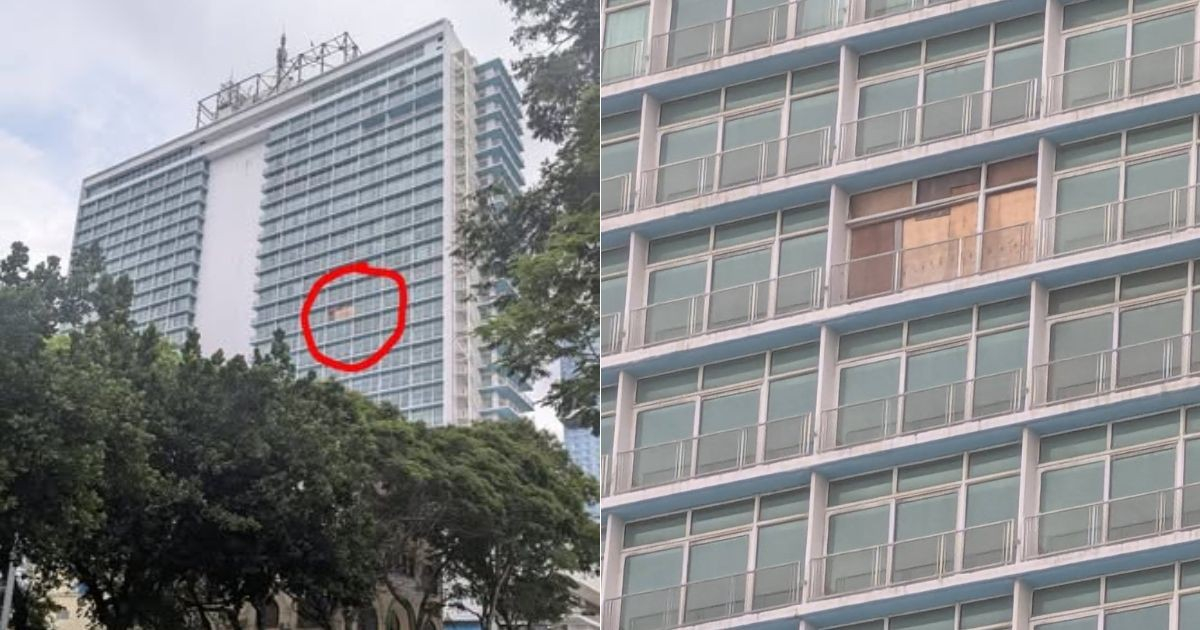
A photographer captured this week what could be the most eloquent visual summary of the state of Cuban tourism: a window of the Hotel Habana Libre, in the heart of Havana's Vedado, covered with wooden planks instead of the original glass, while the rest of the iconic blue-green facade continues to pretend that all is well.
The author of the images, Alberto Glez Delgado, posted it on Facebook with a brief text that says it all: "The solution to the 'patch'. Hotel 'Habana Libre'. When there is no glass in a room, the easiest thing is to 'cover' the hole so it isn't visible."
The brown wooden patch —seemingly plywood, with no attempt at concealment— is located approximately between the 13th and 15th floors of the 25-story tower, resembling a stain of institutional negligence on one of the most emblematic buildings in Cuba.
The historical irony is significant: the Habana Libre was inaugurated in March 1958 as the Hotel Habana Hilton, then the tallest and largest hotel in Latin America, with an investment of 24 million dollars and over 600 rooms, designed by architect Welton Becket along with Cubans Nicolás Arroyo and Gabriela Menéndez.
The revolutionary government nationalized it in June 1960 and renamed it with its current name, after it had served as Fidel Castro's headquarters in 1959. Since then, in this building, as well as in other iconic structures, the transformation of what was once a symbol of luxury has been, let's say, in the opposite direction to progress.
Internet users quickly reacted with the right mix of indignation and irony that the situation deserved. One summed it up with surgical precision: "They're incompetent, that's what they are. They charge you an arm and a leg for anything in that iconic hotel in Cuba. And now even paying for a coffee is in dollars. The rooms are a mess, customer service is terrible, everything is in decline these days. It's embarrassing." Another, with fewer words but more accuracy, attributed it to the "department of incompetence at the Ministry of Tourism."
There was no shortage of those who recalled that "Havana was Free before 1959," nor was there anyone who declared that "this would not have happened when it was called the Havana Hilton." Someone else pointed out, with prophetic resignation: "Soon it will look like a building from Old Havana." And another internet user, with dark humor, summed up the entire experience of the hotel: "If you take the stairs, you'll have a heart attack. If you take the elevator, it's another odyssey."
That last joke is backed by documented evidence. In March 2026, a guest had to walk down 22 floors because none of the elevators at the Habana Libre were working, all after paying 47,200 Cuban pesos for a two-person stay. A luxury, without a doubt.
The patch on the window is not an isolated anecdote but rather a visible symptom of a structural crisis that is rotting from within. Cuban tourism has been in freefall for four years: in the first quarter of 2026, the island received only 328,608 international tourists, a drop of 55.8% compared to the same period last year. Hotel occupancy hovers around an accumulated 21.5%, with some analyses placing it below 10% during certain periods.
The Canadian market —historically the largest— dropped from 346,109 visitors between January and April 2025 to just 125,444 during the same period in 2026, a decline of 63.8%. The Blue Diamond chain has already confirmed its exit from Cuba, and other hotel companies have followed suit. On the other hand, Germany issued a harsh travel warning against the island this week. In the face of the collapse, the regime implemented a "tourism compacting" strategy since February, closing hotels with low occupancy; in Cayo Santa María, Gaviota closed 20 hotels, affecting more than 7,000 workers.
Meanwhile, on the façade of the Habana Libre, a brown wooden plank continues to serve as a window. As an internet user summarized with unintentional philosophy: "Everything here has been like this, patching things up." And another, looking to the future with well-founded pessimism, warned: "This is how Varadero and the keys will gradually look."
Filed under: