
Related videos:
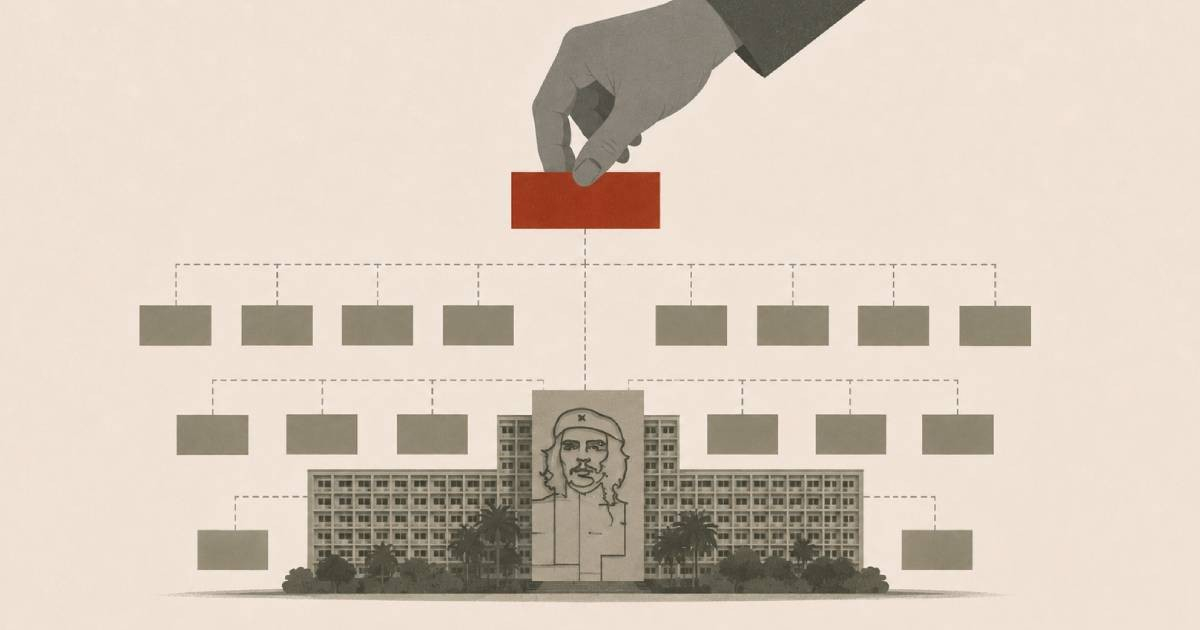
The National Assembly of People's Power published the draft law on the Organization of the Central State Administration, a 72-page document that completely redesigns the structure of the Cuban government and reduces the ministerial bodies from 27 to 20 ministries, expected to be approved in July 2026.
The document, signed by Juan Esteban Lazo Hernández as president of the Assembly and Miguel Díaz-Canel as president of the Republic, repeals Decree-Law 67 of 1983, which had governed the Cuban central administration for more than four decades, along with all its subsequent amendments.
The most striking reform is the creation of the Ministry of Agrifood, which consolidates under a single entity the entire food production chain: agriculture, the food industry, sugar and its derivatives, beverages, spirits, fishing, and the forestry sector.
According to Article 67 of the draft, this new body will be "responsible for directing and controlling state policy concerning the sustainable possession and use of agricultural and forestry land in the country, agricultural production, sugarcane, and forestry; the food industry, sugar and its derivatives, beverages and liquors, as well as fishing activities and their commercialization."
This fusion occurs while Cuba is experiencing an unprecedented food crisis. The 33.9% of Cuban households reported in 2025 that at least one person went to bed hungry, and the country imports between 70% and 80% of the food it consumes.
Another significant change is the merger of the Ministry of Economy and Planning with the Ministry of Finance and Prices into the new Ministry of Economy, Finance, and Planning, which will consolidate planning, budgeting, taxation, pricing, public credit, and insurance under a single authority.
The project also establishes the Ministry of Environment, Habitat, and Housing, which encompasses the environment, hydraulic resources, land management, urban planning, national cadastre, and housing, all under a single government structure, in a context where the housing deficit exceeds 900,000 units and cement production operated at 10% of its installed capacity in 2024.
Among the other significant changes is the establishment of the Ministry of Information and Social Communication, which elevates to ministerial status the control over media, advertising, sponsorship, and the so-called "Country Brand," thereby strengthening the institutional framework for communication control by the regime.
The Central Bank of Cuba becomes an entity of the Central State Administration directed by a Minister-President, who sits on the Council of Ministers, and the project expressly allows a vice prime minister to simultaneously hold that position.
The National Institute of Sports, Physical Education, and Recreation (INDER) is transformed into the Ministry of Sports and Recreation, while Higher Education absorbs science and technology into a new unified ministry, and industry and construction are placed under the same portfolio.
The complete list of the 20 ministries is: Agro-food, Trade and Foreign Investment, Culture, Sports and Recreation, Economy, Finance and Planning, Education, Higher Education, Science and Technology, Energy and Mines, Industries and Construction, Information and Social Communication, Communications, Justice, Environment, Habitat and Housing, Foreign Relations, Public Health, Labor and Social Security, Tourism, Revolutionary Armed Forces, Interior and Transport.
The law will come into effect 60 days after its publication in the Official Gazette, and the ministers will have up to one year to complete the transfer of human, material, and financial resources between agencies, according to the transitional provisions of the project.
Filed under: