
Related videos:
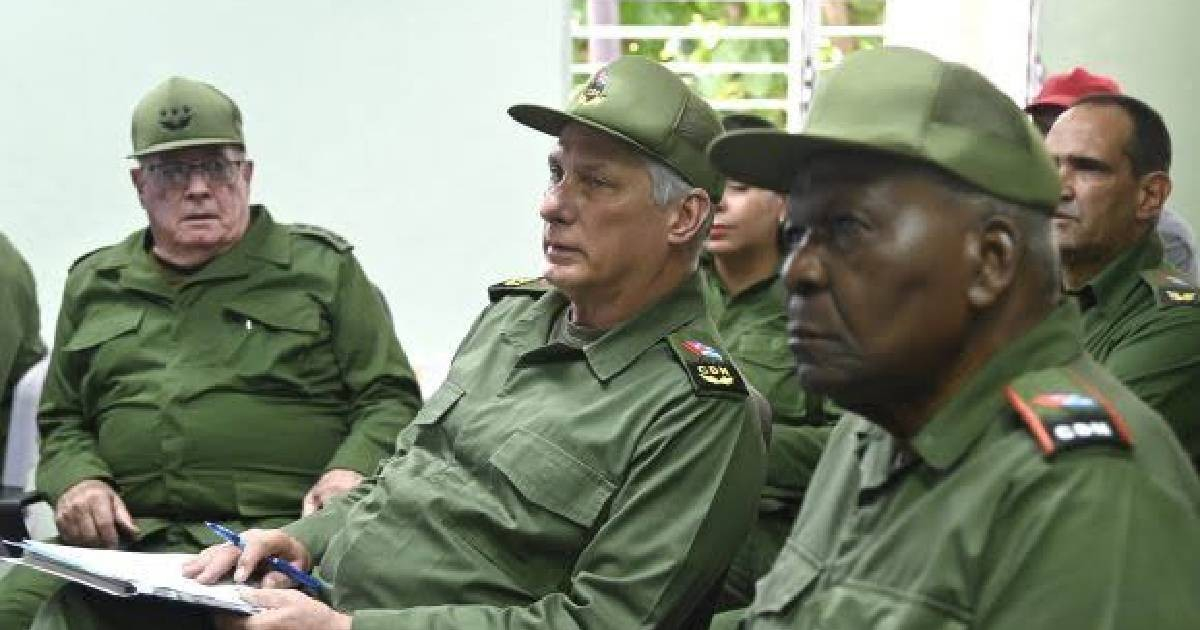
Miguel Díaz-Canel made another appearance dressed in an olive green military uniform this Friday during a visit to the "Santa Fe" Defense Zone in the Havana municipality of Playa, in the context of National Defense Day, and the images triggered a flood of mockery and criticism on social media.
Alongside him, also in uniform, were Prime Minister Manuel Marrero and General Álvaro López Miera, in what Cubans quickly described as a "disguise," a "show," and a ridiculous staging.
During the event, Díaz-Canel highlighted the area as a "benchmark" for its adaptation to the country's challenges and stated that "the historic contribution of the current generation, along with a people who resist heroically, consists of salvaging the Cuban Revolution amid the pressure exerted by the United States against the island."
The president of the Santa Fe Defense Zone, Tanelvy Bolaños Borges, explained that the area encompasses over 21,000 inhabitants and 11 districts.
Far from portraying the image of strength that the regime intended, photographs of civilian officials dressed in military uniforms in a meeting room had the opposite effect on the Cuban people.
The comments on social media included descriptors such as "clown," "puppet," and "ridiculous," while phrases like "Tick tock, your time is running out" and "Resign now" flooded the posts about the event.
The dominant tone was summarized in a widely circulated phrase: "Gringos see that photo and die laughing," reflecting the perception that the image, far from intimidating anyone, was seen as funny by both the American audience and the Cubans themselves.
It is not the first time that Díaz-Canel's military attire has provoked such reactions. In December 2025, his uniformed appearance already sparked an initial wave of sarcasm on social media, and since then, this tactic has been used with increasing frequency.
The event on Friday was the second consecutive Saturday dedicated to National Defense Day activities in Cuba, and it also coincided with the 65th anniversary of the Western Army.
The militaristic rhetoric has intensified in 2026 alongside the pressure from the Trump administration. On May 2, Díaz-Canel denounced a "dangerous and unprecedented" level of threats from Washington, and on June 4, the United States sanctioned the Committees for the Defense of the Revolution, the Cuban Institute of Friendship with the Peoples, and Díaz-Canel himself in a third wave of measures against the core of Cuban power.
The regime described those sanctions as "immoral, illegal, and criminal" and responded with increased acts of territorial military preparedness.
While the regime's leadership insists on military preparation as a response to external pressure, Cubans on social media do not hide their frustration: "They celebrate. Now that they have little time left," wrote one of the hundreds of users who commented on the images of the event.
Filed under: