
Related videos:
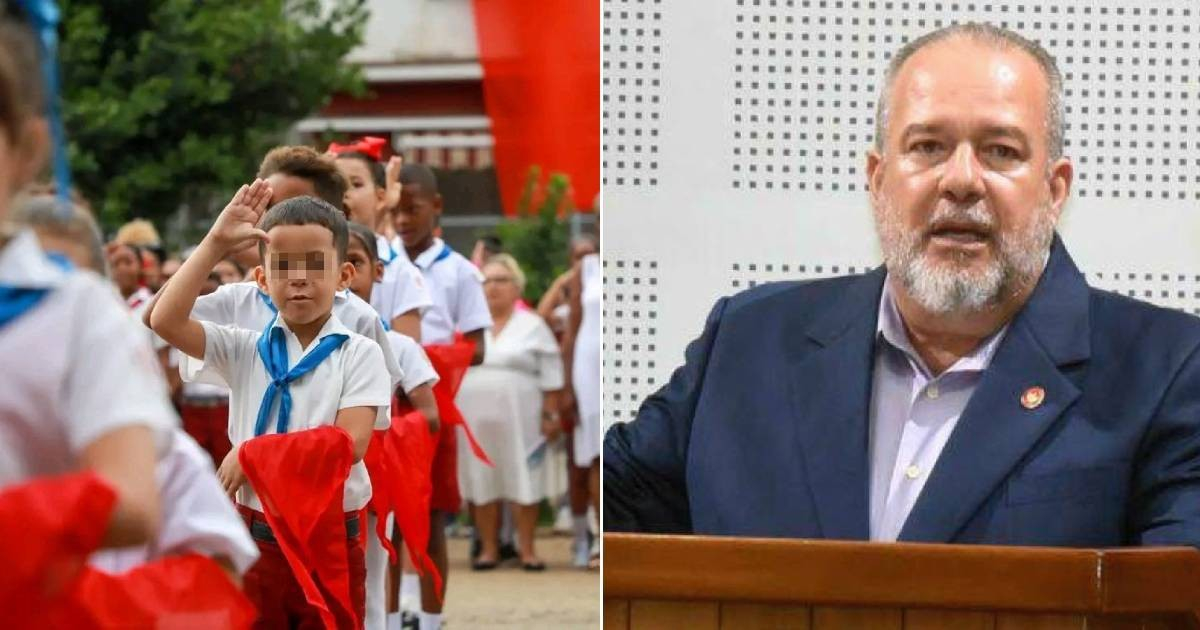
The Cuban Prime Minister Manuel Marrero Cruz posted a message on his X account this Saturday, celebrating the ritual of changing the blue scarf for the red one in the José Martí Pioneers Organization, describing the event as "a source of inspiration during these difficult days, under the impact of the fiercest imperial blockade."
However, the post regarding the change of scarf, which takes place every year on June 14, generated a wave of critical responses from Cubans who contrasted the official narrative with the reality of hunger, blackouts, and a lack of medications that families on the island are experiencing.
Marrero wrote: "In #Cuba, the change of attribute is a special moment for pioneers, teachers, and families. The joy of children exchanging their blue neckerchief for the red one is a source of inspiration in these challenging days, under the impact of the most fierce imperial blockade."
The citizen response was immediate and forceful: Cubans both inside and outside the island rejected the message, pointing out that children have neither joy nor a future, but rather hunger and scarcity.
The contrast between the official discourse and the available data is stark. According to the Food Monitor Program, from April 2026, 96.91% of the Cuban population lacked adequate access to food, and 33.9% of households reported that at least one member went to bed hungry in the previous 30 days.
UNICEF reported that 9% of children under five years old in Cuba suffer from severe nutritional deprivation, and that 48.5% of students aged six to eleven do not receive food or snacks at school.
More than 11,000 Cuban children were awaiting surgeries delayed due to power outages and a lack of medical supplies, while the survival rate for minors with cancer is said to have dropped from 85% to 65% according to reports from this year.
This is not the first time that Marrero's statements have generated this type of reaction. Last May, when he accused the United States of wanting to "suffocate" Cuba, users on social media responded with direct reproaches to the regime.
In that same month, in the face of power outages, the viral phrase “In the chief of UNE’s block there is electricity” circulated as a symbol of the inequality between the nomenklatura and the people.
The pattern repeats with other officials. On June 1, Díaz-Canel celebrated Cuban children as a "treasure" and received similar criticism in response. On June 5, the President of the National Assembly stated that "no one dies of hunger here", a declaration that also sparked outrage.
The World Food Programme indicates that Cuba is facing increasing challenges to food security amid a prolonged recession, inflation, and fuel shortages, factors that the regime solely attributes to the U.S. embargo, while international organizations and the opposition also point to the structural flaws of the state economic model.
Essential medications in Cuba were only available at around 30% of usual supply levels, according to data from 2026, a fact that Cubans do not forget when the Prime Minister speaks of the "joy" of their children.
Filed under: