
Related videos:
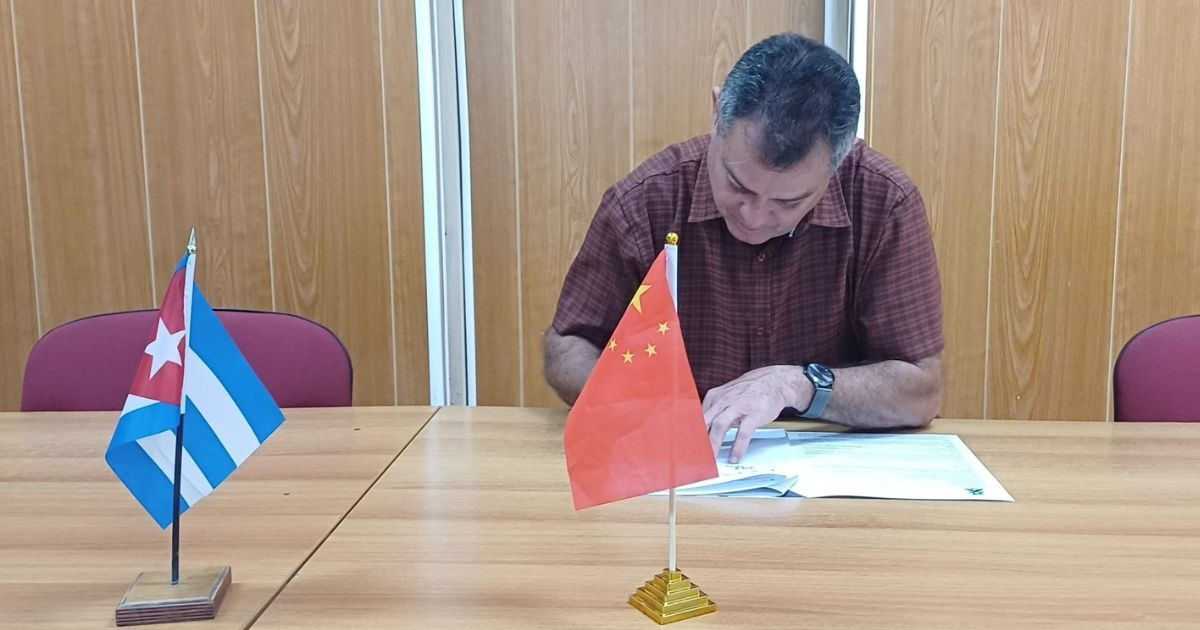
The University of Pinar del Río «Hermanos Saíz Montes de Oca» (UPR) and the Chinese technology company Shanghai Loop Artificial Intelligence Technology Co., Ltd formalized a General International Cooperation Agreement last Friday, aimed at enhancing artificial intelligence, academic mobility, and doctoral training in strategic areas of knowledge.
The agreement was signed by Wang Jialiang, founder of Shanghai Loop AI, and Dr. C. Yorki Mayor Hernández, rector of UPR, in an event described by the institution as a step that "solidifies bilateral relations between both institutions and projects the high educational center of Pinar on the international academic and technological stage."
The agreement establishes joint actions that directly involve the faculties of Forestry and Agricultural Sciences, Technical Sciences, Physical Culture, and Early Childhood Education, with an emphasis on strengthening infrastructure and the professional development of the faculty.
Among the main objectives is to facilitate access to government scholarships offered by Chinese universities for graduate students from the UPR, as well as to arrange research stays in China for doctoral candidates from the Cuban institution.
The agreement also includes training and certifying professionals from the faculties involved in the design and application of artificial intelligence, as well as preparing participants for HSK levels 1 and 2 in the Chinese language.
One of the most concrete commitments is the creation of the "Shanghai OPC Community" in the Lingang area of Shanghai, designed as an annex to the project for initiatives in innovation and artificial intelligence learning with the participation of Cuban students.
Both parties also committed to promoting the mobility—whether in-person or virtual—of professors and researchers holding Master's or Doctorate degrees in Sciences, and to jointly conducting academic events, courses, symposiums, and scientific publications.
The UPR stated that the agreement "is part of the institutional strategy to strengthen internationalization, enhance the academic and scientific potential of its faculty, and project its doctoral training programs onto the international stage, consolidating academic and technological ties between Cuba and China."
Shanghai Loop AI, founded in November 2020, is a company focused on the operation and maintenance of data centers and on data processing with artificial intelligence, currently collaborating with Tencent IDC.
The agreement is part of a broader agenda of the Cuban regime to promote artificial intelligence as part of its strategy for "digital transformation" and "technological sovereignty." In November 2025, the Consortium for Artificial Intelligence of Cuba was established with 22 founding members, including the University of Havana, the UCI, CUJAE, and ETECSA, indicating that UPR is not the only institution investing in this area.
In May of this year, President Miguel Díaz-Canel visited the University of Havana to discuss artificial intelligence and called for the acceleration of the creation of a Cuban AI, mentioning the language model CecilIA, trained with national data.
However, this technological drive clashes with the harsh reality of the country: the energy crisis has led to temporary closures of universities due to fuel shortages in 2026, reducing access to laboratories and resources for research, while unstable connectivity and technological obsolescence pose structural obstacles to realizing artificial intelligence projects in Cuban institutions.
Cuba-China cooperation in the academic and technological fields is part of a bilateral relationship that, in January 2026, included the approval by Xi Jinping of 80 million dollars and 60 thousand tons of rice for the island, solidifying China as one of the main strategic partners of the regime amid its deep economic crisis.
Filed under: