
Related videos:
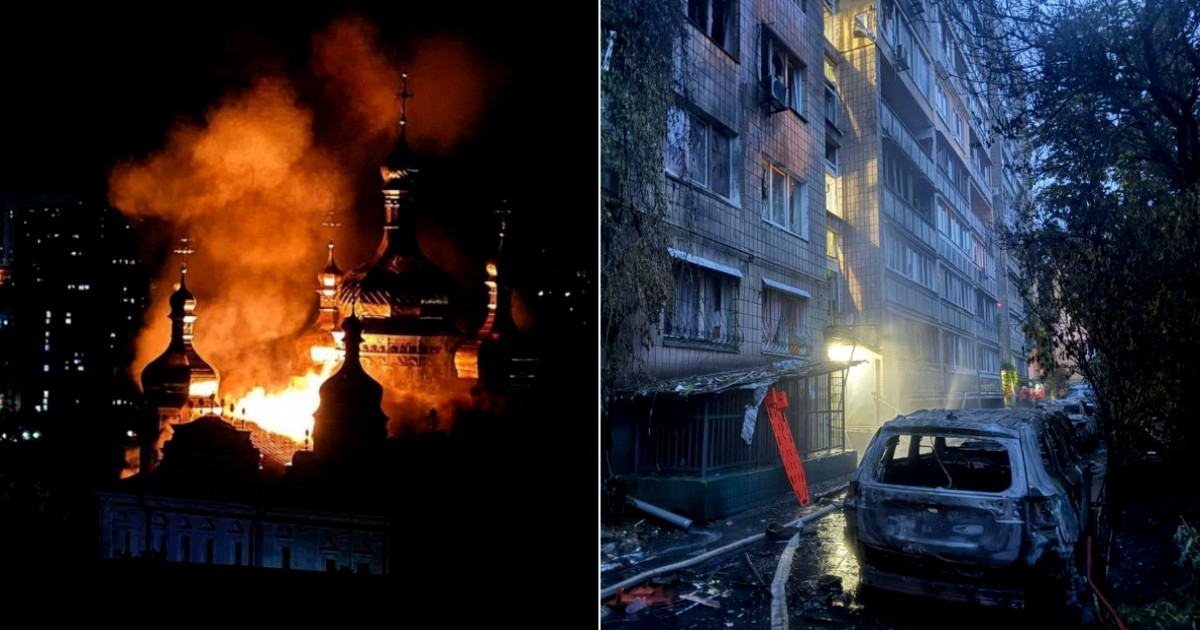
A massive Russian attack early this Monday resulted in at least 10 deaths across Ukraine and caused a fire at the Dormition Cathedral of the Kyiv Pechersk Lavra.
The sacred site, declared a World Heritage Site by UNESCO, was founded in the year 1051. President Volodimir Zelenski described the attack as “one of the most serious crimes by Russia against Christian culture.”
Russia launched 70 missiles and 611 drones against Ukraine overnight, with more than 60 missiles aimed solely at Kyiv, marking the worst attack on the capital in two weeks.
The Ukrainian air defense shot down 50 missiles and 582 drones, but the spokesperson for the Air Force, Yuriy Ihnat, cautioned: "Ballistic missiles continue to be a problem for us. Out of the 34 ballistic missiles launched, only 15 were intercepted, although it's a solid result."
The most painful symbol of the attack was the fire in the millennium-old cathedral, whose flames were visible from throughout the city. Firefighters from the State Emergency Service managed to extinguish the fire on the roof of the building. Zelenski personally visited the site and stated, "This is an attack on our history. Of course, everything will be restored."
Russia denied attacking the monastery and attributed the damage to a U.S.-made Patriot missile, while Zelensky claimed it was a Russian drone. A source provided Reuters with photographs of Russian drone debris found near the damaged building, although the agency could not immediately confirm the authenticity of the images.
In Kiev, five people died—four on the spot and a fifth later in the hospital—and 34 were injured. In Kharkiv, the country's second-largest city, four emergency responders and a municipal official who were attending to a fire caused by an initial Russian attack were struck by a second deliberate bombing; at least five more people were injured. In Dnipro, Russia hit a railway station, a school, and several businesses.
The pattern of the attack is consistent with a tactic that Russia repeats every time its advance on the front stalls. According to the Institute for the Study of War (ISW) in its assessment from June 14, Russian forces have not achieved confirmed advances in the sectors of Sumy, Slovyansk, Dobropillya, and Orikhiv, with an offensive push largely paralyzed.
This is not the first time that Moscow has responded to military frustration with terrorist attacks against civilians and cultural heritage: in Bucha, following the Russian withdrawal in April 2022, dozens of civilians were found executed with their hands tied, crimes documented by the UN that led Joe Biden to call for Vladimir Putin to be tried as a war criminal.
The international condemnation was immediate. Ukrainian Foreign Minister Andrii Sybiha stated that "Putin has forever inscribed his name on the list of history's worst barbarians" and announced the urgent initiation of proceedings before UNESCO. The French Foreign Minister, Jean-Noël Barrot, compared the attack to "bombing Notre Dame or Saint Denis." The head of European Union diplomacy, Kaja Kallas, described it as a "war crime."
The attack occurred a day after Zelenski spoke with President Donald Trump about efforts to achieve a ceasefire, as the G7 meets this week in France. Zelenski demanded that the G7's response be "decisive and substantial: more pressure on the aggressor and more support for Ukraine's air defense, especially in ballistic capabilities."
The metropolitan Epifaniy, head of the Orthodox Church of Ukraine, summarized the outrage of millions with a question: “What else must the Antichrist of the Kremlin do for the world to understand that decisive measures must be taken to end the Russian terror against Ukraine?”
Filed under: