
Related videos:
A 5.3 magnitude earthquake struck western Cuba this Monday at 1:37 PM, and the provincial authorities of Pinar del Río confirmed that there were no reported material or human damages, according to reports from the Cuban News Agency.
The event was identified by the head of the National Seismological Service, Enrique Diego Arango Arias, as a aftershock of the 6.2 magnitude earthquake that shook western Cuba on June 8.
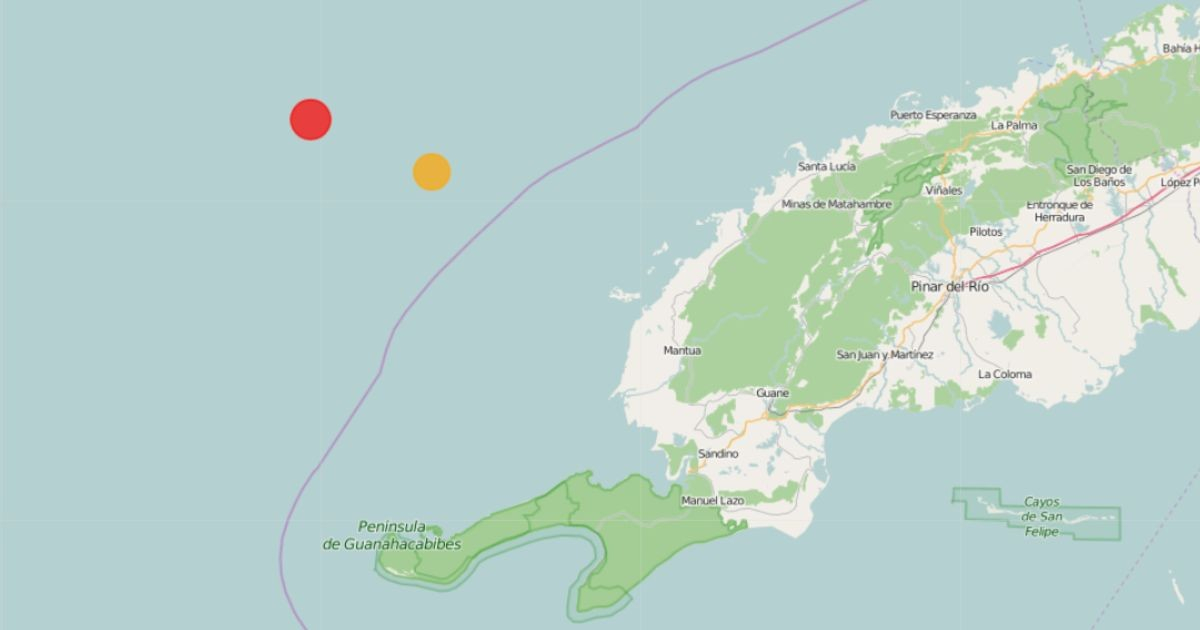
«A perceptible earthquake was recorded in the western part of the country at 1:37 PM with a magnitude of 5.3, a aftershock of the 6.2 magnitude earthquake from last Monday, June 8, located 98 kilometers northwest of Mantua, Pinar del Río,» specified Arango Arias.
The National Center for Seismological Research located the epicenter at coordinates 22.76 degrees north latitude and -85.10 degrees west longitude, at a depth of 10 kilometers.
Lieutenant Colonel Noel Lozano Martínez, head of the Civil Defense Organ in the province, reported that the perceptibility reports came from the municipalities of Mantua and Minas de Matahambre, specifically in the areas of La Sabana and the Caribbean Mining Company (Emincar).
"So far, no damages have been reported," stated Yamilé Ramos Cordero, the first secretary of the Communist Party of Cuba in Vueltabajo and a member of the Central Committee, in remarks to the official agency.
Unlike the earthquake on June 8, which was felt throughout the province and generated a wave of social media posts, this aftershock had a more localized impact, which authorities attribute to the epicenter being located further from the provincial territory.
The Cuban seismologist surprised by the earthquake in the Gulf of Mexico had acknowledged that the main event on June 8 caught the scientific community off guard, as it occurred on a stable carbonate platform with no known faults or history of seismic activity of that magnitude.
The western part of Cuba has historically been an area of low seismic activity compared to the eastern part of the country, where the highest seismicity of the archipelago is concentrated.
The year 2026 has been seismically intense across the island: in the east, a magnitude 6.0 earthquake shook Guantánamo on March 17, generating over 900 aftershocks within 24 hours, and in February, a 5.6 earthquake caused cracks in 14 homes and at the polyclinic in Imías.
The aftershock this Monday confirms that the seismic sequence initiated on June 8 in western Cuba remains active a week after the main event, although it has not had any consequences for the population so far.
Filed under: