
Related videos:
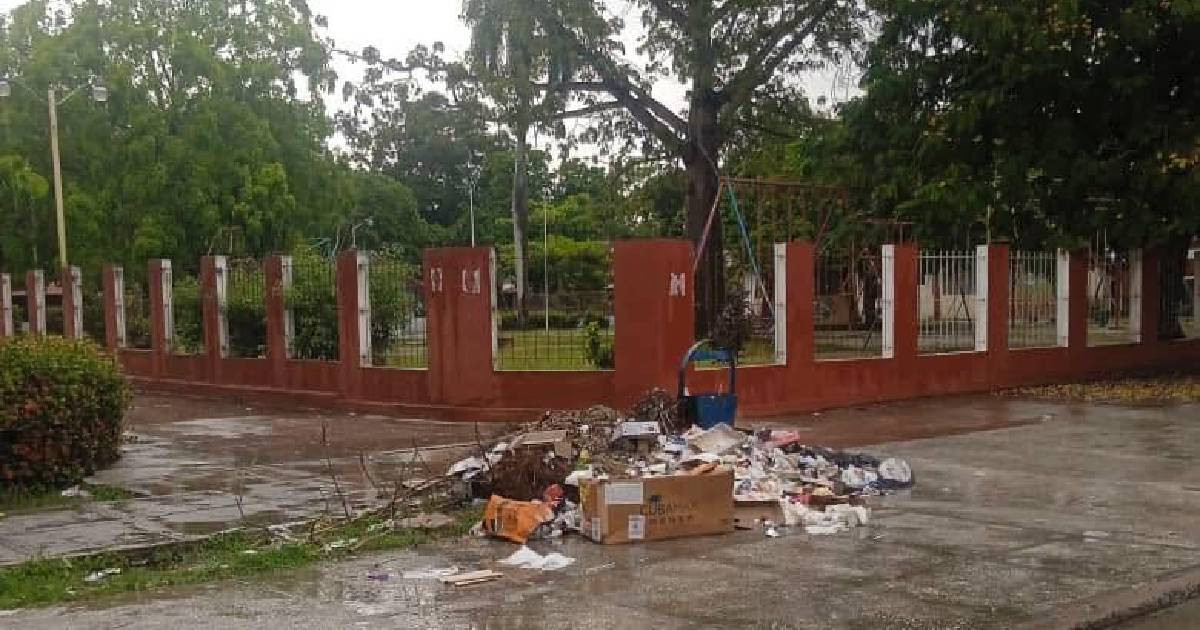
A new garbage hotspot is forming in front of the children's park in the city of Holguín, alerted the Facebook page Holguín Memories this Saturday, which published images of cardboard boxes, branches, plastic bags, and debris piled up on the wet street, with the park's red fence visible in the background.
"If action is not taken quickly, we will have another dump, and this time in the city center, in front of the children's park. This garbage issue is getting out of control," warned the post, which sparked a flood of reactions from outraged neighbors.
The comments indicate that the problem has been worsening for days. A resident directly pointed to a nearby store: "That garbage dump has been growing for a while... the culprit? Ask the owner of the bar across the street; he's the one who throws all the trash there."
Another neighbor described an even more widespread situation: "I live on Pepe Torres Street, and it has been more than a week since the garbage truck last came by. There is now a dump every 25 meters on both sides of the street; the communal services have delivered flags."
Health concerns dominate many of the reactions, especially with summer approaching. "We are going to die with so many diseases that appear in summer," wrote a citizen.
Another person reported that the situation is even replicated next to facilities for children: "In the Mario Pozo 8 children's center, where there are kids, they made a garbage dump on one side, and this country couldn't care less, not even if the children get sick."
Several comments agree on identifying the root of the problem: the lack of systematic waste collection. "Garbage is like water; it has to go somewhere. If it's not collected, it's obvious that a landfill will always form," summarized a neighbor.
Another directly questioned the authorities: "Where are those responsible for this? Are they shortsighted or afraid to step forward?"
This new focus adds to a pattern of accelerated deterioration in Holguín that has been documented for months. At the beginning of this month, El Mambisito Park, located in the Mayabe Valley, was described as a ruin with missing roofs and attractions out of service.
Previously, a viral video showed a dumpster out of control in Reparto Zayas. And in May, the lot of the former children's park Los Caballitos, demolished between 2023 and 2024 without a replacement plan, was documented as an improvised dump.
The old Holguín-Gibara railway station, one of the oldest railway terminals in Cuba, founded in the 19th century, has turned into a dumping ground for trash and debris.
The Holguín Communal Services Company has acknowledged shortages of trucks, spare parts, fuel, and workforce, without providing concrete solutions.
On a national scale, garbage collection dropped to 24.9 million cubic meters in 2023, and in Havana, only 44 out of 106 collection trucks were operational in February.
The health risk is particularly serious during the hot months. In October and November 2025, Holguín reported cases of dengue—serotype four confirmed by PCR—and chikungunya in almost all of its 14 municipalities, with the accumulation of garbage identified as a factor contributing to the breeding grounds of the Aedes aegypti mosquito.
In January, the provincial station Radio Angulo warned that the burning of waste was generating dioxins, furans, and carbon monoxide, while each resident produces approximately 1.5 kg of waste per day and only 35% of the provincial garbage is utilized.
Holguín was considered for decades one of the cleanest cities in Cuba. Today, the people of Holguín demand answers that the authorities have not provided and describe a situation that, if not addressed immediately, threatens to turn the heart of the city into a new open-air dump.
Filed under: