
Related videos:
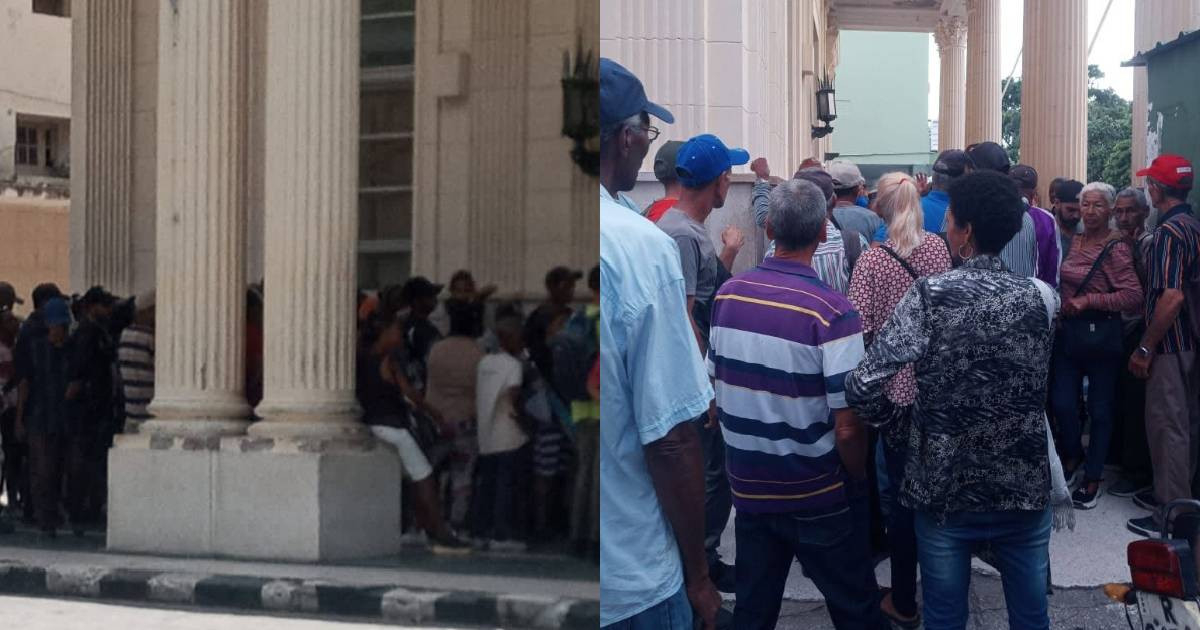
The resident of the city of Santa Clara Freddy De León López reported on Thursday that it took him three days to withdraw only 40% of his salary due to a lack of cash, banking system failures, and operational restrictions that hinder the normal use of money.
The testimony published on Facebook described a scenario in which accessing one's own salary becomes a prolonged process hindered by multiple operational obstacles.
He reported that the ATMs rarely have cash available, the system experiences frequent outages, and sometimes the money is simply not accessible, which forced him to spend three days just to withdraw a portion of his salary.
After partially accessing his salary, the citizen attempted to make purchases at a self-employed workers' business using electronic payment, a method that also includes a 6% bonus on the transaction.
However, the establishment rejected payment by card, highlighting another facet of the contradiction between formal banking and its real application in everyday economics.
In his complaint, De León López added that inspectors present in the area acknowledged the existence of tax accounts with large sums of money in private businesses, but there was no possibility of withdrawing cash due to the lack of availability in the banking system.
This establishes, according to his account, a paradox in which money exists in digital records, but does not circulate in practice.
The result, he described, is a dysfunctional circuit where salaries are deposited onto cards, ATMs do not guarantee cash, businesses reject electronic payments, and control mechanisms do not ensure compliance with the regulations. A chain of failures that, in practice, prevents the effective use of earned income.
The complaint from De León López brings to light once again the structural tensions of the banking process in Cuba, in a context where access to money has become a daily issue for large segments of the population.
A citizen's comment on the post summed it up clearly: "The chain is broken when it gets to the bank and the TCP cannot withdraw cash. Therefore, the inspection body cannot take action against the bank and, as a result, electronic payments cannot be accepted."
Other Cubans who commented on the post pointed in the same direction. "The only guilty party is the bank and its leadership. They implemented a first-world system in a fifth-world country," wrote one person.
A private vendor added that the maze traps her as well: "We no longer have cash, and we have nowhere to buy; they don't accept bills of 10, 20, and in many places, not even 50, and using transfer is like disrespecting them."
The most forceful voice among the comments came from those demanding an end to the policy: "Just eliminate the so-called banking system. It doesn't work. It tortures the most vulnerable. Get rid of it. We want cash."
This testimony comes just one day after the regime announced, in an extraordinary session of the National Assembly, a package of 176 economic measures which includes, for the first time since 1959, the authorization of private banking and the removal of limits on transfers and withdrawals. The irony is hard to overlook.
The failure of banking integration is not new. Less than 10% of private businesses in Sancti Spíritus regularly accepted transfers according to a survey conducted in May.
Furthermore, the director of macroeconomic policies at the Central Bank of Cuba publicly acknowledged that "if electronic payments are not easier or faster to make than cash payments, of course they will not be widely accepted."
The situation worsened further when Fincimex suspended operations with Visa and Mastercard earlier this month, as a result of U.S. sanctions on institutions linked to GAESA, the conglomerate of the military elite on the island.
By May, more than 50% of the ATMs in Havana had already stopped working.
While the regime announces historic reforms on paper, in the streets of Santa Clara a worker needs three days to withdraw part of their own salary and still cannot afford to buy food with it.
Filed under: