
Related videos:
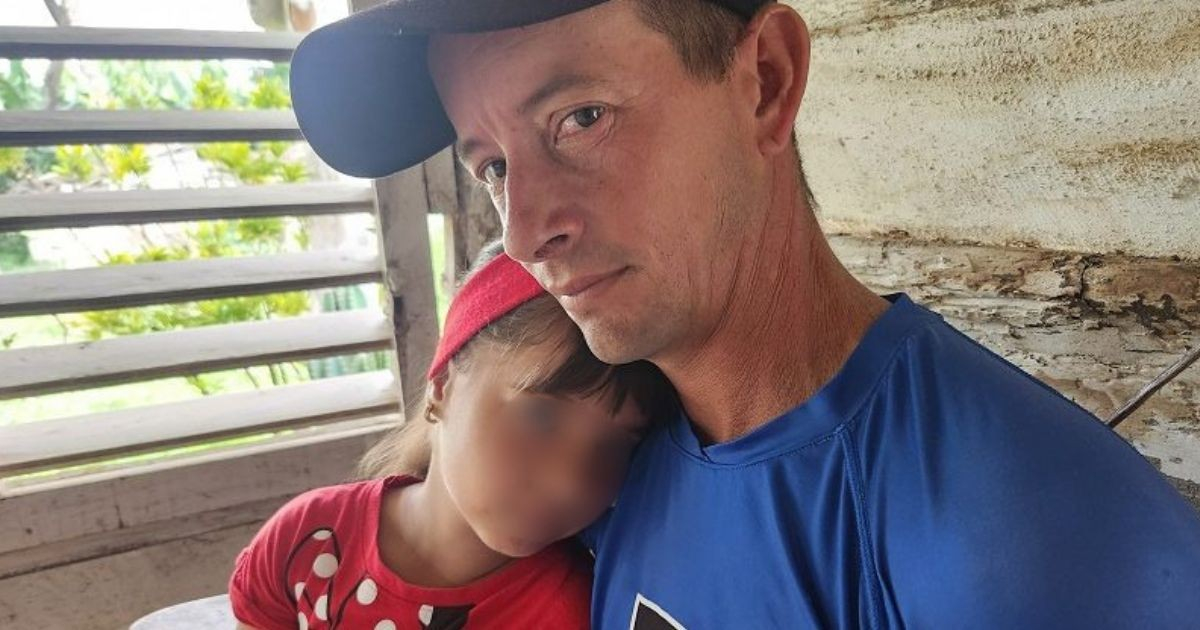
A 39-year-old Cuban father gave up on emigrating to the United States because doing so meant leaving his six-year-old daughter behind.
Octavio López Ramírez, known as Tavito, rejected the immigration parole that had been granted to his partner so that both could leave Cuba, explaining it with a single phrase: "They gave my wife the parole for us to both go, and I said: without Cuqui, I won't do it. After all, I always find a way here."
The story was reported by the official newspaper Escambray in an article published on Sunday, which portrays the life of this farmer in La Cueva de la Virgen, an area of extreme poverty near the Zaza hotel, in Sancti Spíritus, where drinking water is unavailable and the homes have metal roofs and dirt floors.
Tavito takes on the sole responsibility of guarding and caring for Dainalis Rosalba, whom he affectionately calls Cuqui, since the girl was only 11 months old, after divorcing her biological mother without receiving any support from her.
"If I took a step back, it would be like handing her over to the orphanage. Just imagine, when I was left alone, I didn’t receive any help from my biological mother. What would happen if I threw in the towel?" he recounted.
Tavito's current partner, Dayana, does not have any children of her own and has become the backbone of the household. The girl calls her mom. It was Dayana who was granted parole, the immigration mechanism that would have allowed the couple to enter the United States temporarily while they processed their residency.
The program was canceled by the U.S. Department of Homeland Security on December 15, 2025, with all benefits expiring on January 14, 2026, which makes the opportunity rejected by Tavito no longer existent.
The decision contrasts with a trend that has emptied the island: since 2021, more than a million Cubans have left the country, leaving fractured families behind.
Sancti Spíritus is one of the most affected provinces: in 2024 it lost 8,689 inhabitants due to emigration, low birth rates, and aging, and almost half of its working-age population is unemployed.
In that context of precariousness, Tavito built his house board by board, selling his labor for whatever he can find—"I could just as easily dig a post, make charcoal, fell a tree, or clean a well"—and he rides his bicycle over two kilometers to the Remigio Díaz Quintanilla school, where Cuqui learned to read and add this year.
The girl has experienced two episodes of seizures that put her life at risk. During the most challenging moments, supportive groups on social media coordinated donations that brought essential items to her home, including clothing, a television, a rice cooker, a pot, and a blender.
"I am very grateful. The girl has clothes that she may not wear," said Tavito.
When she was asked why dad sometimes can't play with her, Cuqui replied without hesitation: "When dad can't play with me, it's because he's working."
Tavito, who at one point was separated from Dayana for eight months and returned home "with nothing to his name," has no doubts about what he did or what he would do.
"The only formula is to want it and have the desire to act. If you lack strength and will, you won't achieve it. I've never lacked for it; as I already told you, it is my everything," he added.
Filed under: