
Related videos:
The Wall Street Journal dedicated an extensive obituary on Wednesday to Ramiro Valdés Menéndez, who passed away on June 21 at the age of 94, presenting him as one of the most influential and feared figures in the Cuban power structure since the triumph of the Revolution.
In the article, signed by journalist Robert P. Walzer, the American newspaper describes Valdés as one of the key architects of the state security system and the repressive apparatus that has sustained the Cuban regime for decades.
The historian Michael Bustamante, director of the Cuba Program at the University of Miami, described him as "a sinister and feared figure, more known for operating in the shadows than in public."
The publication reviews the political trajectory of Valdés, one of the historical commanders closest to Fidel Castro and a key figure in the construction of the political control mechanisms of the Cuban state. Throughout his career, he held positions of great importance, including Minister of the Interior and Vice President of the Council of State.
Meanwhile, the Cuban regime held several official events in his honor. Miguel Díaz-Canel announced his passing through the social network X without revealing the causes of death and claimed that the news affected him "like that of a father." He later wrote on Facebook: "It's hard to imagine the path ahead without his clear and constant support."
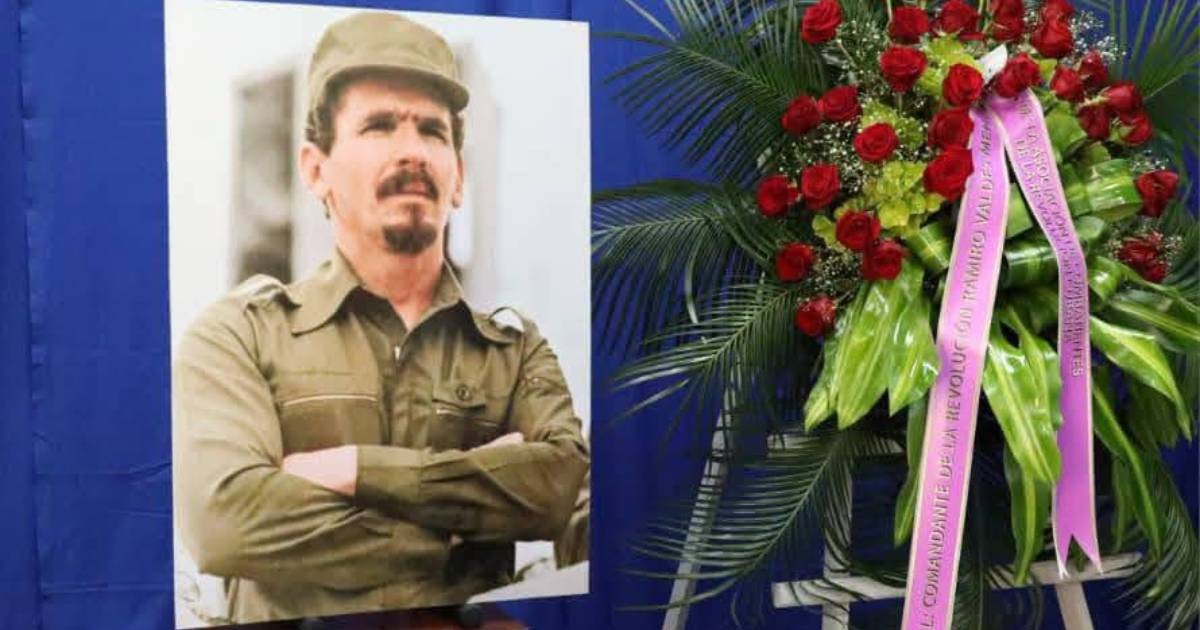
The government declared an official mourning through Presidential Decree 1247 and ordered the Cuban flag to be flown at half-mast on June 23. Valdés' remains were displayed at the Ministry of the Revolutionary Armed Forces in Havana, while simultaneous tributes were organized in various provinces across the country.
Raúl Castro reappeared publicly to lead the first honor guard alongside Díaz-Canel and express his condolences to the family. For his part, Foreign Minister Bruno Rodríguez Parrilla bid farewell on social media, referring to him as the "Hero of Moncada, Granma, the Sierra Maestra, and the revolutionary process."
According to Cuban authorities, Valdés' remains will be transferred this Thursday to Santa Clara to be laid to rest in the Mausoleum of the Las Villas Front, located in the Ernesto Che Guevara Sculptural Complex, in accordance with his last wishes.
The obituary also includes critical voices regarding the leader's legacy. Manuel Cuesta Morúa, an opposition activist and political analyst, stated to the newspaper that Valdés was "one of the main architects of Cuba's repressive state apparatus and the mechanisms of political control that became the backbone of the Cuban system."
"Repression is one of the main tools of power of the regime, and Valdés was one of the key figures responsible for its creation and maintenance," he added.
The publication also highlights the reactions provoked by his passing among sectors of the exile community and the Cuban opposition. The Cuban-American congressmen Carlos Giménez and María Elvira Salazar expressed their regret that the former leader died without facing legal proceedings for alleged human rights violations.
Another aspect pointed out by the newspaper was the timing of Valdés' death coinciding with the recent announcement of a package of economic reforms by the Cuban government. Bustamante believed that some of those measures would hardly have received the backing of a figure historically associated with the more orthodox positions within the regime.
"It is surprising that, just a few days before his death, they announced something that he would have strongly rejected. It is hard to ignore the coincidence of dates," stated the scholar.
For Brian Latell, a former CIA analyst specializing in Cuba, Valdés' disappearance represents a symbolic blow to the old revolutionary guard.
"The death of Valdés is a significant loss for the old revolutionary guard. Ramiro was the most important among the historic figures still living," he declared to the newspaper.
With his passing, the group of historical leaders who participated in the revolutionary triumph of 1959 is now reduced to figures like Raúl Castro, Guillermo García Frías, and José Ramón Machado Ventura, all of whom are nonagenarians.
Filed under: