
Related videos:
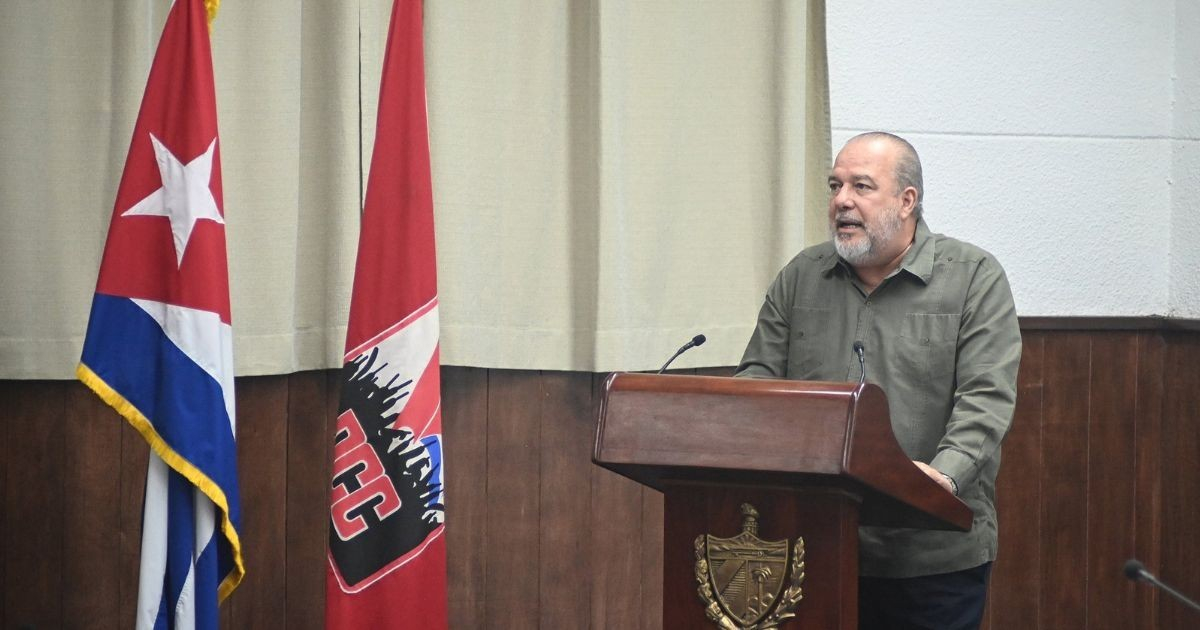
The Council of Ministers of Cuba is meeting this Wednesday to review the package of 176 recently approved economic and social transformations, with the promise that they will be published in full once the internal analyses are completed.
The announcement was made by Prime Minister Manuel Marrero Cruz through his account on X, shortly confirmed afterwards by the official Granma.
"Today we will analyze in the Council of Ministers the recently approved economic and social transformations, which have been enriched by the considerations of the Political Bureau, as well as the interventions made at the Plenary of the Communist Party and in the National Assembly," wrote Marrero Cruz.
In the same thread of the tweet, he promised that the measures would be announced without cuts.
Marrero described them as "a bold and sovereign response resulting from the process of updating and perfecting the Cuban Economic Model, initiated in 2011 and deepened from the year 2021."
The Secretary of Organization of the Central Committee of the PCC, Roberto Morales Ojeda, also joined the official narrative on X, asserting that the transformations "are implemented by the Council of Ministers" and linking them to the legacy of Fidel Castro.
"Change what must be changed with an awareness of the historical moment, as Fidel taught," he emphasized.
The reform package, which includes 176 measures across 23 key areas, was presented by Marrero Cruz at the Extraordinary Plenary of the Central Committee of the PCC on June 17 and ratified by the National Assembly the following day.
Among the measures are the opening to private banking, private currency exchange, the buying and selling of shares in state-owned companies by private individuals and foreigners, partial dollarization, a reduction of ministries from 27 to between 20 and 21, the elimination of salary caps, and a tax reform with a gradual introduction of VAT.
The very Miguel Díaz-Canel acknowledged while closing the Plenary that "creative resistance is no longer enough" and that "it's no longer enough to explain the crisis; it has to be changed," an unusual admission of the regime's economic management failures over the years.
However, the promise of transparency comes amid a backdrop of deep skepticism and hopelessness.
The Cuban population responded to the announcement of the reforms with pot-banging protests in Santiago de Cuba, Santa Clara, and Havana, while on social media the expression "the same dog with a different collar" dominated.
Distrust has historical ground: in 2016, the government itself admitted that it had only fulfilled 21% of the economic guidelines promised in 2011.
The international community has also shown little enthusiasm.
The U.S. State Department described the 176 measures as "superficial smoke signals" on June 19, and just four days later, the Trump administration announced new sanctions against five Cuban entities linked to the military conglomerate GAESA, including the International Financial Bank and RAFIN S.A.
The Secretary of State Marco Rubio warned that "foreign banks and other companies providing services to these entities must immediately freeze those activities," making it clear that Washington does not view the reforms as a genuine change in direction.
The background is an economy in freefall: ECLAC projects a contraction of the Cuban GDP of 6.5% for 2026, the worst in Latin America, with a cumulative decline of over 23% since 2019.
The new reforms will also require the modification of more than 148 legal provisions, a process whose actual implementation the regime has not clearly explained.
Filed under: