
Related videos:
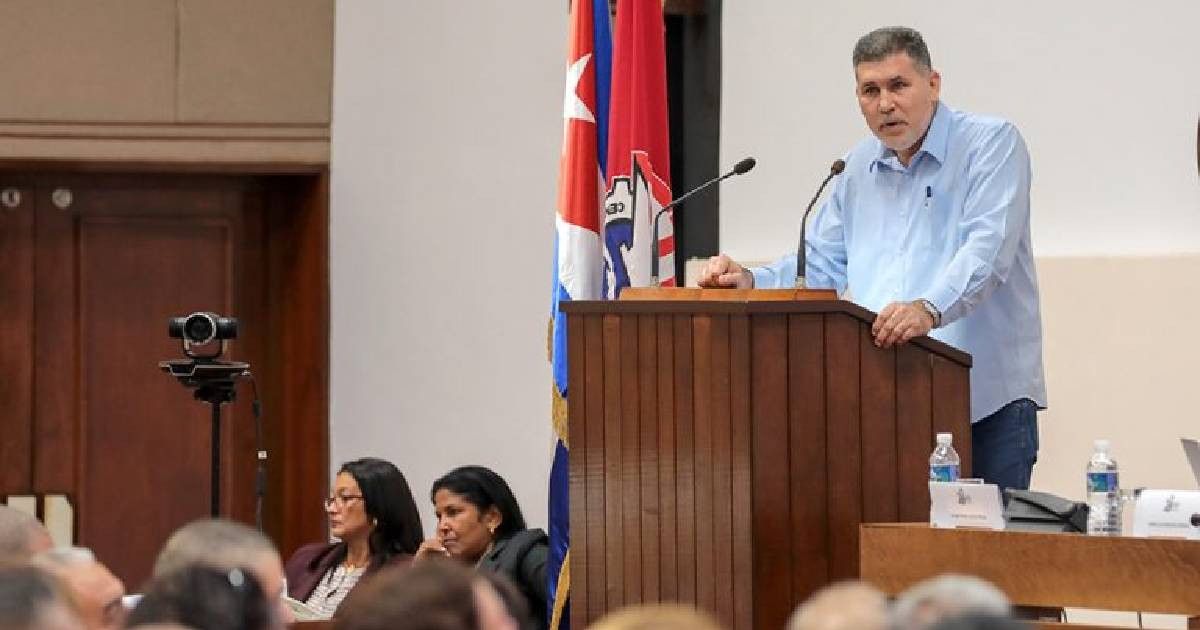
The Deputy Prime Minister Oscar Pérez Oliva-Fraga appeared this Friday before the delegates of the XXII Congress of the Central Workers' Union of Cuba (CTC) to advocate for the elimination of generalized subsidies as part of the 176 economic and social measures approved by the regime.
According to the version disseminated by the pro-government portal Cubadebate, the current Minister of Foreign Trade and Foreign Investment stated that the current model is unsustainable for state finances.
"Our economy cannot continue, simply because it is a mathematical equation, applying equal product subsidies to the entire population. The economy cannot sustain it," he stated.
During his speech, he revealed that the state budget allocates 92 billion pesos to subsidize the business system, of which approximately half is dedicated to maintaining electricity rates.
Pérez Oliva-Fraga acknowledged that maintaining those levels of spending would require "levels of productivity and efficiency that we are not achieving at this moment."
He also stated that state-owned companies must operate without direct financial support from the government. "The business system must completely live without state subsidies and must be self-managed," he declared.
The official connected the need to eliminate subsidies with the energy crisis the country is experiencing. "Without energy, there can be no economy. Without energy, we cannot produce. We produce with limitations, the economy comes to a standstill, and wealth is not generated. If wealth is not generated, it cannot be distributed," he argued.
As an alternative to universal subsidies, the regime proposes to focus assistance on individuals deemed vulnerable, identified through the digital platform SOBERANÍA, with the aim of "having more resources to genuinely distribute among those in need."
For his part, the ruler Miguel Díaz-Canel called for "creating wealth" to sustain reforms, a message that contrasts with decades of official rhetoric opposing concepts typical of market economics.
The shift in subsidy policy has direct precedents. In 2020, the then head of the Commission for the Implementation of the Guidelines of the Communist Party of Cuba, Marino Murillo, announced the elimination of excessive subsidies as part of the Monetary Reformatory, a measure that was never fully implemented.
On June 18, Díaz-Canel announced that the basic basket will no longer be universal and will be restricted to retirees, families with chronically ill children, and vulnerable individuals, marking a historic shift in the Cuban social model.
The social assistance will be adjusted according to the income of each family, in a context where the minimum wage is 3,210 pesos per month, while the economist Javier Pérez Capdevila estimated in May that a person needs at least 96,060 pesos per month to cover their basic needs.
The economist Mauricio de Miranda warned that the reforms are designed to appeal to sectors of the U.S. government interested in business and cautioned that without democratic checks and balances, the outcome will be a "Russian-style transition," with Communist Party elites transformed into oligarchs through opaque privatizations.
Filed under: