
Related videos:
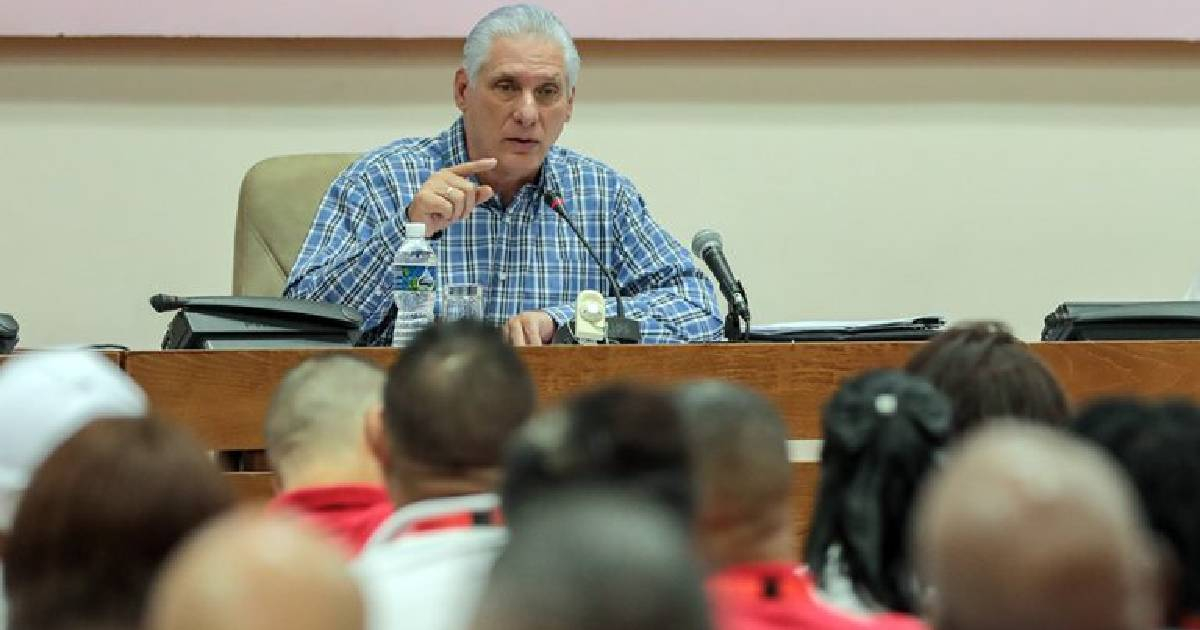
The ruler Miguel Díaz-Canel defended this Friday at the XXII Congress of the Cuban Workers' Central (CTC) the need to "create wealth" to sustain the program of economic reforms promoted by the regime, a speech that contrasts with decades of official rhetoric against concepts traditionally associated with a market economy.
"To defend that, one must produce, one must create wealth, and one must be capable of distributing that wealth with a sense of justice," affirmed Díaz-Canel during the session held at the Palacio de Convenciones in Havana, reported the official portal Cubadebate.
The president also urged workers to support the economic transformations recently approved by the Government.
"The implementation of these transformations will not yield the results we desire if there is not active participation from our workers," he stated.
The intervention took place during the XXII Congress of the CTC, which brings together 759 delegates from across the country. Of these, 561 are participating via videoconference from the provinces, a format necessitated by the energy crisis affecting the Island.
During the meeting, Vice Prime Minister Oscar Pérez Oliva-Fraga presented the 176 economic and social transformations approved on June 18 by the Central Committee of the Communist Party of Cuba (PCC), and stated that the program is an essential condition for achieving the Government's economic objectives.
The announced measures include the authorization of foreign direct investment in private businesses, the creation of private banking, the removal of the 100-worker cap for small and medium enterprises, increased liberalization in price formation, and the gradual reduction of generalized subsidies.
The reforms represent one of the most extensive packages of economic changes driven by the regime in decades, set against a backdrop of deteriorating production, inflation, power outages, and shortages.
However, the official rhetoric on economic growth and wealth generation clashes with the salary reality of most Cubans.
The minimum wage was recently increased to 3,210 pesos per month, but economist Javier Pérez Capdevila estimated in May that a person needs at least 96,060 pesos per month to meet their basic needs.
The difference is especially noticeable in food prices. A carton of eggs can cost between 3,000 and 4,000 pesos in the informal market, a figure that is equal to or exceeds the monthly minimum wage.
The announcement of the new measures provoked numerous critical reactions on social media, where users questioned the capacity of the reforms to address issues such as power outages, food shortages, and the loss of purchasing power.
"Download them, and you eat them and illuminate with the measures on paper," wrote an internet user in reference to the critical economic and social situation the country is facing.
The economist Mauricio de Miranda, from the Cuba Transformación group, warned that the reforms are designed to attract sectors of the U.S. government interested in business, not to improve the lives of Cubans.
"These measures are aimed at telling certain people in the United States government: look, we are capable of opening the economy," he pointed out in statements to CiberCuba.
De Miranda also warned that, without democratic institutional checks and balances, the outcome will be "a transition like Russia's", with PCC elites transformed into oligarchs through opaque privatizations.
The new Labor Code, presented in Congress by Minister Jesús Otamendiz Campos, does not recognize the right to strike or allow independent unions, thereby maintaining the monopoly of labor representation in the hands of the CTC since 1961.
The U.S. State Department has already categorized the 176 reforms as "superficial smoke signals," and the Trump administration imposed new sanctions against five entities linked to GAESA, the business conglomerate of the military elite.
Filed under: