
Related videos:
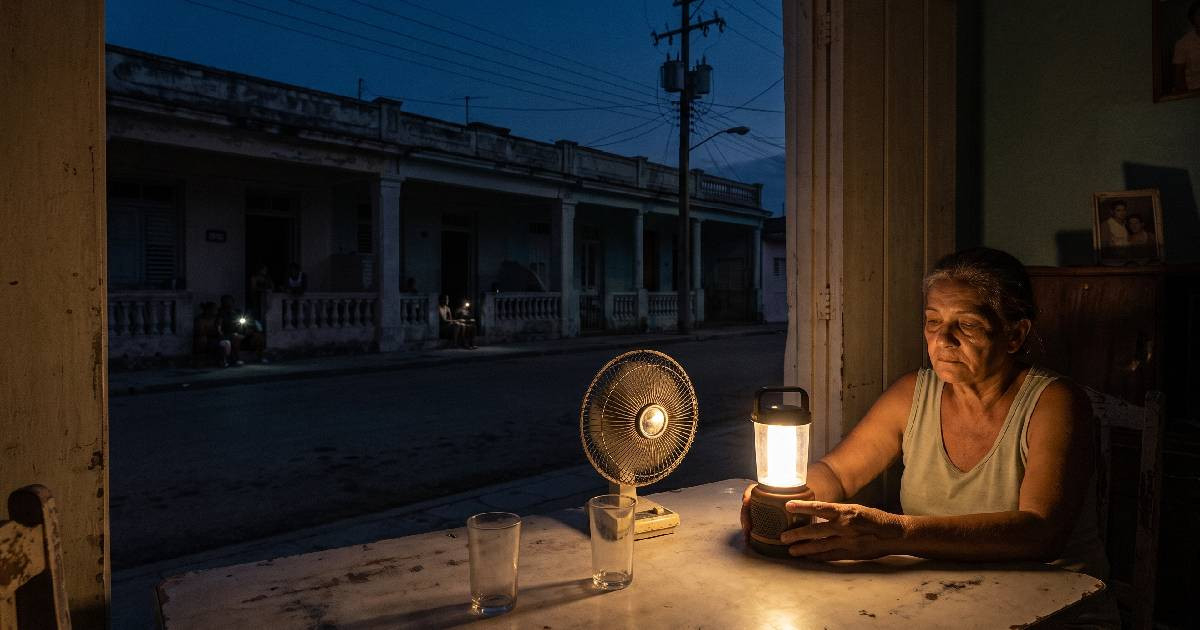
The so-called "democratization" of blackouts in Holguín has triggered a wave of critical reactions on social media, where many Cubans interpret the measure as the institutionalization of an equitable distribution of the electricity crisis rather than a solution to the energy collapse that the province is experiencing.
Regarding this situation, the digital creator José Poveda Cruz sarcastically remarked this Saturday on his Facebook profile, stating that "the electrical democratization has finally arrived in Holguín," a supposed distributive justice where "everyone to sacrifice, everyone to the shadows."
In a text filled with satire, he described the new organization of blackouts as "equality in the dark," where privileged circuits disappear and suffering is distributed with "administrative rigor."
The publication argues that darkness has become the only truly egalitarian element for the population. Poveda depicts a reality where relief no longer comes from an improvement in service, but from the knowledge that the neighbor is also without electricity, a dynamic he summarizes as a form of "thermal communism," where heat, mosquitoes, and nights without fans become a shared experience.
The decision comes amid the worst deterioration of the electrical system in Holguín. The province has only 70 MW available to meet a maximum demand of 240 MW, less than 30% of the necessary capacity.
Of that generation, 26 MW are reserved for essential services and around 20 MW for the nickel industry, leaving only 14 MW to supply an estimated residential demand of 190 MW.
In practice, the scheme requires that the majority of residential circuits receive approximately three hours of electricity for every 39 to 40 hours of blackout.
A resident of the Vista Alegre neighborhood, in the known City of Parks, confirmed this Saturday to CiberCuba that she remained without electricity for 51 consecutive hours, from Thursday until around noon this Saturday, when her service was restored. However, she warned that the service would likely be interrupted again just two hours later, with no certainty of when it would return once more.
The general director of the Electric Company of Holguín, Ruber Reynaldo González, publicly acknowledged the seriousness of the situation, admitting that it is understandable for families to connect all their devices when the service returns, even though this demand ultimately overloads an extremely deteriorated network.
This overload further exacerbates the crisis. As the executive explained, each restoration of service results in damage to between 10 and 20 transformers, while the replacement capacity is significantly lower. As an example, he noted that the company can receive only six transformers to replace 25 damaged units.
The electricity crisis has steadily deepened throughout 2026. In March, three-hour service shifts began; in April, outages reached up to 18 hours a day; by the end of May, reports indicated blackouts lasting over 24 consecutive hours, and with the arrival of summer, nights without ventilation have become a problem that directly impacts the living conditions of the population.
Citizen reactions reflect a mix of resignation, irony, and questioning of the government's management of the crisis. One voice captures it succinctly: "The competition of blackouts between circuits isn't about demanding improvements; it's about making sure everyone is worse off."
Another highlights the root of the problem: "Cubans have fallen so low in their human condition that their struggle is not for everyone to have electric service; their struggle is for everyone to be in the dark."
A resident reported being without electricity for over 20 days, from four in the afternoon until after eight in the morning, despite the beach circuit being prioritized. "Here, it doesn't matter if you scream, get upset, or stomp your feet," she wrote.
Another citizen voice points directly to the regime's responsibility: "If we have fallen into this endless crisis due to poor government management, which no media outlet dares to mention, there is no reason for a part of the population to live in a different Cuba; if there is a crisis, the crisis is for everyone."
The growing discontent is also reflected in the protests. The Cuban Conflict Observatory recorded 153 demonstrations related to the lack of electricity and water just in April 2026, out of a total of 1,133 protests reported that month, an increase of 29.5% compared to the same period the previous year.
Filed under: