
Related videos:
The 45th edition of the Caribbean Festival —also known as the Festival of Fire— will take place from July 3 to 5 in Santiago de Cuba under a reduced scheme adapted to the severe crisis the country is facing, according to the state-run Cuban News Agency.
Daniela Anaya, a member of the Organizing Committee, acknowledged that this edition is marked by "numerous challenges" and described it as "very significant" to hold the event despite the limitations, as she believes it demonstrates a commitment to the continuity of an event that is a benchmark of local, national, and Caribbean identity.
Anaya herself warned that this will be an atypical edition: there will be no traditional parades or the gala for the guest country of honor, Colombia, although spaces will be guaranteed for the cultural expressions of the participating nations each day.
The artistic programming will take place between three in the afternoon and seven in the evening. Orlando Vergés, president of the Organizing Committee and director of the Casa del Caribe, explained that this schedule aims to facilitate public mobility and encourage participation, a decision that directly reflects the restrictions imposed by the prolonged blackouts that the city is experiencing.
Santiago de Cuba is experiencing one of its worst energy crises in June 2026: the Renté thermoelectric plant is operating at a standstill, and the fuel shortage worsens the situation. The local electric company admitted on June 18 that it could not guarantee even two hours of electricity per day, and entire areas of the city had recently gone 40 days without water, with pot-banging and citizen protests in response.
This context contrasts radically with the previous edition: number 44, held in July 2025 and dedicated to Curaçao, brought together over 400 foreign guests from 15 countries and featured a full program, including parades, galas, and the traditional Burning of the Devil. This time, around 70 foreign guests will participate from a dozen nations: Argentina, Brazil, Colombia, the United States, Haiti, Mexico, and the Dominican Republic, in addition to representatives from the embassies of Romania, Azerbaijan, and Egypt.
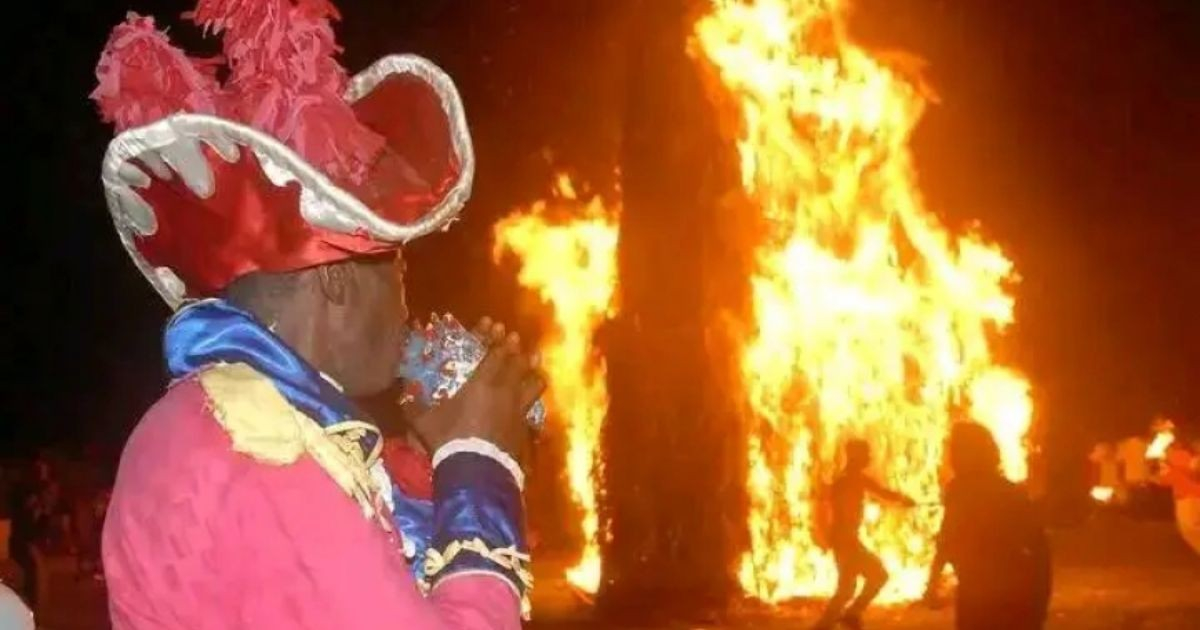
Some emblematic traditions of the festival will be preserved, although with adjustments. The Burning of the Devil —a closing ritual symbolizing purification— will be moved to the community of Portuondo, while the Ceremony of Slave Rebellion in El Cobre will be held on its regular date of July 7. Activities will also extend to the neighborhoods of Abel Santamaría and Nuevo Vista Alegre, the source indicated.
The academic program will include the Colloquium "The Caribbean that Unites Us," featuring the inaugural lecture by Colombian journalist Orlando Oliveros, the presentation of a project on Latin American and Caribbean critical thinking, and the launch of the call for the First International Meeting on Digital Culture of Cuba and the Caribbean. The workshops will cover theater, popular religiosity, dance, visual arts, and poetry, and for the first time, a space dedicated to food culture will be incorporated.
Vergés pointed out that this edition will pay tribute to the essence of the festival and its founders, and acknowledged the efforts of groups and institutions that made the event possible despite the complexity of the moment. The energy crisis has already forced the postponement of the 2026 International Book Fair of Havana in February, and tourism ended 2025 with 1.81 million visitors, a drop of 17.8% compared to the previous year and the worst record since 2002.
The Caribbean Festival was established in 1981 and has been held continuously every year during the first week of July, becoming one of the most significant cultural gatherings in the Caribbean. The fact that the 45th edition is taking place under such drastic limitations—fewer days, no parades, no gala, with daytime hours affected by blackouts—clearly illustrates the level of deterioration that Cuba faces in 2026.
Filed under: