
Related videos:
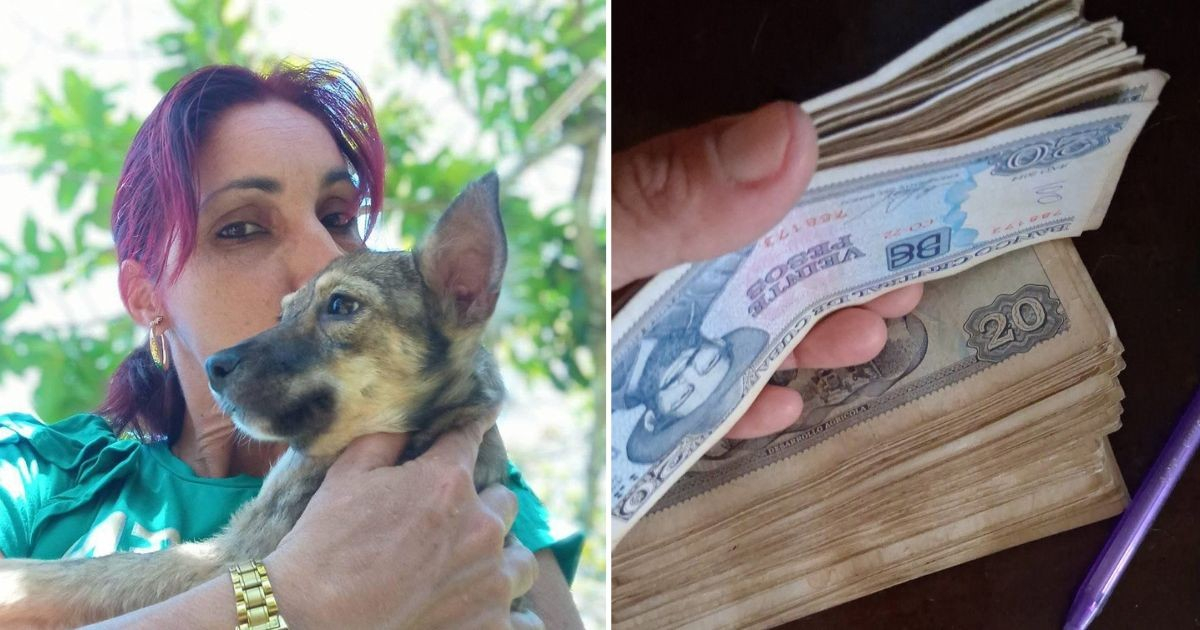
A Cuban activist who cares for over 60 animals at her shelter reported on Facebook a situation that summarizes the economic trap faced by thousands of Cubans: she went out to buy liver with cash in hand because the business she was going to did not accept transfers, and when she placed the 20 pesos bills on the table in a small and medium-sized enterprise, they told her they did not accept them either.
Mileydis Suárez, who manages the shelter "El Jardín de las Mascotas," described the situation with a question that says it all: "What do I do with the money?".
"Today I went out to buy food with cash in hand because they refused to accept transfers... when I found a small business among the many there, I ordered 6... you know that when I placed the 20 peso bills on the table they told me they didn't accept them, and this is how Cubans eat Cuban... we are not helping each other," he wrote in his post.
The shelter representative stated that there is no room to waste hours looking for a place that accepts one payment method or another: "In a shelter, there is no time to spend hours asking where they accept transfers and where they don't."
The episode illustrates a paradox that has become commonplace in Cuba: banks primarily provide low denomination bills—five, ten, and twenty pesos—but an increasing number of private businesses reject them as they find them impractical, while many businesses also do not accept bank transfers.
That second denial is also illegal. The Resolution 111/2023 of the Central Bank of Cuba requires all businesses to accept electronic payments without any surcharges that discourage their use, with fines ranging from 20 to 60 installments —up to 60,000 pesos— for non-compliance.
Despite this, the practice of rejecting transfers or charging fees for their use has become widespread, and in June, a 10% surcharge for paying by transfer was reported at a restaurant in Havana.
The context further exacerbates the situation. In June 2026, the liquidity crisis reached a critical point: the government of Granma admitted it did not have cash to pay pensions to more than 111,000 retirees in the province, and the ATMs in Havana, Santiago de Cuba, and Camagüey are empty, with withdrawal limits of only 500 pesos per month.
For Mileydis Suárez, the consequences are direct and immediate: without food, the animals in her care do not eat. That’s why she took a step she described as unprecedented for her on social media and asked for financial help: "Today I'm asking for something I've never mentioned on social media, but if you are one of those who can help by sending cash, it would be like saving over 60 animals every day."
Animal protection in Cuba operates within an institutional vacuum: there is no legal framework that recognizes or supports private shelters, and activists rely solely on individual donations.
Cases like that of Odalis Hernández Marín, who cares for 60 dogs and two cats in Havana, or that of the elderly Hilda, protector of over 50 cats in Alamar, who fell ill in 2024 and was without food for her animals, show that Mileydis's situation is not exceptional.
"I know that when we say heart, people make a donation to help, but it is becoming increasingly difficult for the protectors every day. May God protect us," concluded the animal rights activist in her post.
Filed under: