
Related videos:
Authorities in the Commerce sector in Villa Clara publicly addressed the intervention at the iconic Coppelia in Santa Clara on Tuesday, following the circulation of images of the partially dismantled building on social media, which raised concerns among the city's residents about the future of the property.
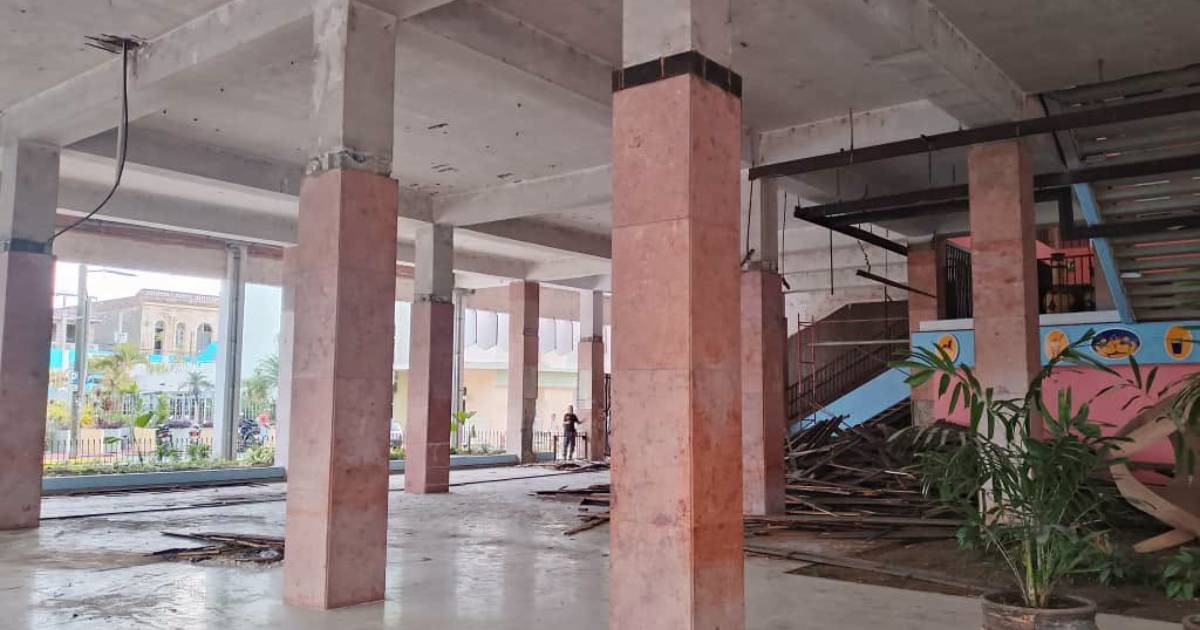
The photographs, shared since June 27, and reported by the independent source CubaNet, showed the ground floor nearly empty, with the wooden structure removed, debris on the floor, and the traditional signs taken down, with no official explanation regarding the work provided until that moment.
"They are fixing it because it was rotten," replied succinctly one of the workers on site when asked by that outlet.
The images sparked a wave of comments and speculations. "And now what's happening with Heladería Coppelia? In whose hands is its future?" asked a user on social media, reflecting the concerns of many residents of Santa Clara.
In light of the growing controversy, Digna Morales Molina, director of the Business Group of Commerce, Gastronomy, and Services of Villa Clara, stated through the official page Soy Villa Clara that the building is undergoing a "practically capital" restoration and that the project will respect its heritage values.
"The upper floor retains its original design, as it was restored in recent years. The ground floor has never been repaired; it was in an advanced state of deterioration and in very poor condition. We faced a dilemma: to seek a temporary solution to maintain the service or completely close that area," explained the official.
Morales stated that the intervention will allow the facility to reopen during July and August, confirmed that the ice cream shop will remain under state management, and emphasized the commitment to maintain affordable prices.
The official explanations, however, did not completely dispel the doubts. While many users welcomed the commitment to preserve the building, many criticized the authorities for waiting until images of the dismantling circulated before providing a public explanation.
"They should have explained before the speculation began; the people have the right to know what is happening in their environment," wrote a user. Another internet user suggested that it would have been sufficient to put up an informational sign at the site to avoid the uncertainty generated in recent days.
Doubts about the final outcome of the intervention also persisted. Some commentators questioned whether a restoration of that magnitude could be completed in just two months, while others insisted that the true challenge will not only be recovering the building but also restoring the quality of service, the variety of flavors, and truly affordable prices for the population.
The concerns expressed by citizens align with the warnings issued by architects and heritage specialists, who questioned the removal of original elements from the building and noted that the intervention may not have been consulted with the Provincial Heritage Center.
The architect Ariel Caso, according to CubaNet, noted that during the renovation work, the wooden blinds that characterized the building's façade—one of the distinctive elements of its design—were removed.
"Every day I am more convinced that Santa Clara needs a bulldozer and some low-level clearing to build everything anew. We lost our identity years ago due to poor management," he wrote on social media.
In the same vein, architect Guillermo Pérez, a specialist at the Provincial Heritage Center, summarized his reaction with a brief statement: "I can only say that it wounds my soul." In the comments on his post, several users hinted that the heritage entity had not been consulted prior to the start of the work.
CubaNet also reported that the doubts reached numerous citizens, some of whom expressed fear that the building may end up being exploited by private operators with unaffordable prices or that the renovations will remain unfinished, as has happened with other iconic buildings in Santa Clara. Among the most frequently cited examples are the Teatro La Caridad, which has been closed since 2021, and the Hotel Florida, across from Parque Vidal, which has been propped up for over a decade.
Inaugurated on February 14, 1967, and designed by architect José Manuel Cortiñas Temes, Coppelia in Santa Clara occupies an entire city block and is regarded as one of the most representative works of modern Cuban architecture. Its heritage value makes it one of the most emblematic buildings in the city.
Concerns about the future arise in a context marked by the decay of Cuba's architectural heritage. In March of this year, the building of the Higher Institute of Design (ISDI) in Havana was demolished after years of neglect, and weeks later, the historic Aldama Palace suffered further damage, fueling the debate on the preservation of historically significant buildings on the Island.
Filed under: