
Related videos:
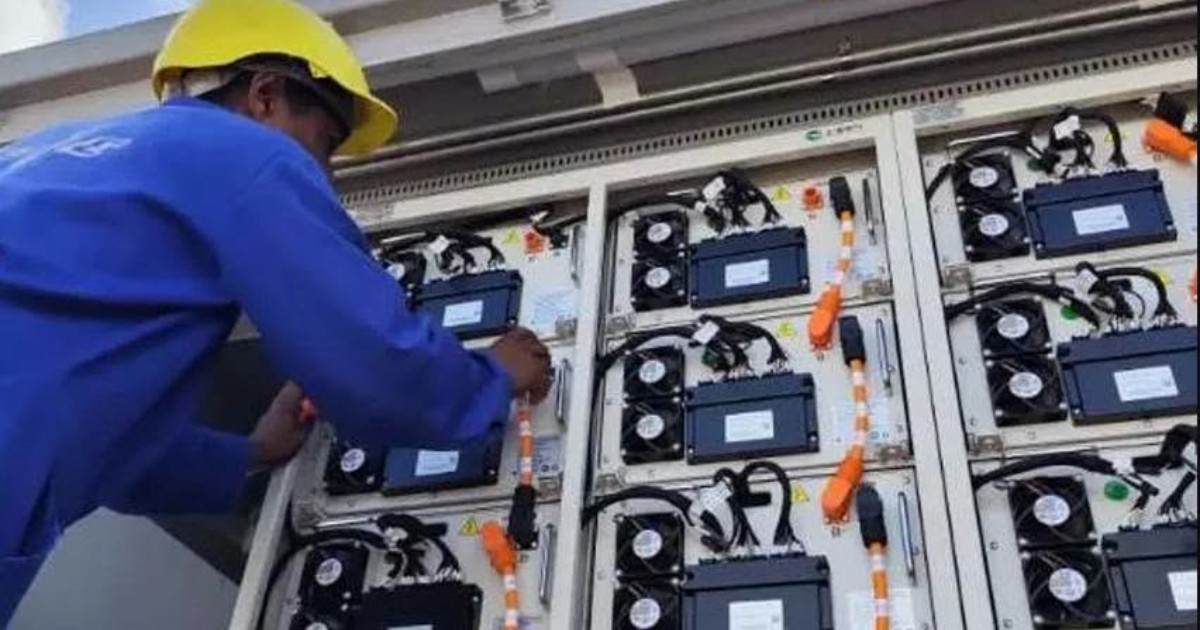
The Cuban regime announced on Wednesday the launch of the first battery bank in the history of Cuba, a system of 50 megawatts (MW) installed at the Cotorro 220 substation, located in the municipality of El Cotorro, Havana, as reported by the state media Cubadebate.
The engineer Ismael Ulloa Rodríguez, from the Ministry of Energy and Mines, stated in the informational magazine Buenos Días that the system is in its final stage of commissioning with "satisfactory" results.
According to the specialist, during the activation week, the bank responded to the shutdown of the Guitera thermoelectric power plant and breakdowns in transmission lines, without any reported failures in the National Electric System.
"This week we have experienced several failures, and the system has been able to either supply or consume energy as needed. There have been no disconnections due to DAF (Automatic Frequency Disconnection) nor any system outages," emphasized Ulloa Rodríguez.
The official announcement, however, directly clashes with the reality experienced by Cubans on the same day: the Electric Union (UNE) forecasted impacts exceeding 2,000 MW during the nighttime peak this Wednesday, with a generation availability of only 1,100 MW against a demand of 3,200 MW.
The maximum recorded deficit reached 2,211 MW at 10:00 PM, while Cuba was experiencing blackouts of over 2,100 MW on the same day of the announcement.
In addition, 106 distributed generation plants remained out of service due to a lack of fuel, totaling 1,203 MW unavailable.
Citizen perception can be summed up in a phrase circulating among Cubans: "The blackouts remain the same."
The Chinese-origin system operates 24 hours a day: it stores excess solar energy during the day to inject it into the grid at night, providing continuous stability to the SEN.
According to Ulloa, it will also allow solar photovoltaic parks to operate at 100% of their capacity, gradually eliminating the limitations they currently face. Cuba has 49 solar parks connected with 1,334 MW installed, although the actual generation averages only about 500 MW due to a lack of storage.
The installation of these systems began in August 2025 in four substations, and the battery energy storage connection project was announced months earlier as part of the government's strategy to diversify its energy matrix with support from Beijing.
The one in El Cotorro is the first of four storage systems planned for the island. The remaining ones will be built in another area of Havana, in the municipality of Cueto (Holguín), and in Bayamo (Granma). The entire operation is managed by trained Cuban technicians capable of handling the technology.
"These four locations will allow us to make the most of all the solar parks as well as wind and hydro generation, leading to significant fuel savings," said Ulloa Rodríguez.
What the government omits is the magnitude of the underlying problem: experts estimate that resolving the Cuban electricity crisis would require an investment of between 8 billion and 10 billion dollars, an amount unattainable for a regime that has gone decades without investing in its thermoelectric infrastructure.
A 50 MW battery bank is not enough to cover a gap of over 2,000 MW of chronic deficit.
Filed under: